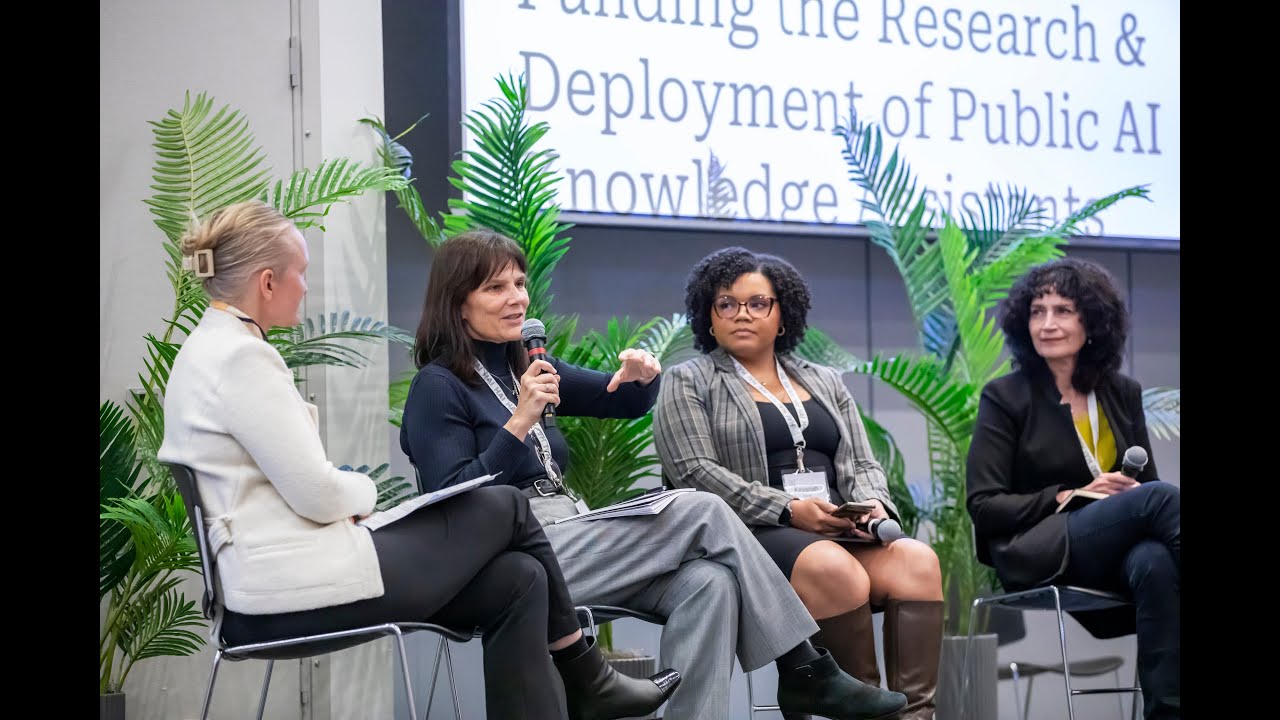
Public AI Assistant to Worldwide Knowledge: Funding the Research & Deployment
Keywords
Summary
147 words
Critical Evaluation
The video provides a valuable overview of how different funding organizations approach AI research and deployment. The speakers are highly credible, representing major institutions like DARPA, Microsoft, and the Sloan Foundation. Their insights into the funding mechanisms and priorities are informative and reflect a thoughtful consideration of the societal implications of AI. However, the discussion is largely high-level and lacks specific data or case studies. The arguments are based on expert opinion rather than empirical evidence, which limits the scientific rigor. The panel does not delve into technical details of AI systems, but rather focuses on funding strategies and the importance of interdisciplinary collaboration. The adéquation between the title and content is good, as the discussion centers on funding the research and deployment of a public AI assistant. The video would benefit from more concrete examples of funded projects and their outcomes. Overall, it is a useful resource for understanding the funding landscape for public AI initiatives, but it is not a scientific study or a comprehensive analysis.
168 words
Title / Content Match
The title accurately reflects the content, which focuses on funding and deployment of a public AI assistant for worldwide knowledge.
Quality & Reliability
7/10
The video features experts from DARPA, Microsoft, Sloan Foundation, and ACLS discussing funding and perspectives on AI. The content is high-level and opinion-based, with no formal citations or data. The credibility is high due to the institutional affiliations, but the lack of specific evidence or references reduces the score.
Key Moments
Markers derived by PSI from the transcript: the creator did not define chapters.
- Introduction to the panel on funding for public AI assistant.
- Kathleen Fisher explains DARPA's funding model and its interest in AI for knowledge closure.
- Discussion on DARPA's CIFI program and the potential of LLMs for knowledge representation.
- Keyanah Nurse introduces the American Council of Learned Societies and its digital justice grants.
- Keyanah Nurse discusses the importance of context and equity in funding technology projects.
- Doron Weber shares the Sloan Foundation's perspective on AI and knowledge.
- Evelyne Viegas talks about Microsoft's role in AI research and funding.
- Panel discussion on the need for sustainable funding and collaboration.
- Q&A session with the audience.
Cited Sources
- DARPA — Kathleen Fisher discusses DARPA's funding model and AI research programs.
- Alfred P. Sloan Foundation — Doron Weber represents the Sloan Foundation and discusses its funding priorities.
- American Council of Learned Societies — Keyanah Nurse discusses ACLS's digital justice grants and humanities funding.
- Microsoft Research — Evelyne Viegas represents Microsoft Research and discusses AI research.
Concurring Sources
- Stanford HAI — The workshop was organized by Stanford HAI, providing institutional support.
Contribution & Novelties
The video provides a unique perspective on funding public AI initiatives, bringing together government, philanthropic, and corporate funders. It highlights the importance of interdisciplinary collaboration and the need for sustainable funding models. The discussion on knowledge closure and the potential of LLMs to compute it is a novel concept.
Pour aller plus loin :
- DARPA’s Big Mechanism program — Historical context for the idea of knowledge closure.
- Knowledge representation and reasoning — Foundational concepts for AI knowledge systems.
- Digital humanities — Relevant to ACLS’s digital justice grants.
87 words
Radar Profile
The radar profile shows moderate scores across all dimensions, with slightly higher quality and reliability due to the expert panel. The quantity of information is moderate, and the technical level is relatively low, reflecting the high-level nature of the discussion.