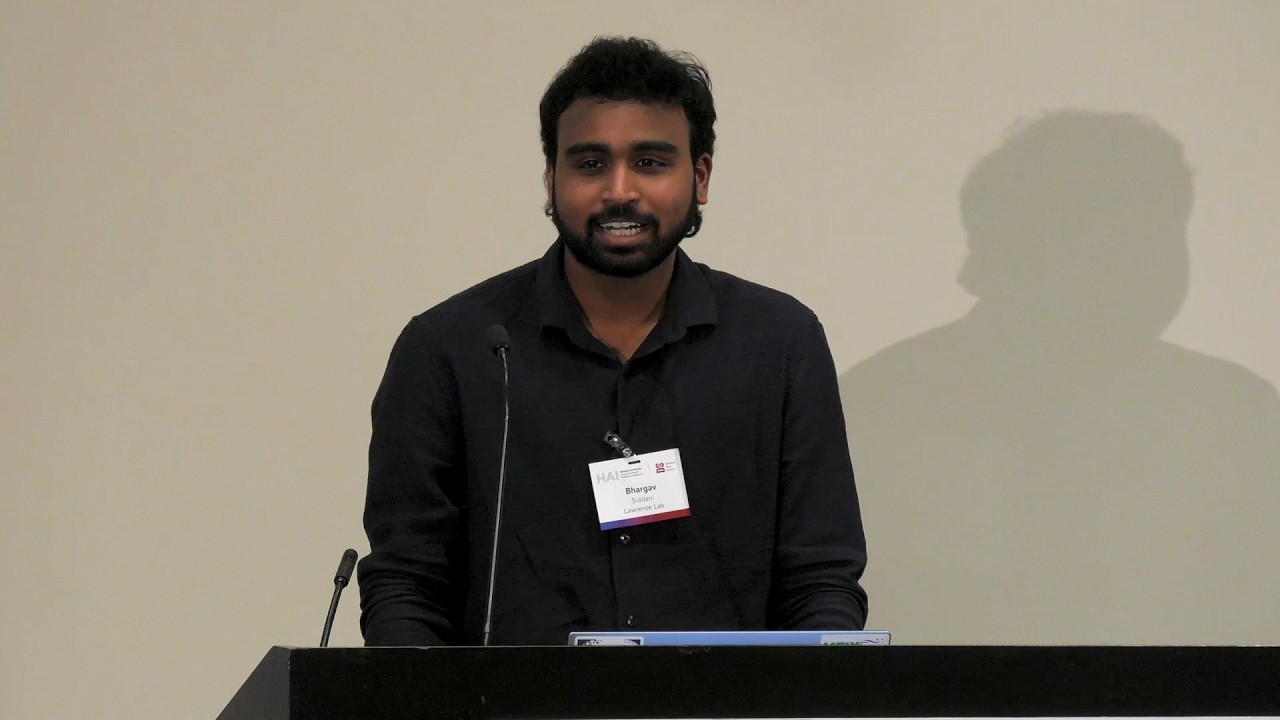
2026 Conference on Physics and AI: Bhargav Siddani
Keywords
Summary
208 words
Critical Evaluation
The talk presents a novel application of flow matching to learn flux distributions in coarse-grained stochastic particle systems, addressing known limitations of traditional SPDE approaches. The motivation is clear: standard coarse-grained SPDEs assume uncorrelated noise, which breaks down at low particle counts and short timescales, leading to non-Gaussian and non-Markovian effects. The speaker identifies these issues and proposes a data-driven solution using generative models, specifically flow matching. The methodology is well-structured: they define integrated current, incorporate history via a transformer, and enforce reflection symmetry in the velocity field. The numerical experiment with a double-well potential demonstrates the model’s ability to capture rare events and higher-order moments, which are crucial for non-equilibrium dynamics. The comparison with ground truth random walker simulations and the standard Dean-Kawasaki equation is convincing, showing clear improvements in accuracy, particularly for variance, skewness, and kurtosis. The speaker also acknowledges limitations, such as computational cost for simple systems, and suggests future work on interacting systems. The presentation is technically rigorous, with clear explanations of the stochastic particle system, coarse-graining, and the flow matching framework. However, the talk is concise and lacks detailed derivations or extensive validation across diverse scenarios. The reliance on a single numerical experiment may limit generalizability. Additionally, the speaker does not discuss potential pitfalls or failure modes of the model. Overall, the work is promising and contributes to the intersection of physics and AI, but further validation and scalability studies are needed. The title accurately reflects the content, and the talk is well-suited for a specialized audience. The presence of a brief sponsorship mention does not affect the scientific content.
265 words
Title / Content Match
The title accurately reflects the content: a conference talk on physics and AI, specifically applying flow matching to stochastic particle systems.
Quality & Reliability
8/10
Presentation of original research with clear methodology, numerical experiments, and comparisons to ground truth. The work is preliminary but grounded in established stochastic processes and generative modeling. The speaker acknowledges limitations and future directions.
Key Moments
Markers derived by PSI from the transcript: the creator did not define chapters.
- Introduction and acknowledgments
- Motivation: stochastic particle systems and Brownian motion
- Coarse-grained stochastic partial differential equations (SPDEs)
- Limitations of standard SPDEs: non-Gaussian and non-Markovian effects
- Proposed approach: learning flux distributions with flow matching
- Model architecture: history encoding and reflection symmetry
- Numerical experiment: double-well potential and rare events
- Results: comparison of moments and negative particle counts
- Conclusions and future work
Cited Sources
- 2026 Conference on Physics and AI (PAI26) — Conference page providing context for the talk and related events.
Concurring Sources
- Flow Matching for Generative Modeling — The flow matching framework used in the talk is based on this paper.
Contribution & Novelties
The talk introduces a novel approach to capture non-Markovian dynamics in coarse-grained stochastic particle systems by learning flux distributions with flow matching. This addresses limitations of traditional SPDEs that assume uncorrelated noise, which fails at low particle counts and short timescales. The incorporation of history information and reflection symmetry in the generative model is a key innovation, enabling accurate prediction of higher-order moments and rare events.
Pour aller plus loin :
- Flow Matching for Generative Modeling — Foundational paper on flow matching, relevant to the generative model used.
- Dean-Kawasaki equation — Background on the standard coarse-grained SPDE.
- Non-Markovian dynamics — Conceptual background on Markovian vs non-Markovian processes.
107 words
Radar Profile
The radar profile shows high scores across all dimensions, indicating a technically rigorous and well-presented talk with strong information content and reliability. The balance between quantity and quality of information is good, and the technical level is appropriate for a specialized audience.