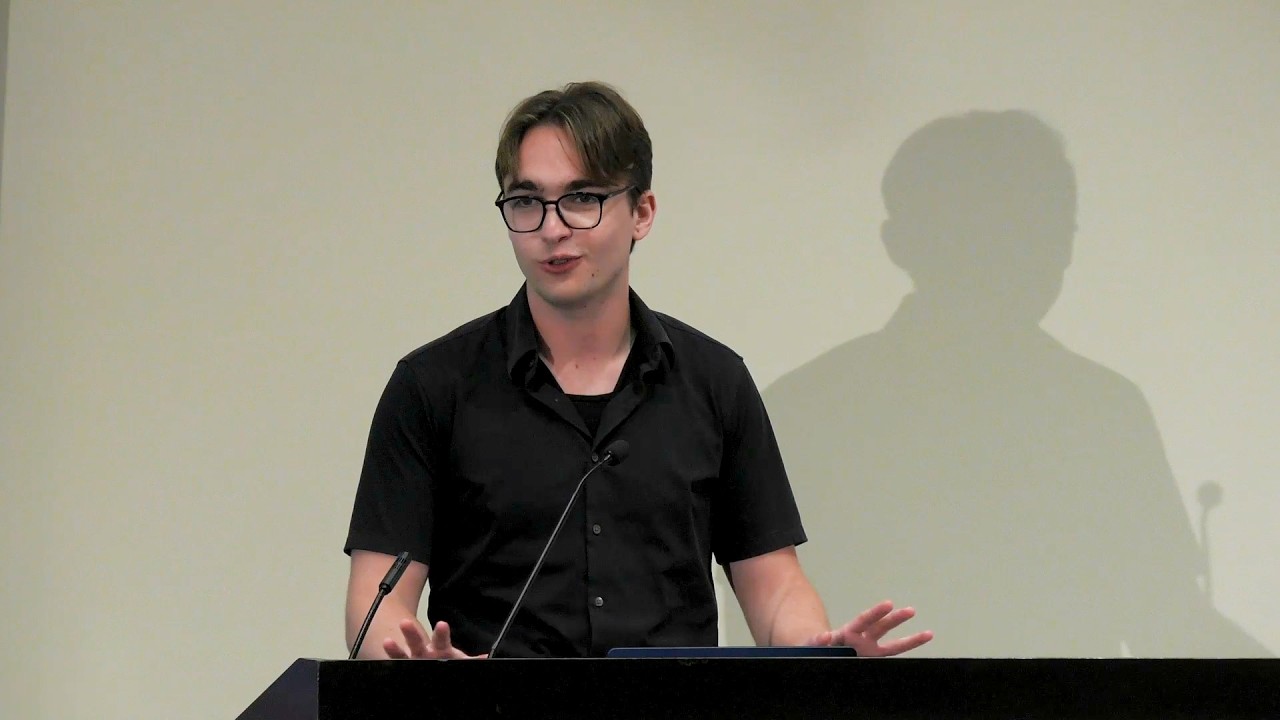
2026 Conference on Physics and AI: Cooper Jacobus
Keywords
Summary
146 words
Critical Evaluation
The talk presents a compelling and well-motivated approach to a challenging problem in cosmology. The speaker clearly articulates the limitations of existing methods and the requirements for a practical inference framework. The use of a Lagrangian neural cellular automaton is innovative, and the design choices (fixed topology, invariant features, KAN) are well-justified for achieving the desired properties of differentiability, efficiency, and equivariance. The presentation is technically rigorous, with a clear explanation of the model’s components and their rationale. However, the talk is a high-level overview, and the excerpt does not include quantitative results or comparisons with existing methods, which limits the ability to assess its practical effectiveness. The speaker mentions a ‘Keystone paper’ but does not provide a citation, and the only source provided is the conference page. The talk is part of a conference, so it is not peer-reviewed, but it represents original research from a reputable institution. The title accurately reflects the content. Overall, the talk is valuable for its conceptual contribution and potential impact, but further validation is needed.
172 words
Title / Content Match
The title accurately reflects the content: a conference talk on physics and AI, specifically on cosmic structure formation using a Lagrangian neural cellular automaton.
Quality & Reliability
8/10
Presentation of original research at a Stanford conference, with clear methodology and results, but limited external validation and no peer review.
Key Moments
Markers derived by PSI from the transcript: the creator did not define chapters.
- Introduction: cosmic web and dark matter
- Analogy of inferring tree structure from fruits
- Comparison of N-body simulations and linear theory
- Requirements for inference: differentiability, efficiency, temporal continuity
- Introduction to neural cellular automata
- Lagrangian neural cellular automaton: fixed topology and moving particles
- Visualization of displacement fields and shell crossings
- Model definition: recurrent neural network with invariant features
- Use of Kolmogorov-Arnold network as analytic prior
Cited Sources
- 2026 Conference on Physics and AI (PAI26) — Conference page providing context for the talk.
Concurring Sources
- Neural Cellular Automata — General background on cellular automata.
Contribution & Novelties
The talk introduces a novel architecture, the Lagrangian neural cellular automaton, which combines the strengths of N-body simulations and linear theory for cosmic structure formation. This approach enables efficient and differentiable simulation of the dark matter distribution, potentially allowing full Bayesian inference of initial conditions from galaxy surveys.
Pour aller plus loin :
- Neural Cellular Automata — Background on cellular automata.
- Kolmogorov-Arnold Networks — The KAN architecture used in the model.
- Zeldovich approximation — Linear theory baseline.
77 words
Radar Profile
The radar profile shows high scores in technical level and information quality, reflecting the advanced nature of the talk. The lower score in quantity of information is due to the limited duration and lack of detailed results in the excerpt.