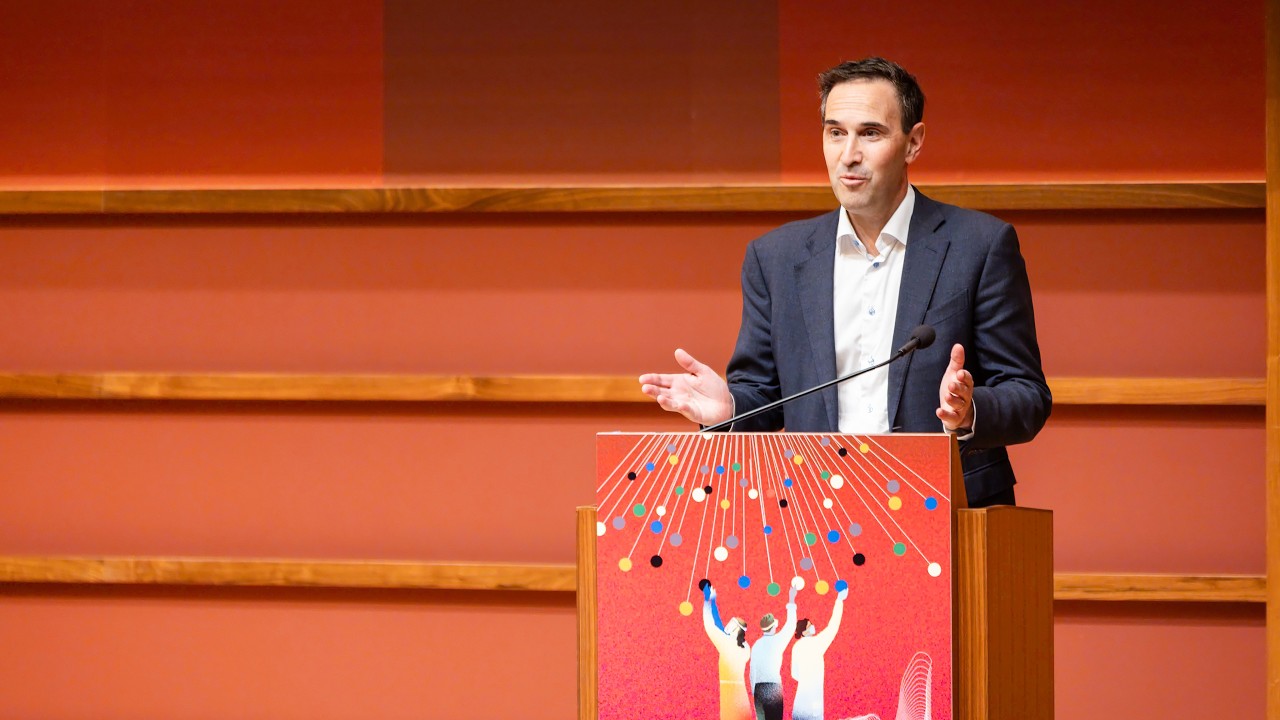
AI+Science: Welcome from the Institute Director and Faculty Organizers
Keywords
Summary
170 words
Critical Evaluation
The video serves as an institutional welcome and strategic framing for a conference on AI in science. Its primary value lies in the authoritative statements from Stanford leadership about the university’s direction and the perceived importance of AI in accelerating discovery. The content is largely opinion and forward-looking, with no specific scientific findings presented. The speakers are highly credible: the President of Stanford and the Director of HAI, lending weight to the claims about the transformative potential of AI. However, the arguments are not substantiated with data or examples; they are aspirational and strategic. The announcement of the HAI-SDS merger is a concrete fact, but its implications are discussed in general terms. The discussion of AI’s role in science is framed around human-centered values and openness, which aligns with broader academic discourse but lacks critical examination of potential risks or limitations. The title accurately reflects the content, as it is indeed a welcome and introductory session. The video does not delve into technical details, making it accessible to a broad audience, but it also lacks depth for experts. The quality of information is high in terms of authority and relevance, but the quantity of substantive information is moderate, as it is more about setting the stage than delivering content. The argumentation is coherent and persuasive, but it relies on authority rather than evidence. Overall, this is a valuable resource for understanding Stanford’s strategic vision for AI in science, but it is not a source of scientific knowledge itself.
248 words
Title / Content Match
The title accurately reflects the content: a welcome and introductory session for the AI+Science conference, with remarks from the institute director and faculty organizers.
Quality & Reliability
8/10
The video features authoritative speakers (Stanford President, HAI Director) discussing institutional strategy and the role of AI in science. The content is primarily opinion and forward-looking statements, not peer-reviewed research. However, the speakers are highly credible, and the claims about AI's potential are generally aligned with current discourse. The announcement of the HAI-SDS merger is factual and verifiable.
Key Moments
Markers derived by PSI from the transcript: the creator did not define chapters.
- Introduction by Risa Wechsler and Surya Ganguli, conference co-chairs.
- Stanford President Jonathan Levin begins his opening remarks.
- Levin reflects on the absence of AI in national science priorities five years ago.
- James Landay announces the merger of HAI and Stanford Data Science.
- Landay outlines three commitments: openness, team science, and global responsibility.
- Landay pays tribute to Steve Denning and concludes his remarks.
- Wechsler and Ganguli return to frame the day's discussions.
- Wechsler draws parallels between AI and historical scientific tools like the telescope and microscope.
Cited Sources
- Stanford HAI — The video is hosted on the Stanford HAI channel, and the institute is the subject of the announcement.
- Stanford Data Science — Mentioned as the entity merging with HAI.
Concurring Sources
- Stanford HAI — The video is from the official channel, and the content aligns with HAI's stated mission.
Contribution & Novelties
The video provides an authoritative announcement of the merger between Stanford HAI and Stanford Data Science, signaling a strategic shift in how the university organizes AI research. It also articulates a vision for the role of universities in AI development, emphasizing openness and team science. While not presenting novel scientific findings, it offers insight into institutional priorities.
Pour aller plus loin :
- Stanford HAI — Official site of the institute, providing context on its mission and activities.
- Stanford Data Science — Official site of the data science initiative, relevant to the merger.
- AI for Science — Wikipedia overview of the field, useful for background.
- Open Science — Wikipedia article on open science principles, relevant to the commitment discussed.
118 words
Radar Profile
The radar profile shows high scores in quality of information and reliability, reflecting the authoritative speakers and institutional context. The quantity of information and technical level are moderate, as the video is introductory and strategic rather than detailed. The overall balance suggests a reliable but not deeply technical resource.
💬 No comments were provided for analysis.