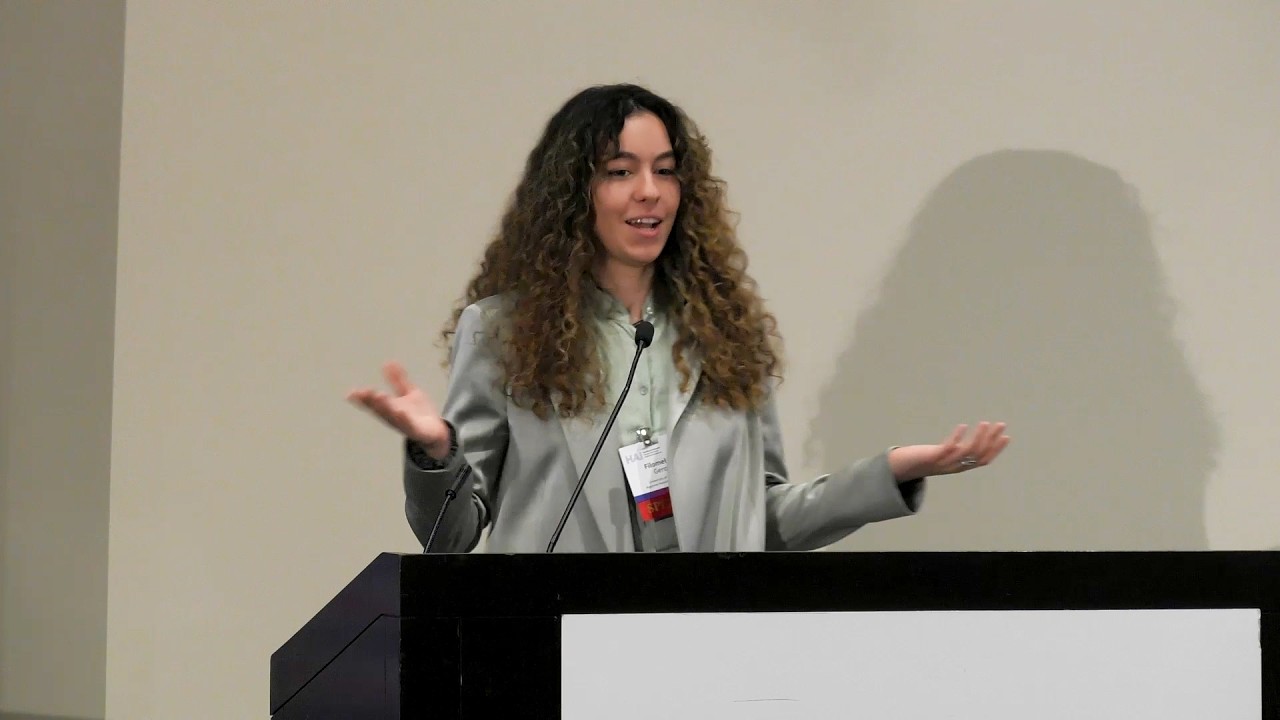
2026 Conference on Physics and AI: Filomela Gerou
Keywords
Summary
147 words
Critical Evaluation
The talk presents a well-structured and thoughtful approach to evaluating AI reasoning in physics. The motivation is strong: existing benchmarks like MMLU, GPQA, and FrontierMath are either too simple (knowledge retrieval) or not scalable (expert-created). The proposed chain-of-thought benchmark addresses this by decomposing problems into steps, requiring both correct answers and sound reasoning, and incorporating a feedback loop that mimics real research collaboration. This is a significant contribution, as it moves beyond multiple-choice accuracy to assess the reasoning process itself.
The methodology is rigorous: the benchmark includes ground truth rationales, automated hints, and a hybrid evaluation combining rule-based checks with an LLM jury for unanticipated but valid solution paths. The metrics are well-defined, including reasoning quality, answer correctness, and efficiency (latency, token count, retries). The use of error bars from multiple runs (15 per question) adds statistical robustness.
The results are interesting, showing a large performance jump in recent models (GPT-5.4, Claude Alpus 4) compared to their predecessors, suggesting that reasoning capabilities are improving significantly. The analysis of reasoning logs provides valuable insights into model limitations, such as non-progressive erroneous reasoning and algebraic deficiencies.
However, there are some limitations. The talk is a conference presentation, so details are limited; the full methodology and results are not peer-reviewed yet. The benchmark covers only a few physics subfields, and scalability is still a concern, as generating ground truth rationales requires expert input. The use of an LLM as a jury introduces potential bias, though the authors acknowledge this and use it only for unanticipated methods. The token count estimation is approximate, but the approach is reasonable.
Overall, the talk is scientifically sound and presents a novel, useful benchmark for the AI-for-science community. The adéquation between title and content is perfect. The presentation is clear and well-organized, with helpful visualizations. The work has the potential to influence future benchmark design and model evaluation in scientific domains.
313 words
Title / Content Match
The title accurately reflects the content: a talk by Filomela Gerou at the 2026 Conference on Physics and AI.
Quality & Reliability
8/10
The talk presents a novel benchmark for physics reasoning, with a clear methodology, quantitative results, and a hybrid evaluation approach. The speaker is a master's student at Michigan working with Argonne National Lab, and the work is presented at a Stanford conference, indicating institutional credibility. However, the talk is a conference presentation, not a peer-reviewed publication, and details are limited by time constraints.
Key Moments
Markers derived by PSI from the transcript: the creator did not define chapters.
- Introduction and motivation for domain-specific benchmarks.
- Comparison of existing benchmarks (UG physics, GPQA, FrontierMath).
- Proposed chain-of-thought benchmark structure with sub-questions.
- Example of a quantum field theory question with rationales.
- Feedback loop and hint system.
- Evaluation metrics: reasoning quality, answer, efficiency.
- Results: 60% improvement in newer models.
- Analysis of reasoning logs: common failure modes.
- Contributions and limitations.
Cited Sources
- 2026 Conference on Physics and AI (PAI26) — Conference page providing context for the talk and the Center for Decoding the Universe.
Concurring Sources
- Chain-of-Thought Prompting Elicits Reasoning in Large Language Models — This paper introduced chain-of-thought prompting, which is the foundation for the benchmark's approach.
Contribution & Novelties
The talk introduces a novel benchmark for evaluating reasoning models on physics problems, using a chain-of-thought approach with sub-questions and a feedback loop. This is a significant contribution because it moves beyond simple multiple-choice accuracy to assess the reasoning process itself, which is crucial for real-world research applications. The hybrid evaluation combining rule-based comparison with an LLM jury is also innovative, allowing for the assessment of unanticipated but valid solution paths.
Pour aller plus loin :
- Chain-of-Thought Prompting Elicits Reasoning in Large Language Models — This paper introduced chain-of-thought prompting, which is the foundation for the benchmark’s approach.
- GPQA: A Graduate-Level Google-Proof Q&A Benchmark — A benchmark mentioned in the talk, providing a comparison point.
- FrontierMath: A Benchmark for Evaluating Advanced Mathematical Reasoning in AI — Another benchmark mentioned, highlighting the need for scalable, expert-created problems.
136 words
Radar Profile
The radar chart shows a well-rounded profile with high scores across all dimensions, indicating a balanced and reliable presentation. The strongest areas are information quality and technical level, while the slightly lower score in information quantity reflects the time constraints of a conference talk.
💬 No comments were provided for analysis.