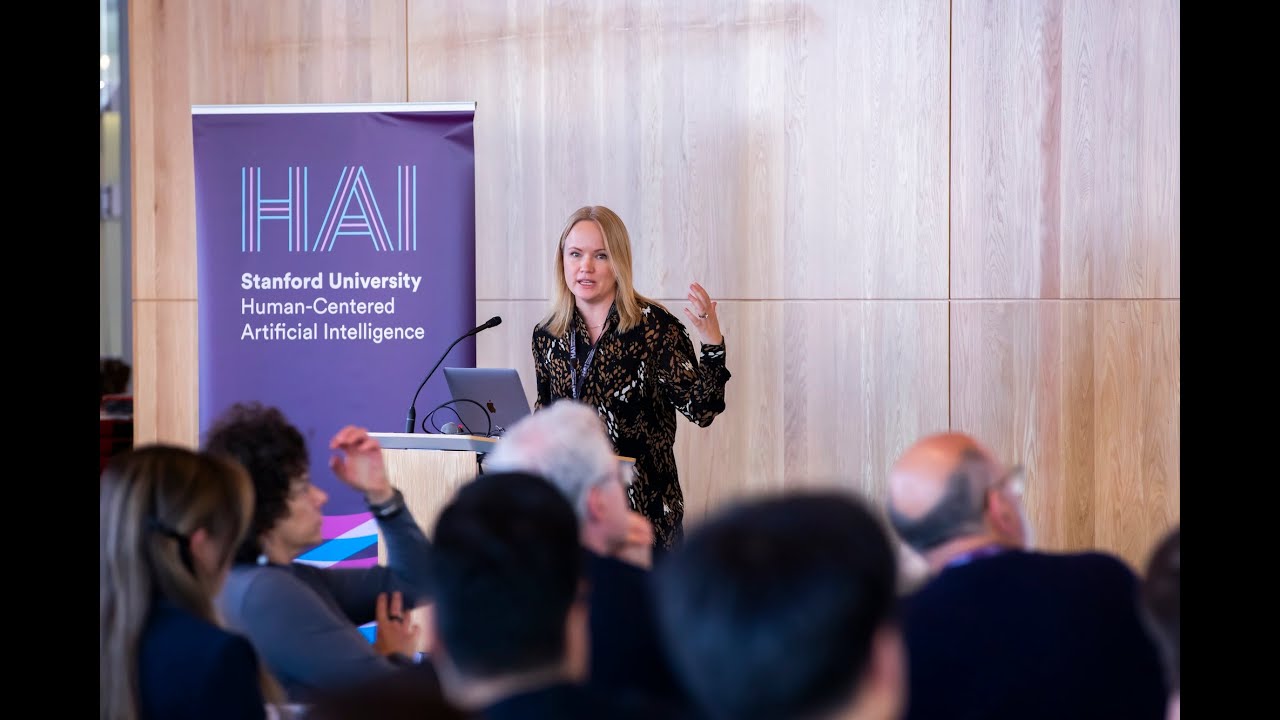
Session 3: Accelerating Drug Discovery and Personalized Treatment Using AI
Keywords
Summary
129 words
Critical Evaluation
The talk provides a compelling and well-structured overview of a cutting-edge research initiative. The speaker effectively communicates the ambitious goal of creating a virtual cell model, grounding it in fundamental biological principles (central dogma, self-organization). The presentation is strong in its articulation of the multi-modal, multi-scale approach and the need for spatial awareness. The team’s collaborative nature and the breadth of expertise are highlighted, lending credibility. The mention of 21 papers and several models indicates significant productivity, but the talk remains at a high level, lacking detailed methodological explanations or critical evaluation of limitations. The claims about model performance (e.g., SubCell outperforming DINOv2) are stated without presenting benchmark details or error bars, which limits the ability to assess their robustness. The sources cited are primarily the team’s own work and the perspective paper, which is appropriate but not independent. The talk does not address potential biases in the data or ethical considerations beyond a brief mention of guardrails. The Q&A segment, though not transcribed, likely provided further insights. Overall, the talk is informative and inspiring, but its scientific rigor is moderate due to the lack of depth and independent verification. The title accurately reflects the content, and the presentation is well-suited for an expert audience, though it avoids technical jargon that might exclude non-specialists.
214 words
Title / Content Match
The title accurately reflects the content, which focuses on using AI to accelerate drug discovery and enable personalized treatment through virtual cell modeling.
Quality & Reliability
8/10
The talk is delivered by a leading researcher from Stanford, presenting a well-structured overview of a funded research project. It references a peer-reviewed perspective paper in Cell and describes concrete models and datasets (UCE, SubCell, hotpocketNN) with performance claims. However, it is a high-level overview without detailed methodology or independent verification, and the claims are not fully substantiated in the talk.
Key Moments
Markers derived by PSI from the transcript: the creator did not define chapters.
- Introduction and vision of AI virtual cell
- Central dogma and self-organization principles
- Data modalities and team introduction
- Overview of first-year achievements and publications
- Sequence models: UCE and Tabula Sapiens 2.0
- Structure models: hotpocketNN for binding pockets
- Image models: SubCell for protein localization
- Discussion of future directions and impact
- Q&A session begins
Cited Sources
- Hoffman-Yee Research Grant Program — The project is supported by this grant program, and the link provides details on the grant recipients.
Concurring Sources
- Perspective paper in Cell (mentioned in talk) — The speaker references a perspective paper in Cell that outlines the vision for virtual cells, but no specific URL is provided.
Contribution & Novelties
The talk presents a novel integrated approach to building a virtual cell model, combining multiple data modalities and scales. The emphasis on spatial organization and self-organization as key principles is a distinctive contribution. The development of models like UCE, SubCell, and hotpocketNN represents concrete advances in the field.
Pour aller plus loin :
- Virtual Cell — Provides background on the concept of computational cell models.
- Foundation Models in Biology — Discusses the broader context of foundation models applied to biological data.
- AlphaFold — A related breakthrough in protein structure prediction, relevant to the structural modeling aspect.
96 words
Radar Profile
The radar profile shows high scores in quantity and quality of information, with a slightly lower technical depth, reflecting the high-level nature of the talk. The overall reliability is strong due to the credibility of the speakers and the referenced work.