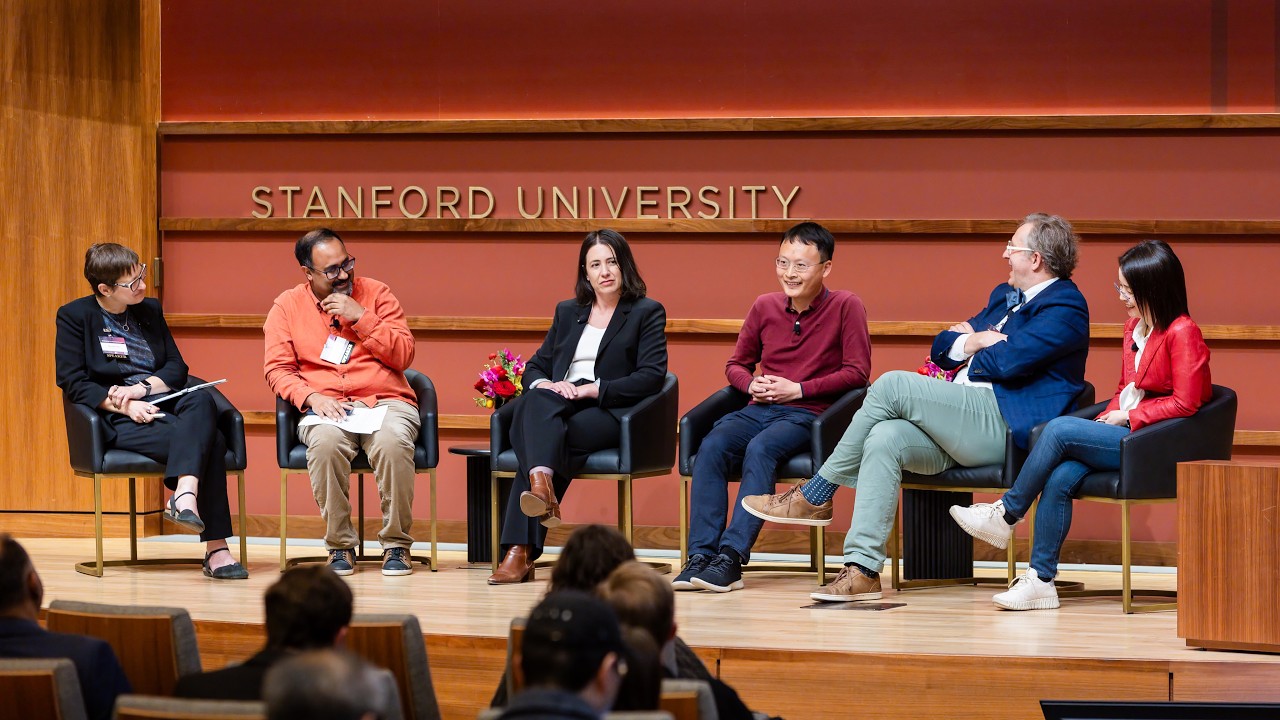
AI+Science: Role of Human Understanding in the Future of Scientific Discovery
Keywords
Summary
144 words
Critical Evaluation
The panel provides a thoughtful and interdisciplinary examination of AI’s impact on scientific discovery. Angèle Christin’s opening remarks offer a critical perspective from science and technology studies, highlighting the embedded values of Silicon Valley in LLMs and the potential misalignment with academic norms. Her points about opacity, efficiency, and cost-cutting are well-articulated and grounded in sociological theory, though they may oversimplify the diversity within both industry and academia. James Evans brings empirical insights from his research on teams and AI reasoning, presenting intriguing findings about the internal conversational dynamics of reasoning models. However, some claims, such as the 500% increase in conversational behavior, lack detailed context and may be difficult for a general audience to assess. The discussion successfully raises key concerns about the future of science, including the risk of ‘big data’ monoculture and the erosion of human skills. Yet, it occasionally veers into speculation without concrete evidence, and the panelists do not always engage directly with each other’s points. Overall, the content is intellectually stimulating and offers valuable perspectives, but it would benefit from more rigorous data and a clearer synthesis of the arguments presented.
187 words
Title / Content Match
The title accurately reflects the panel's focus on the role of human understanding in AI-driven scientific discovery.
Quality & Reliability
8/10
Panel of established academics from Stanford, University of Chicago, and Google, discussing the societal and epistemological implications of AI in science. Arguments are nuanced and grounded in research, though some claims are anecdotal or speculative.
Key Moments
Markers derived by PSI from the transcript: the creator did not define chapters.
- Introduction by moderator Risa Wechsler, setting the stage for the panel.
- Angèle Christin begins her talk on LLMs as objects of study, embedded in social and economic dynamics.
- Christin discusses the opacity of LLMs and the contrast with academic openness.
- Christin highlights the logic of efficiency and its potential conflict with scientific creativity.
- Christin concludes with concerns about cost-cutting and the future of PhD training.
- James Evans begins his talk on 'after science' and the rise of hermeneutics in AI.
- Evans presents findings on internal conversations in reasoning models and the emergence of diverse 'societies'.
- Discussion on the implications of AI for scientific monoculture and the importance of diverse perspectives.
- Panel Q&A session begins, addressing audience questions on AI and scientific practice.
Cited Sources
- Ted Chiang's short story 'The Evolution of Human Science' — Referenced by James Evans as a fictional illustration of a world where AI makes all discoveries.
Concurring Sources
- The AI Scientist: A New Paradigm for Scientific Discovery — Discusses AI agents that can autonomously conduct research, aligning with the panel's concerns about automation.
- The Impact of AI on Scientific Discovery — Reports on how AI is accelerating scientific discovery, supporting the panel's discussion of efficiency.
Dissenting Sources
- AI and the Future of Scientific Research
Contribution & Novelties
The panel offers a unique interdisciplinary perspective on AI in science, bridging sociology, physics, and computer science. It highlights the often-overlooked societal and epistemological implications of AI adoption, such as the potential for ‘big data’ monoculture and the erosion of human skills. The discussion also introduces the concept of ‘hermeneutics’ in AI, where researchers interpret models’ internal reasoning, a relatively new area of study.
Pour aller plus loin :
- Mechanistic Interpretability — Relevant to the discussion of interpreting AI models.
- Science and Technology Studies — Provides background on the sociological perspective brought by Angèle Christin.
- The Knowledge Lab at University of Chicago — James Evans’ research group, relevant to his work on teams and knowledge generation.
116 words
Radar Profile
The radar profile shows high scores in quantity and quality of information, reflecting the panel's depth and breadth. The technical level is moderate, making it accessible to a general audience. The overall reliability is high due to the credibility of the speakers, though some speculative elements temper the score.
💬 Sur les 0 commentaires analysés, aucune tendance n'est disponible.