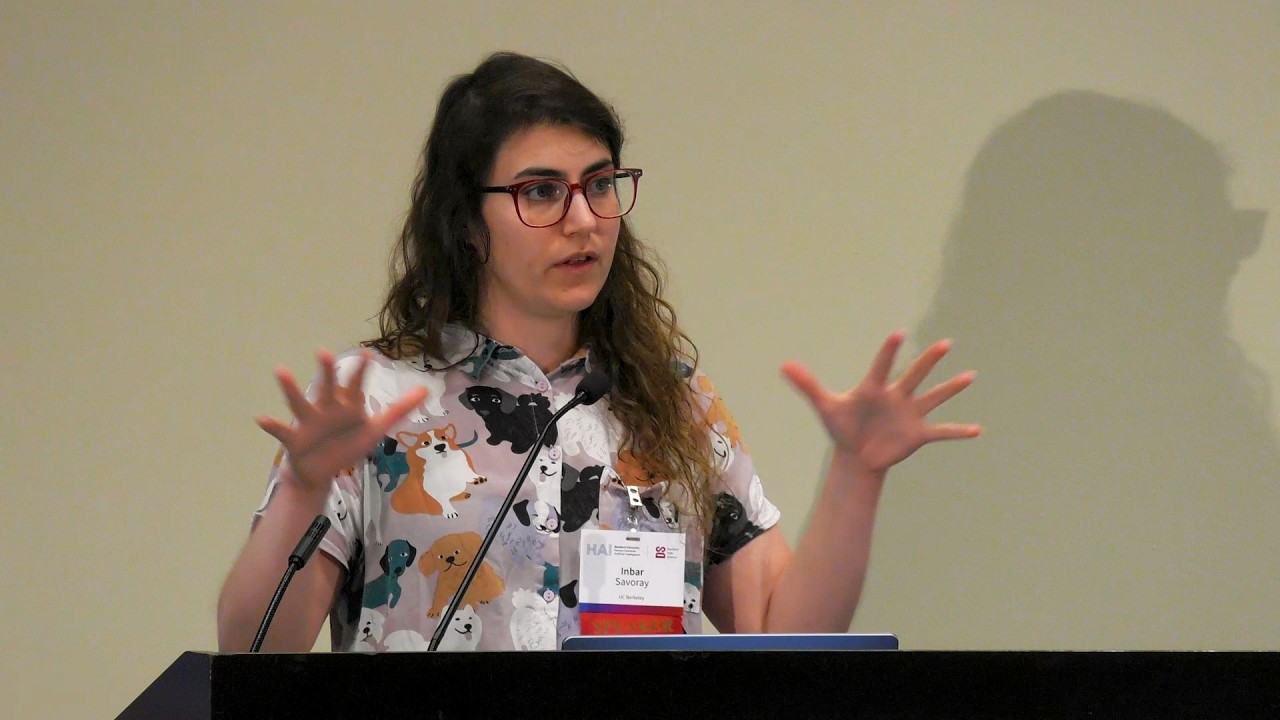
2026 Conference on Physics and AI: Inbar Savoray
Keywords
Summary
151 words
Critical Evaluation
The talk provides a clear and insightful overview of the intersection of physics and machine learning, specifically focusing on the role of symmetries. The speaker, Inbar Savoray, demonstrates a strong command of both particle physics and machine learning concepts, making the content accessible to a technical audience. The argumentation is well-structured: she identifies the limitations of the standard model, motivates the use of ML, and then systematically introduces the concept of symmetries and how to incorporate them. The discussion of equivariant networks is accurate, and she appropriately highlights their challenges, such as expressivity and training difficulties. The introduction of the symmetry-encouraging loss is a novel and promising idea, as it offers a more flexible alternative to hard architectural constraints. However, the talk lacks concrete experimental results or benchmarks to validate the effectiveness of the proposed method. The speaker mentions that the method is recent and refers to a 2024 paper, but no specific performance metrics are provided. Additionally, the description only includes a link to the conference page, not to the paper or related resources, which limits the ability to verify claims. The talk is more of a conceptual proposal than a rigorous scientific study, but it is well-founded on existing literature. The title accurately reflects the content, and the presentation is engaging and well-paced. Overall, the talk offers valuable insights and a promising direction for future research, but it would benefit from more empirical evidence.
236 words
Title / Content Match
The title accurately reflects the content: a conference talk on physics and AI by Inbar Savoray.
Quality & Reliability
7/10
The speaker is a particle physicist presenting a novel method (symmetry-encouraging loss) with references to existing equivariant models and a 2024 paper. The talk is technical and grounded in established physics principles, but lacks detailed experimental validation and peer-reviewed sources in the description.
Key Moments
Markers derived by PSI from the transcript: the creator did not define chapters.
- Introduction and motivation for beyond Standard Model physics
- Discussion of machine learning's scalability and flexibility
- Introduction to symmetries and Lorentz invariance
- Explanation of equivariant networks and their challenges
- Proposal of symmetry-encouraging loss (SEL) and its variants
- Practical implementation details and sampling strategies
- Discussion of approximate symmetries and flexibility
- Conclusion and potential impact on particle physics
Cited Sources
- 2026 Conference on Physics and AI (PAI26) — Conference page providing context for the talk and related resources.
Concurring Sources
- Equivariant neural networks — General concept of equivariant networks, which the talk builds upon.
Dissenting Sources
- No specific discordant sources found — The talk does not directly contradict established knowledge, but the proposed method lacks empirical validation.
Contribution & Novelties
The talk introduces a novel loss function approach (symmetry-encouraging loss) that allows for approximate symmetries in machine learning models, offering a flexible alternative to hard architectural constraints. This could improve performance in particle physics tasks where symmetries are only approximate.
Pour aller plus loin :
- Equivariant neural networks — Overview of equivariant architectures.
- Lorentz group — Mathematical foundation of Lorentz invariance.
- Standard Model — Reference for particle physics context.
69 words
Radar Profile
The radar profile shows high scores in information quality and technical level, indicating a technically rich talk. The lower score in information quantity suggests the talk is focused rather than broad. Overall, the talk is well-balanced but could benefit from more concrete examples.