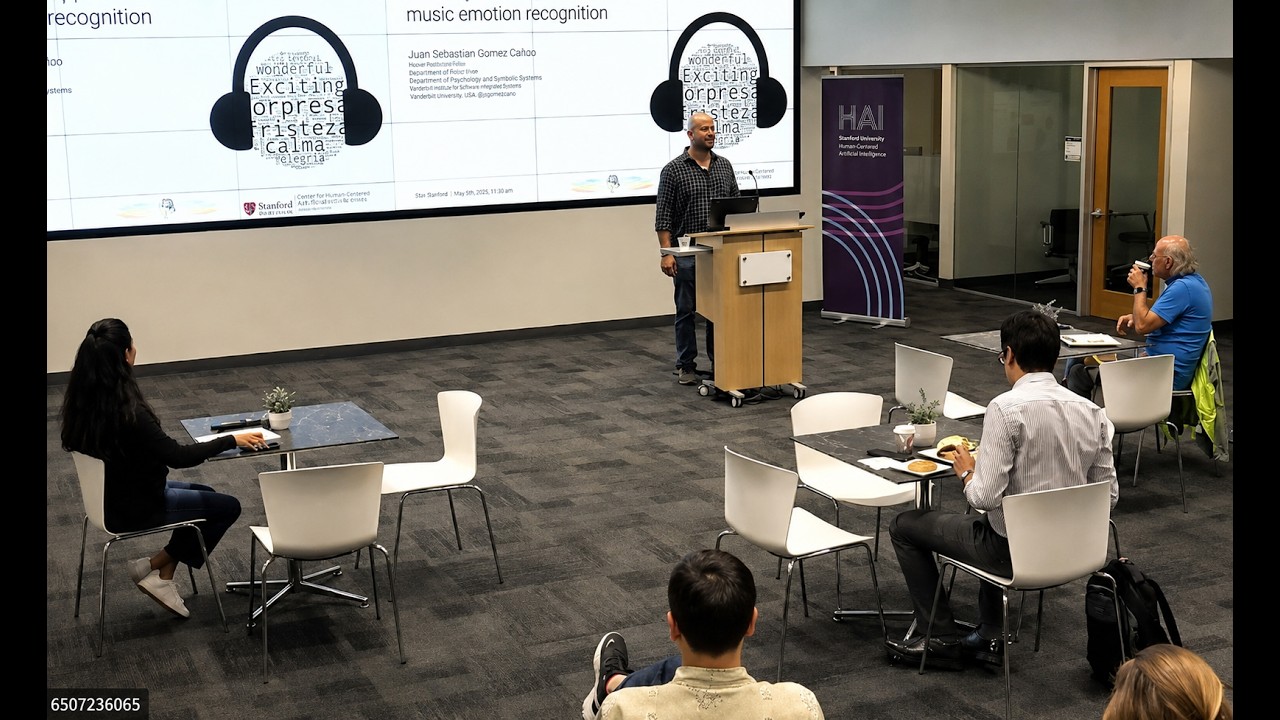
HAI Seminar: Challenges & Opportunities For Human-Centered Music Emotion Recognition
Keywords
Summary
163 words
Critical Evaluation
The seminar provides a thorough and well-articulated overview of the field of music emotion recognition, emphasizing the importance of human-centered approaches. Gómez-Cañón demonstrates deep expertise, drawing on his interdisciplinary background in electronics, music, and AI. He effectively communicates the complexities of modeling emotions, such as the distinction between perceived and induced emotions, and the challenges of creating reliable ground truth due to subjectivity and cultural variability. The talk is well-grounded in academic literature, referencing key researchers like Eric Young, Patrick Juslin, and Lisa Feldman Barrett, which lends credibility to his arguments. The discussion of ethical considerations, particularly the potential misuse of emotion recognition in political contexts, is timely and adds depth to the presentation. However, the talk is primarily an overview rather than a presentation of novel research findings, and some technical details are glossed over. The Q&A session provides valuable insights, but the overall content may be more accessible to a general audience than to specialists. The title accurately reflects the content, and the presentation is well-structured, with clear transitions between topics. The speaker’s enthusiasm and clear communication style enhance the delivery. While the seminar does not break new ground, it serves as an excellent synthesis of current challenges and opportunities in MER, making it a valuable resource for those interested in the intersection of AI, music, and emotion.
220 words
Title / Content Match
The title accurately reflects the content, which focuses on the challenges and opportunities in human-centered music emotion recognition.
Quality & Reliability
8/10
The talk is given by a postdoc scholar at Stanford with relevant expertise, referencing established researchers and studies in music psychology and MIR. The content is well-structured and grounded in academic literature, though it is a seminar presentation rather than a peer-reviewed publication.
Chapters
Cited Sources
- Stanford HAI — The seminar is hosted by Stanford HAI, and the speaker is a postdoc scholar there.
Concurring Sources
- Stanford HAI — The seminar is hosted by Stanford HAI, and the speaker is a postdoc scholar there.
Contribution & Novelties
The talk provides a comprehensive synthesis of the challenges and opportunities in human-centered music emotion recognition, emphasizing the need for personalization and context-awareness. It highlights the importance of considering individual and cultural differences in emotional responses to music, and discusses ethical implications of such technologies.
Pour aller plus loin :
- Music Emotion Recognition: A State of the Art Review — A comprehensive review of MER methods and challenges.
- The Psychology of Music — Foundational text on music psychology.
- Affective Computing — MIT Media Lab’s affective computing research group, relevant to emotion recognition technologies.
93 words
Radar Profile
The radar profile shows high scores in information quantity, quality, and reliability, with a slightly lower technical level, indicating a well-rounded and accessible presentation that is both informative and credible.