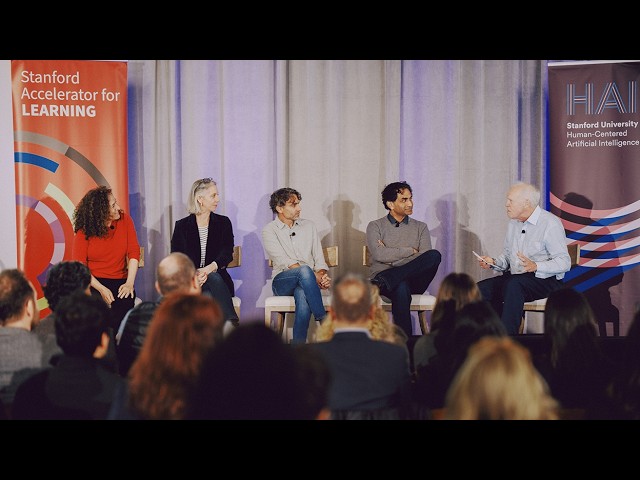
AI+Education Summit 2026: Closing Session – From Possibility to Progress
Keywords
Summary
207 words
Critical Evaluation
The panel discussion provides a thoughtful and balanced exploration of AI’s potential impact on education, drawing on the diverse expertise of the participants. The value of the information lies in the nuanced perspectives on personalization, access, and the need to rethink educational purposes. The argumentation is generally solid, with each panelist supporting their views with reasoning and occasional anecdotes, though empirical evidence is sparse. The discussion is rigorous in its consideration of both opportunities and risks, such as cognitive offloading and the digital divide. However, the lack of formal citations and reliance on personal experiences limits the scientific robustness. The sources are not explicitly cited, but the panelists’ credibility adds weight. The title accurately reflects the content, which focuses on moving from theoretical possibilities to practical implementation. The session does not include a promotional segment. Overall, the discussion is insightful and relevant, though it would benefit from more concrete data and references to research.
154 words
Title / Content Match
The title accurately reflects the session's focus on moving from potential to practical implementation in AI and education.
Quality & Reliability
7/10
The discussion features credible experts from academia, industry, and non-profits, but it is a debate without formal citations or empirical evidence. The content is opinion-based and forward-looking, with some references to research and personal anecdotes.
Key Moments
Markers derived by PSI from the transcript: the creator did not define chapters.
- Introduction and framing of the debate on whether AI is truly transformative for education.
- Susanna Loeb highlights AI's generative capabilities as a key difference from previous technologies.
- Rebecca Winthrop draws parallels to social media, emphasizing the need for proactive engagement.
- Neerav Kingsland discusses the uncertainty and potential of AI as a transformative technology.
- Shantanu Sinha shares a story of a girl in Afghanistan using online learning to pursue a PhD.
- Discussion on personalization and the limitations of previous ed tech.
- Rebecca Winthrop introduces the concept of shifting from 'age of achievement' to 'age of agency'.
- Susanna Loeb advocates for integrating learning sciences and rapid A/B testing in AI implementation.
- Neerav Kingsland outlines a phased approach to AI integration in education.
- Discussion on the changing role of education in preparing students for a future with AI.
Contribution & Novelties
The session offers a multi-stakeholder perspective on AI in education, emphasizing the need for adaptive implementation and a shift towards student agency. It provides a framework for thinking about AI’s impact in phases and highlights the importance of measuring outcomes in real-time.
Pour aller plus loin :
- The Disengaged Teen — Book by Rebecca Winthrop and Jenny Anderson, referenced in the discussion.
- Khan Academy — Mentioned by Shantanu Sinha as an example of online learning impact.
- Anthropic — Neerav Kingsland’s organization, relevant to AI development.
- Stanford HAI — Host of the summit, providing further resources on AI and education.
99 words
Radar Profile
The radar profile shows a balanced distribution across information quantity, quality, technical level, and reliability, with slightly lower scores on technical depth and reliability due to the debate format and lack of formal citations.