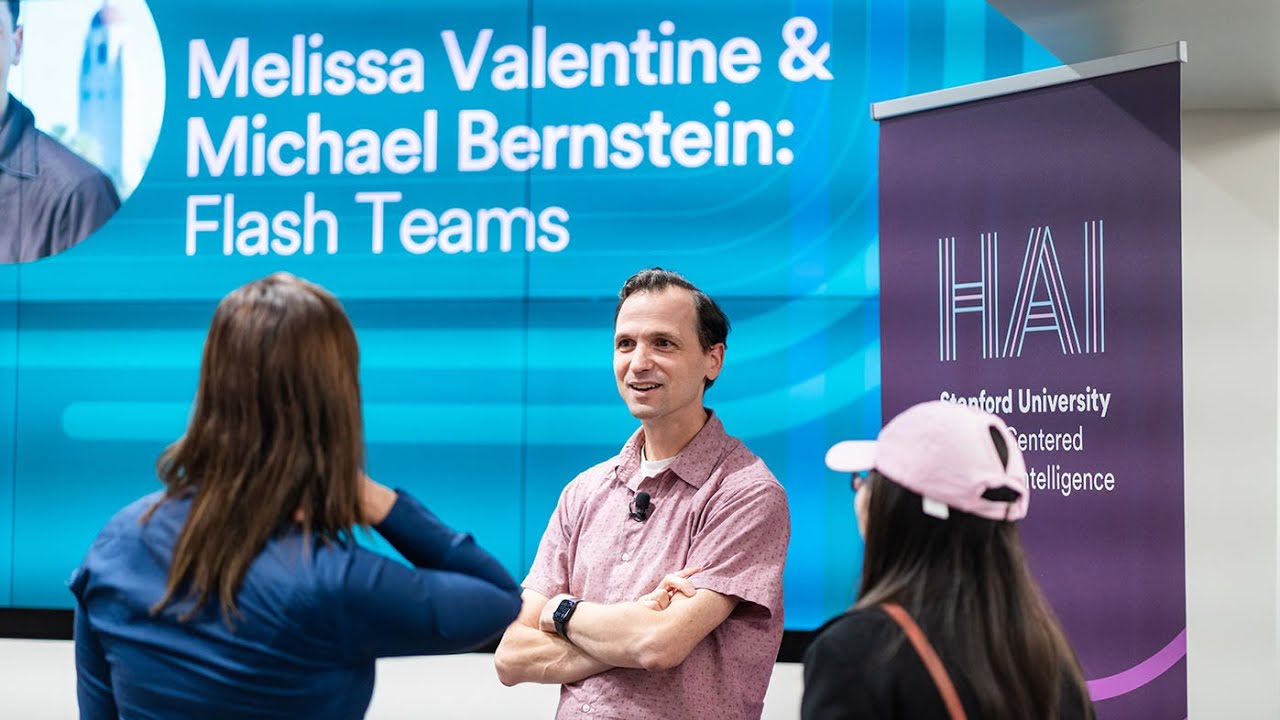
HAI Seminar: Melissa Valentine and Michael Bernstein on Flash Teams
Keywords
Summary
155 words
Critical Evaluation
The seminar provides a compelling and well-articulated vision of the future of work, grounded in the authors’ extensive research. The presentation is structured logically, starting with a relatable anecdote, then introducing the concept of flash teams, and finally discussing the implications for organizational design. The speakers effectively combine their expertise in organizational behavior and computer science, offering a multidisciplinary perspective. The evidence presented, such as the case studies and the data from their platform Foundry, lends credibility to their claims. However, the seminar is primarily an advocacy for their own ideas, and the discussion could benefit from more critical examination of potential downsides, such as the gig economy’s impact on worker rights, the potential for algorithmic bias in team formation, and the long-term sustainability of such models. The sources cited are mostly their own publications, which is expected but limits the breadth of perspectives. The adéquation between title and content is excellent, as the seminar directly addresses the book’s themes. Overall, the seminar is informative and thought-provoking, offering valuable insights for managers and researchers interested in the intersection of AI and organizational design.
183 words
Title / Content Match
The title accurately reflects the content: a seminar by Melissa Valentine and Michael Bernstein on their book Flash Teams.
Quality & Reliability
8/10
The seminar features two Stanford professors presenting their book based on years of research, with concrete examples and references to their own published work. The content is well-structured and grounded in academic research, though it is primarily a presentation of their own ideas rather than a systematic review of the field.
Key Moments
Markers derived by PSI from the transcript: the creator did not define chapters.
- Introduction of speakers and topic
- Melissa Valentine begins lecture with story of ER doctor
- Michael Bernstein explains the concept of flash teams and online labor platforms
- Discussion of role structures and their importance in flash teams
- Presentation of Foundry platform and research findings
- Melissa Valentine discusses data-driven organization science and Perceptics
- Q&A session begins
- Discussion of challenges and future directions
Cited Sources
- Flash Teams (book) — The book being discussed, providing the foundation for the seminar.
- Foundry platform — The platform developed by the authors to coordinate flash teams.
Concurring Sources
- Retelny, D., et al. (2017). Expert Crowdsourcing with Flash Teams. ACM CHI. — The original research paper on flash teams, supporting the seminar's claims.
Dissenting Sources
- Critiques of the gig economy — Potential downsides of on-demand work, such as lack of benefits and job security, which are not deeply addressed in the seminar.
Contribution & Novelties
The seminar presents the novel concept of flash teams, which are rapidly assembled, on-demand teams enabled by online platforms and AI. This approach challenges traditional organizational structures and offers a new paradigm for team design. The authors emphasize the importance of role structures and data-driven decision-making, providing a framework for managers to leverage AI in team formation and coordination.
Pour aller plus loin :
- Flash Teams: Working Together in an Age of Speed and Agility — The book itself, offering a comprehensive exploration of the concept.
- The Rise of the Gig Economy — Provides background on the labor market trends that enable flash teams.
- Human-AI Collaboration — Stanford HAI’s research on human-AI interaction, relevant to the AI-augmented aspects of flash teams.
121 words
Radar Profile
The radar profile shows high scores in information quantity and quality, reflecting the depth of the presentation. The technical level is moderate, making it accessible to a broad audience. The reliability is high due to the academic credentials of the speakers and the research backing their claims.
💬 No comments were provided for analysis.