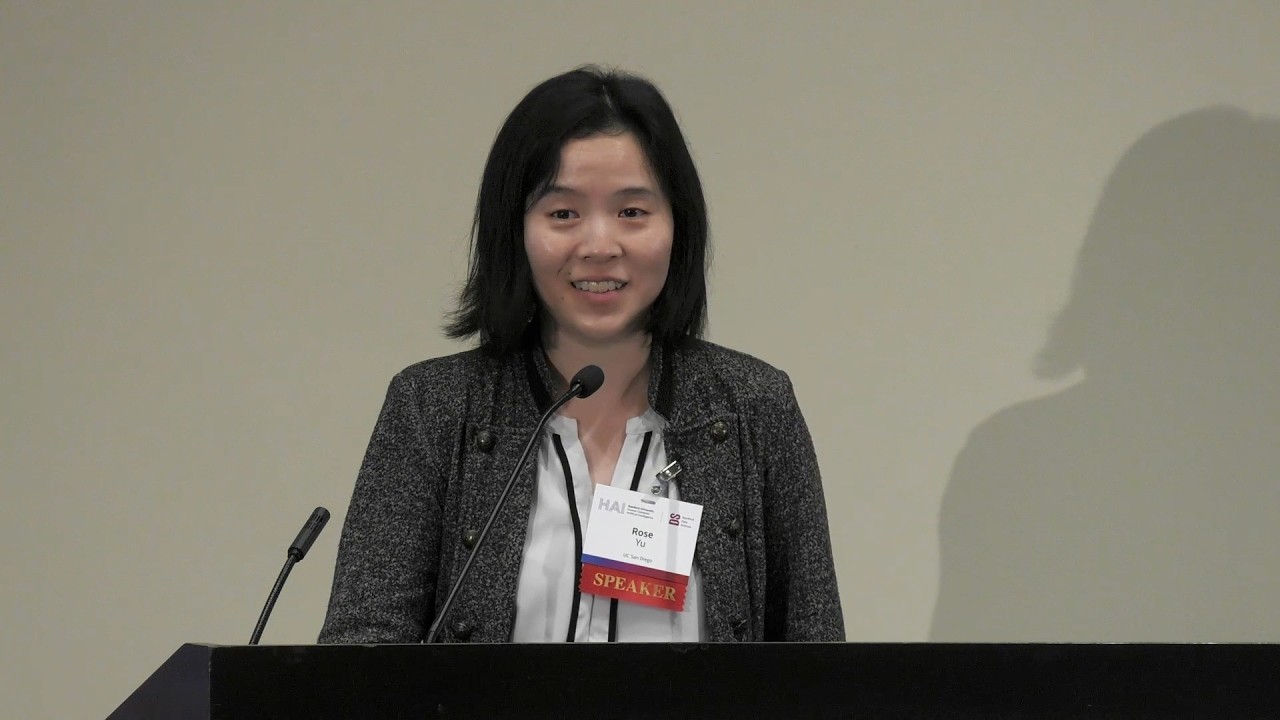
2026 Conference on Physics and AI: Rose Yu
Keywords
Summary
174 words
Critical Evaluation
The talk provides a comprehensive overview of the intersection of AI and physics, highlighting both directions: AI for science and science for AI. Rose Yu demonstrates a strong command of the subject, presenting concrete examples from her research group that illustrate the benefits of incorporating physical principles into AI models. The argument for entanglement is compelling, as she shows how physics can provide inductive biases that improve AI’s performance in scientific domains, while AI can help discover physical laws and accelerate simulations. The technical depth is high, with references to specific methods like equivariant neural networks, adversarial symmetry discovery, and physics-informed diffusion models. The talk is well-structured, moving from familiar AI-for-science applications to more novel science-for-AI ideas, such as teleportation and Noether’s theorem for deep learning. However, the talk is a conference presentation, so it lacks the rigor of a peer-reviewed paper; some claims are presented without detailed evidence, and the audience is assumed to have a background in both fields. The sources cited are primarily the speaker’s own work and the conference itself, which is appropriate for this format. The title accurately reflects the content. Overall, the talk is informative and thought-provoking, offering valuable insights into the symbiotic relationship between physics and AI.
204 words
Title / Content Match
The title accurately reflects the content: a conference talk on the intersection of physics and AI.
Quality & Reliability
8/10
Talk by a recognized academic (professor at UCSD) presenting research results, with references to published work and conference context. The content is technical and appears rigorous, though not peer-reviewed in this format.
Key Moments
Markers derived by PSI from the transcript: the creator did not define chapters.
- Introduction by host and start of Rose Yu's talk.
- Rose Yu introduces the concept of AI for science and science for AI, citing the LIGO example.
- Discussion on the pros and cons of physics and AI, highlighting the need for entanglement.
- Introduction to AI for science: modeling turbulence with TFNet and incorporating multi-scale dynamics.
- Use of equivariant neural networks for turbulence, addressing symmetry breaking.
- Adversarial symmetry discovery method, rediscovering Lorentz symmetry from LHC data.
- Discovering latent coordinates for reaction-diffusion systems and simplifying governing equations.
- Physics-informed diffusion model for climate simulation, speeding up by 25 times.
- Transition to science for AI: teleportation optimizer exploiting symmetry in loss landscapes.
- Applying Noether's theorem to deep learning, finding conserved quantities and analyzing mode connectivity.
- Discussion on the entanglement of AI and physics, emphasizing the need for a unified approach.
- Conclusion and Q&A session begins.
Cited Sources
- 2026 Conference on Physics and AI (PAI26) — Conference page providing context for the talk.
Concurring Sources
- 2026 Conference on Physics and AI (PAI26) — Conference page confirming the event and speaker.
Contribution & Novelties
The talk presents several novel contributions from Rose Yu’s group, including TFNet for turbulence modeling, relaxed equivariant models that adapt to symmetry breaking, adversarial symmetry discovery, and a physics-informed diffusion model for climate simulation. It also introduces teleportation, an optimizer that exploits symmetry, and applies Noether’s theorem to deep learning to find conserved quantities and analyze mode connectivity. These contributions advance both AI for science and science for AI.
Pour aller plus loin :
- Equivariant neural networks — Overview of equivariant networks, relevant to the symmetry-based approaches discussed.
- Noether’s theorem — Fundamental physics principle applied to deep learning in the talk.
- Physics-informed neural networks — Related approach for incorporating physics into AI models.
- Diffusion models — Background on the generative models used for climate simulation.
125 words
Radar Profile
The radar profile shows high scores in technical level and information quality, with slightly lower scores in quantity and reliability, reflecting the depth and specificity of the talk.