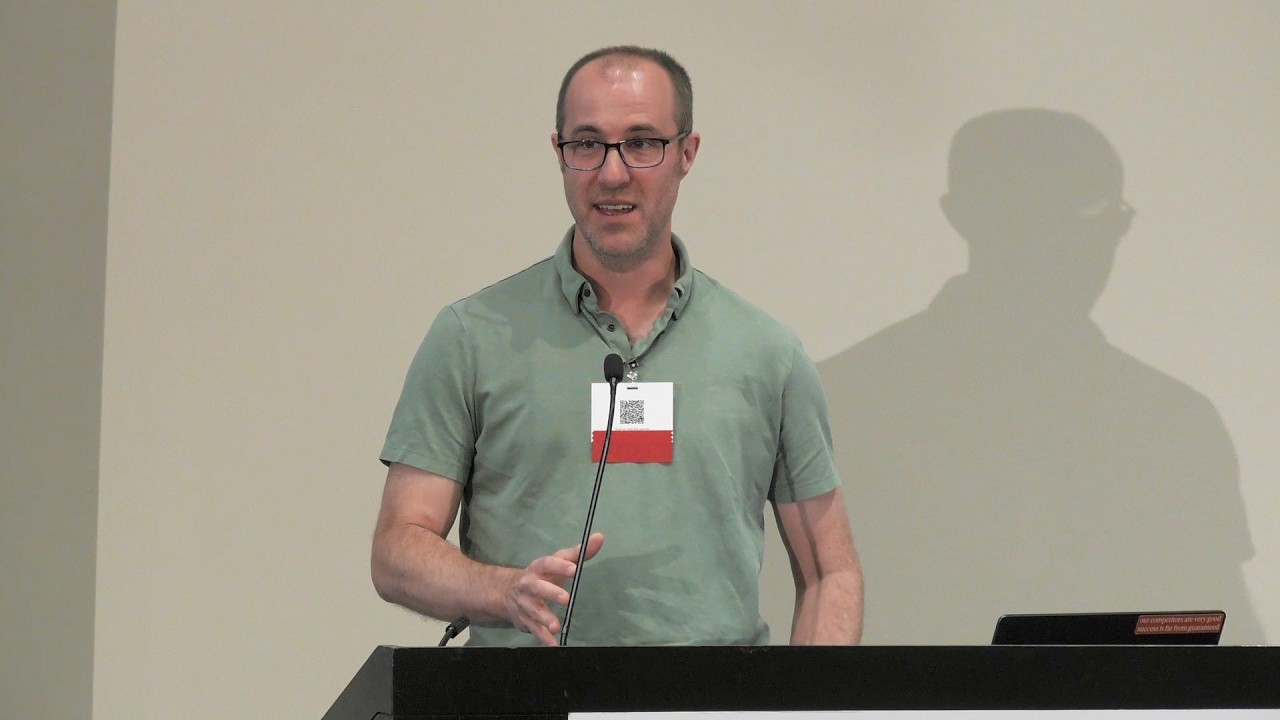
2026 Conference on Physics and AI: Jascha Sohl-Dickstein
Keywords
Summary
220 words
Critical Evaluation
The talk presents a compelling and well-argued perspective on the rapid advancement of AI and its potential societal impact. Sohl-Dickstein effectively uses data on compute scaling and task automation to support his claims, and he acknowledges the speculative nature of his projections. The argument is strengthened by references to respected figures and institutions, which helps to normalize the discussion of AGI. However, the talk is primarily an opinion piece rather than a rigorous scientific analysis. The extrapolations from log-linear trends are presented without thorough discussion of potential limiting factors, such as algorithmic efficiency, energy constraints, or fundamental theoretical barriers. The speaker’s personal experience with Claude is anecdotal and may not generalize. The advice for researchers, while practical, is based on his own judgment rather than empirical evidence. The talk does not engage with counterarguments in depth, and the Q&A session is brief. Overall, the talk is thought-provoking and valuable for its perspective, but it should be viewed as an expert opinion rather than a definitive scientific forecast.
167 words
Title / Content Match
The title accurately reflects the content, which is a talk on the intersection of physics and AI, focusing on the future impact of AI.
Quality & Reliability
8/10
The talk is an expert opinion by a prominent AI researcher (Jascha Sohl-Dickstein) at a Stanford conference. It presents data on AI compute scaling and task automation, but relies heavily on extrapolation and personal judgment. The speaker acknowledges uncertainty and invites questions. The content is well-reasoned but not peer-reviewed.
Key Moments
Markers derived by PSI from the transcript: the creator did not define chapters.
- Introduction and setup: the talk will argue that AI will transform the world, and individuals have leverage.
- Discussion of the Anthropocene epoch and the potential for AI to end it.
- Plot of compute used to train notable AI models, showing exponential growth and comparison to human brain compute.
- METR study on AI task automation: time scale of tasks AI can perform is increasing exponentially.
- AI solving open problems in mathematics, countering the claim that AI only works within training data.
- Discussion of the Overton window and quotes from leaders like Rishi Sunak, Barack Obama, and Eric Schmidt.
- Predictions for AGI timeline: consensus in the AI field is a few years, and no barriers seen by those working on models.
- Advice for researchers: choose projects robust to AI changes, focus on areas where human taste matters.
- Emphasis on individual leverage and the importance of taking AI seriously.
Cited Sources
- 2026 Conference on Physics and AI (PAI26) — Conference page providing context for the talk.
Concurring Sources
- AI and Compute — OpenAI's analysis of compute scaling trends, supporting the exponential growth in AI training compute.
Dissenting Sources
- The Bitter Lesson — Rich Sutton's essay argues that general methods leveraging computation are the most effective, which aligns with the speaker's view, but it also cautions against over-reliance on human knowledge, which might be seen as a counterpoint to the emphasis on human taste.
Contribution & Novelties
The talk provides a unique perspective on the future of AI, combining data on compute scaling and task automation with practical career advice. It normalizes the discussion of AGI by citing respected figures and encourages researchers to consider the long-term implications of AI in their work.
Pour aller plus loin :
95 words
Radar Profile
The radar profile shows high scores in quantity and quality of information, with a moderate level of technical depth. The reliability score is slightly lower due to the speculative nature of the talk. This suggests a well-informed but opinionated presentation.