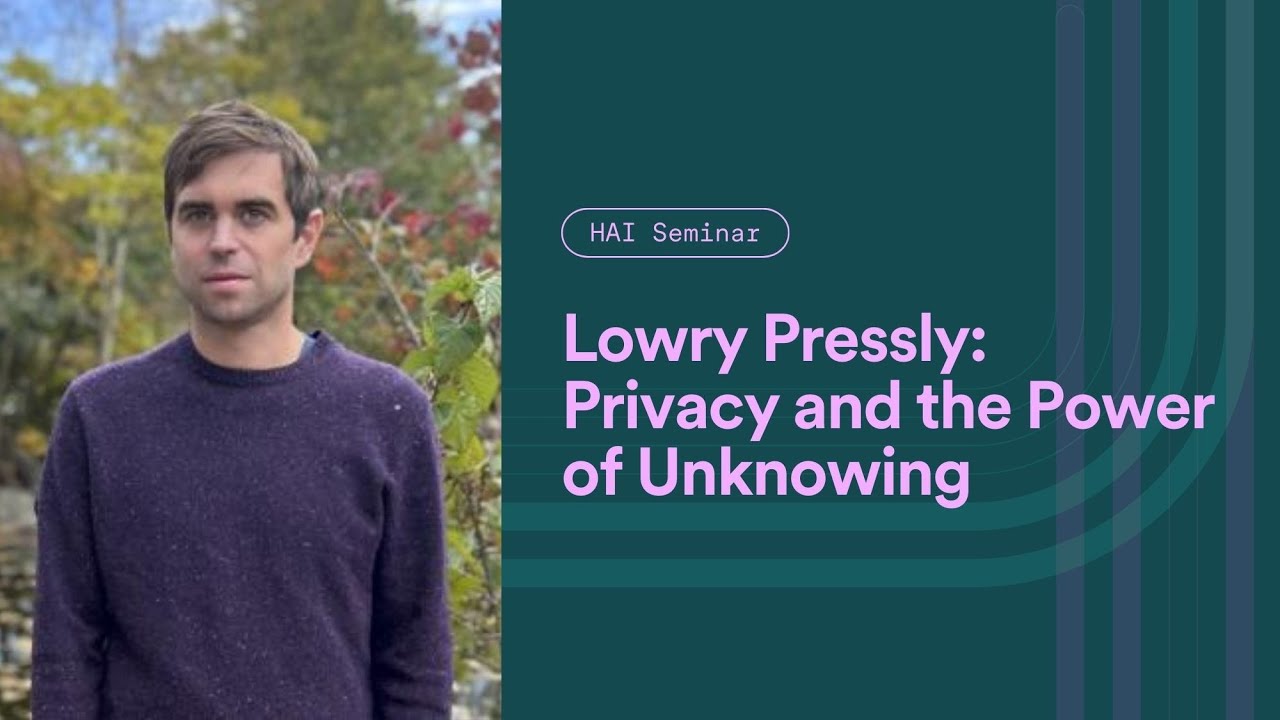
HAI Seminar with Lowry Pressly: Privacy and the Power of Unknowing
Keywords
Summary
129 words
Critical Evaluation
The talk presents a compelling philosophical argument that challenges the prevailing information-centric view of privacy. Pressly’s distinction between privacy and secrecy is insightful and well-illustrated with everyday examples, making the abstract concept of ‘oblivion’ accessible. His critique of privacy defenders who inadvertently naturalize information is thought-provoking and relevant in the age of AI. However, the argument is primarily theoretical and lacks empirical evidence or engagement with counterarguments. The speaker does not address practical implications or policy recommendations in depth. The talk is well-structured and delivered clearly, but it may not satisfy those seeking concrete solutions. The sources cited are limited to his own book and a few philosophical references, which are not explicitly named. Overall, the talk offers a valuable perspective that enriches the privacy debate, but its scope is narrow and academic.
133 words
Title / Content Match
The title accurately reflects the content, which focuses on privacy and the concept of oblivion.
Quality & Reliability
8/10
The speaker is a philosopher with academic credentials, presenting a well-structured argument based on his book. The talk is a philosophical exposition rather than empirical research, but it is coherent and grounded in ethical theory.
Key Moments
Markers derived by PSI from the transcript: the creator did not define chapters.
- Introduction of the speaker and topic by Patrick Hynes.
- Pressly introduces the common assumption that more knowledge is better.
- Discussion of the Delphic maxims 'Know yourself' and 'Nothing in excess'.
- Introduction of the concept of 'oblivion' and its relation to privacy.
- Contrast between privacy and secrecy with examples.
- Critique of privacy defenders who conflate privacy with secrecy.
- Discussion of the social implications of understanding privacy as oblivion.
- Exploration of how AI and data technologies threaten oblivion.
- Conclusion and call to rethink privacy beyond information control.
Cited Sources
- The Right to Oblivion: Privacy and the Good Life — Pressly's book, which forms the basis of the talk.
Concurring Sources
- Stanford Encyclopedia of Philosophy - Privacy — Provides philosophical context on privacy theories.
Dissenting Sources
- Data Protection and Privacy — The talk challenges the dominant data protection framework, which may be seen as discordant with mainstream privacy advocacy.
Contribution & Novelties
The talk offers a novel philosophical framework for understanding privacy, shifting the focus from information control to the cultivation of oblivion. It challenges the prevailing data-centric view and provides a nuanced distinction between privacy and secrecy. This perspective has implications for how we think about AI and surveillance.
Pour aller plus loin :
- The Right to Oblivion: Privacy and the Good Life — The book expands on the talk’s arguments.
- Privacy (Stanford Encyclopedia of Philosophy) — A comprehensive overview of philosophical perspectives on privacy.
- The Right to Privacy — The seminal 1890 article by Warren and Brandeis, foundational to privacy discourse.
101 words
Radar Profile
The radar profile shows high scores in quality and reliability, reflecting the speaker's expertise and coherent argumentation. The lower score in technical level indicates the talk is more philosophical than technical, which is appropriate for the topic.