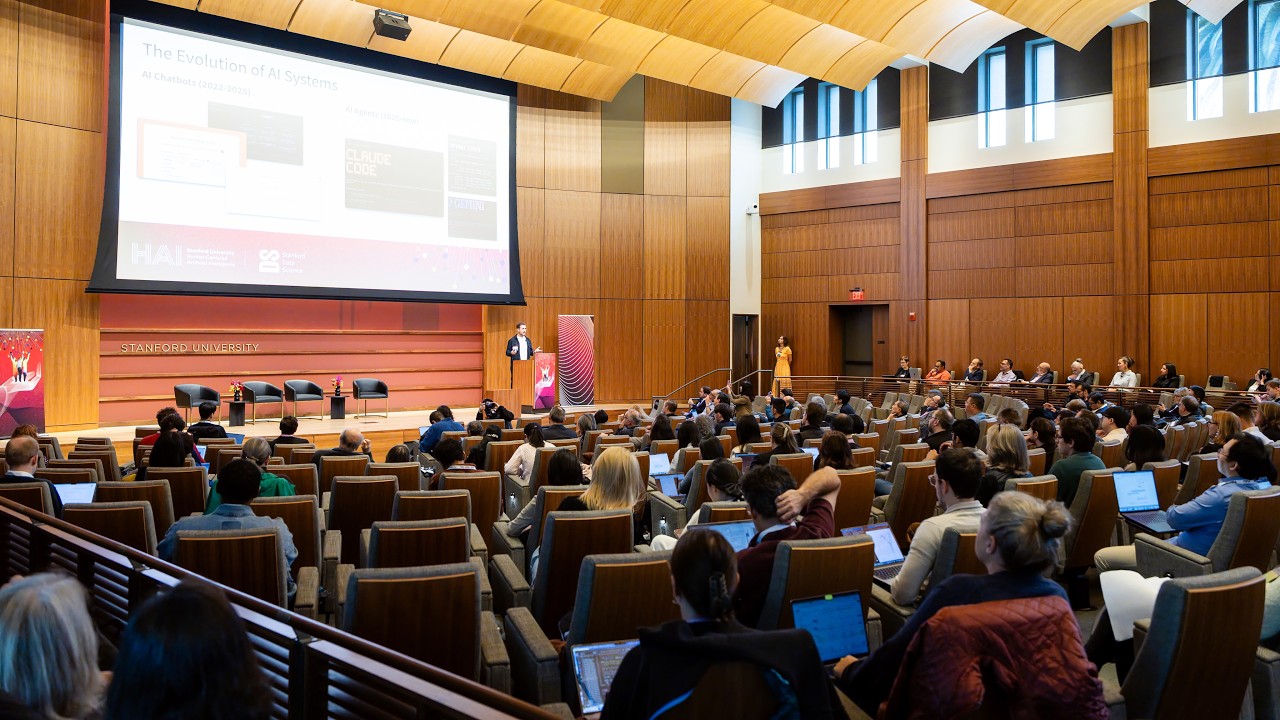
AI+Science: Lightning Talks (Session 1)
Keywords
Summary
157 words
Critical Evaluation
The video provides a valuable snapshot of cutting-edge AI research applied to scientific problems. Each talk is concise but informative, offering a clear overview of the research question, methodology, and preliminary findings. The speakers are knowledgeable and present their work with appropriate technical detail, making the content suitable for an academic audience. The strength of the video lies in its diversity, showcasing four distinct areas: reinforcement learning for healthcare, causal inference with text, AI agent benchmarks for science, and NLP for climate finance. This breadth illustrates the wide applicability of AI methods. However, the lightning talk format inherently limits the depth of explanation. For instance, Aishwarya Mandyam’s talk on off-policy evaluation introduces concepts like conformal prediction intervals and confidence intervals but does not delve into the technical details or assumptions. Similarly, Amar Venugopal’s causal inference pipeline is sketched without discussing potential pitfalls or alternative approaches. Steven Dillmann’s benchmark proposal is compelling but lacks specifics on task design and evaluation metrics. Aldis Elfarsdottir’s regression analysis is presented with coefficients but without reporting standard errors or discussing potential confounding variables. The lack of citations to published papers or external sources in the video or description is a notable weakness, as it prevents viewers from verifying claims or exploring the research further. The title accurately reflects the content, and the production quality is adequate, with clear audio and slides. Overall, the video serves as an excellent introduction to ongoing research, but viewers seeking in-depth understanding would need to consult the original papers or contact the researchers. The absence of a Q&A or discussion segment limits the opportunity for clarification. Despite these limitations, the video is a valuable resource for those interested in the intersection of AI and science.
285 words
Title / Content Match
The title accurately reflects the content: a session of lightning talks at the AI+Science conference.
Quality & Reliability
7/10
The video presents four research talks from Stanford researchers, each describing ongoing work with methodological details. The content is expert-level and likely reliable, but the format (lightning talks) limits depth and verification. No external sources are cited in the video or description, reducing verifiability.
Key Moments
Markers derived by PSI from the transcript: the creator did not define chapters.
- Introduction by the session chair, setting the stage for lightning talks.
- Aishwarya Mandyam begins her talk on safe and uncertainty-aware clinical decision-making.
- Aishwarya Mandyam introduces off-policy evaluation and the use of synthetic data.
- Amar Venugopal presents causal effect estimation with latent textual treatments.
- Amar Venugopal discusses the empirical example with city council comments.
- Steven Dillmann introduces Terminal-Bench-Science for evaluating AI agents.
- Aldis Elfarsdottir presents her analysis of corporate climate reports and credibility.
Contribution & Novelties
The video presents four novel research contributions: (1) a method for off-policy evaluation in clinical settings using synthetic data to improve safety and uncertainty quantification; (2) an end-to-end pipeline for causal effect estimation with textual treatments, including a residualization technique to control for unintended text modifications; (3) a new benchmark, Terminal-Bench-Science, to evaluate AI agents on real scientific computational workflows; (4) an analysis linking specific language in corporate climate reports to credibility and future emissions, with implications for greenwashing detection.
Pour aller plus loin :
- Off-policy evaluation — Provides background on the statistical technique used in the first talk.
- Conformal prediction — Relevant to the uncertainty quantification method mentioned.
- Causal inference — Foundational concepts for the second talk.
- Terminal-Bench — The benchmark that inspired Terminal-Bench-Science.
- Greenwashing — Relevant to the fourth talk’s findings.
133 words
Radar Profile
The radar profile shows a balanced performance across all dimensions, with slightly higher scores in information quantity and technical level, reflecting the dense presentation of research ideas. The lower score in reliability is due to the lack of cited sources and the preliminary nature of the work.