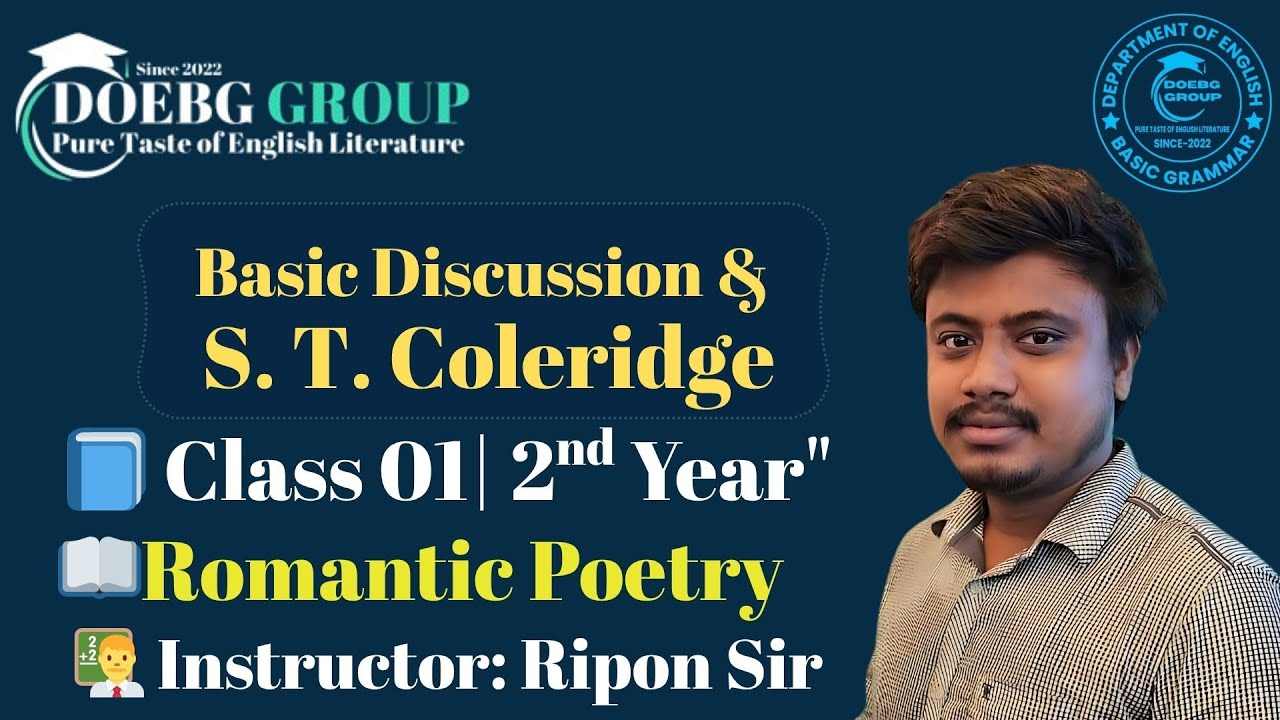
Class - 01 | Basic Discussion & S. T. Coleridge poem | 2nd Year | Ripon Sir | DOEBG
Keywords
Summary
197 words
Critical Evaluation
Value of the Information & Strength of the Argument
The video provides a structured introduction to Romantic Poetry, offering a clear overview of the historical context and key poets. The instructor uses interactive questioning to engage students, but the argumentation is largely based on general knowledge and lacks depth. The value lies in its pedagogical approach, breaking down complex topics into manageable segments. However, the information is presented without critical analysis or reference to scholarly sources, limiting its scientific value.
Scientific Rigor, Source Quality, Title Accuracy
The scientific rigor is low: the lecture contains factual errors, such as stating the French Revolution ended in 1837 (it ended in 1799) and misattributing the publication date of Lyrical Ballads. No external sources are cited, and the instructor relies on oral tradition. The title accurately reflects the content, but the lack of source verification undermines the reliability. The video is a tutorial, not a scholarly presentation.
153 words
Title / Content Match
The title accurately reflects the content: a basic discussion on Romantic Poetry and an introduction to S.T. Coleridge, as delivered in a classroom setting.
Quality & Reliability
5/10
The video is an educational lecture on Romantic Poetry, but it contains several factual inaccuracies (e.g., incorrect dates for the French Revolution and the publication of Lyrical Ballads) and relies on oral transmission without citing primary sources. The pedagogical approach is interactive but lacks rigorous source verification.
Key Moments
Markers derived by PSI from the transcript: the creator did not define chapters.
- Introduction and administrative announcements; discussion on syllabus and first-year mistakes.
- Overview of the Romantic Age: timeline (1798-1832), French Revolution, and Industrial Revolution.
- Explanation of the exam pattern: Part A, B, C, and in-course assessment.
- Introduction to the poets: William Blake, Wordsworth, Coleridge, Byron, Shelley, and Keats.
- Discussion on Blake's poems: Songs of Innocence and Experience, and the contrast between innocence and experience.
- Analysis of typical exam questions and the importance of understanding themes.
- Detailed discussion on the Romantic Period: characteristics, influence of French Revolution, and the slogan 'Art for Art's Sake'.
- Conclusion and summary of key points; encouragement for students.
Cited Sources
- Facebook Group DOEBG — Mentioned in the video description as a platform for further engagement.
- Facebook Page DOEBG — Mentioned in the video description as a page for updates.
- Website DOEBG Group — Mentioned in the video description as a resource.
Concurring Sources
- Romanticism (Wikipedia) — Provides background on the Romantic era, aligning with the video's general overview.
Dissenting Sources
- French Revolution (Wikipedia) — The video incorrectly states the French Revolution ended in 1837; it actually ended in 1799.
Contribution & Novelties
The video offers a structured pedagogical introduction to Romantic Poetry for 2nd-year students, emphasizing exam preparation and conceptual understanding. Its novelty lies in its interactive teaching style and focus on common exam questions. However, it does not present original research or new interpretations.
Pour aller plus loin :
- Romanticism (Wikipedia) — Overview of the Romantic movement.
- Lyrical Ballads (Wikipedia) — Details on the collection by Wordsworth and Coleridge.
- S.T. Coleridge (Wikipedia) — Biography and works of Coleridge.
77 words
Radar Profile
The radar profile shows moderate scores in quantity of information and technique, but lower scores in quality and reliability, indicating a lecture that is informative but lacks depth and source verification.
💬 Sur les 0 commentaires analysés, aucune tendance n'est disponible.