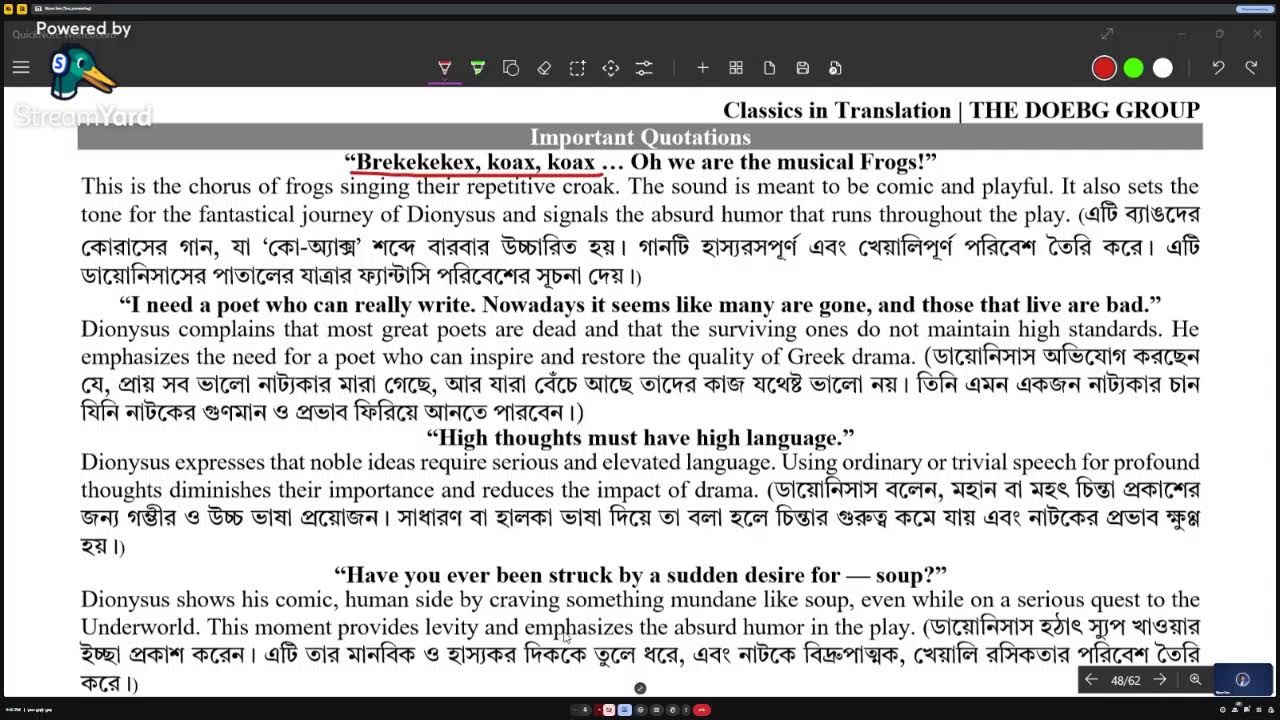
Class - 10 | The Frogs | Aristophanes | Classics in Translation | 4th Year | Ripon Sir | DOEBG
Keywords
Summary
170 words
Critical Evaluation
Value of the Information & Strength of the Argument
The video provides a thorough and accessible summary of ‘The Frogs’, making it valuable for students seeking a clear understanding of the play’s plot and characters. The instructor’s explanations of Aristophanes’ satirical style and the play’s themes are coherent and well-structured. However, the argumentation is largely descriptive rather than critical, with limited engagement with scholarly debates or deeper literary analysis. The lecture relies on a single source (the play itself) and does not present multiple perspectives, which limits its scholarly depth.
Scientific Rigor, Source Quality, Title Accuracy
The scientific rigor is moderate: the instructor provides accurate historical context (e.g., Aristophanes’ dates, the play’s composition in 405 BC) and correctly identifies key characters and themes. However, no external sources are cited, and the lecture is based on the instructor’s own notes and a Bengali translation. The title accurately reflects the content, as it is indeed a class on ‘The Frogs’ in a Classics in Translation course. The video’s informal nature and technical interruptions slightly detract from its academic presentation.
177 words
Title / Content Match
The title accurately describes the content: a class on Aristophanes' 'The Frogs' in a Classics in Translation course.
Quality & Reliability
6/10
The video is a classroom lecture providing a detailed summary and analysis of Aristophanes' 'The Frogs'. It includes historical context, character descriptions, and thematic discussion. However, the presentation is informal, with technical issues and digressions, and lacks rigorous sourcing or citations.
Key Moments
Markers derived by PSI from the transcript: the creator did not define chapters.
- Introduction to Aristophanes and his significance as the Father of Comedy.
- Overview of the plot: Dionysus's journey to the underworld to bring back Euripides.
- Detailed character analysis: Dionysus, Xanthias, Aeschylus, Euripides, and others.
- Discussion of the play's themes: satire, decline of Athens, and the power of poetry.
- Scene-by-scene summary of the play, including the encounter with Charon and the frogs.
- The contest between Aeschylus and Euripides and Dionysus's decision.
- Conclusion and final remarks on the play's relevance.
Cited Sources
- StreamYard — Mentioned in the description as a promotional link for streaming software, not directly related to the content.
Contribution & Novelties
The video offers a comprehensive and accessible summary of ‘The Frogs’ in a classroom setting, which is useful for students. It provides a clear narrative of the plot and character analysis, but does not introduce new scholarly insights. The lecture’s value lies in its pedagogical approach, breaking down the play for students.
Pour aller plus loin :
- Aristophanes — Overview of the playwright and his works.
- The Frogs — Detailed article on the play, including plot and themes.
- Old Comedy — Context on the genre to which ‘The Frogs’ belongs.
90 words
Radar Profile
The radar profile shows moderate scores across all dimensions, with a slight peak in quantity of information and a dip in technical level. This reflects a lecture that provides substantial content but lacks deep analytical rigor and technical sophistication.