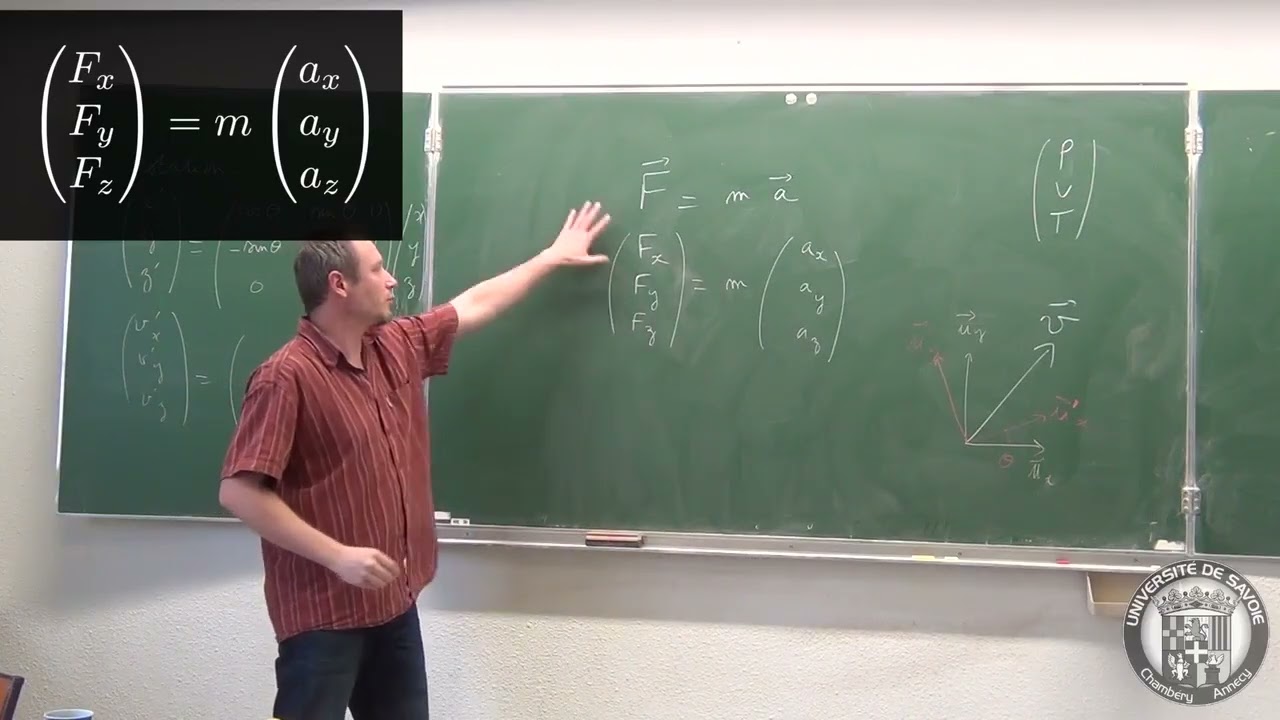
Relativité restreinte 4 cours Richard Taillet
Keywords
Summary
155 words
Critical Evaluation
The lecture provides a solid and rigorous introduction to quadrivectors, a fundamental concept in special relativity. Richard Taillet, a recognized physicist, demonstrates a clear pedagogical approach, starting with a review of ordinary vectors and their transformation properties, then extending the concept to four-dimensional spacetime. The explanation of why vectors are important—because they ensure that physical laws are invariant under coordinate changes—is particularly well articulated and serves as a strong motivation for introducing quadrivectors. The mathematical derivations are accurate and consistent with standard treatments of special relativity. However, the lecture is a recording of a classroom session, which may include digressions and informal language that could be less polished than a prepared video. The transcription also contains some errors and omissions, but these do not detract from the overall clarity. The content is appropriate for undergraduate physics students with a basic understanding of linear algebra and mechanics. The lecture does not cite external sources, but it is based on well-established physics. The title accurately reflects the content, and the lecture fulfills its goal of preparing students to use quadrivectors in relativistic physics. Overall, this is a high-quality educational resource, though it may not offer new insights for those already familiar with the topic.
202 words
Title / Content Match
The title accurately reflects the content: it is the fourth lecture on special relativity by Richard Taillet, focusing on quadrivectors.
Quality & Reliability
8/10
The lecture is given by a recognized physicist (Richard Taillet), with a clear pedagogical structure and rigorous mathematical derivations. The content is consistent with established special relativity theory. However, the video is a recording of a lecture, and the transcription may contain errors or omissions, and no external sources are cited.
Key Moments
Markers derived by PSI from the transcript: the creator did not define chapters.
- Introduction: recap of previous lectures and outline of today's topic (quadrivectors).
- Review of vectors: definition, coordinates, and transformation under rotations.
- Importance of vectors: why physical laws are written as vector equations (F=ma example).
- Generalization to four-dimensional spacetime: introduction of quadrivectors and Lorentz transformations.
- Discussion on how quadrivectors ensure invariance of physical laws across inertial frames.
- Further mathematical details and examples of quadrivectors.
- Conclusion and summary of key points.
Contribution & Novelties
This lecture provides a clear and rigorous introduction to quadrivectors, a key mathematical tool in special relativity. It emphasizes the importance of transformation properties and motivates the use of quadrivectors to ensure the invariance of physical laws. The lecture is particularly valuable for students transitioning from classical mechanics to relativistic physics.
Pour aller plus loin :
- Special relativity - Wikipedia — Provides a comprehensive overview of the theory.
- Lorentz transformation - Wikipedia — Details the mathematical transformations used in special relativity.
- Four-vector - Wikipedia — Explains the concept of quadrivectors in depth.
92 words
Radar Profile
The radar profile shows high scores across all dimensions, indicating a well-balanced and reliable educational resource. The lecture is technically rigorous, provides substantial information, and is presented by an expert in the field.