Relativité générale 11 cours Richard Taillet
Keywords
Summary
184 words
Critical Evaluation
The lecture provides a clear and pedagogically effective introduction to Einstein’s field equations, emphasizing the physical reasoning behind their form. The instructor carefully explains the need for a tensor equation, the role of the energy-momentum tensor, and the construction of the Einstein tensor to satisfy the conservation law. The mathematical steps are presented in a step-by-step manner, making the derivation accessible to students with a background in tensor calculus. However, the lecture does not delve into the derivation of the Riemann tensor or the energy-momentum tensor for specific matter fields, which might be a limitation for a comprehensive understanding. The presentation is rigorous, but it relies on the authority of the course rather than citing specific references. The instructor correctly notes that Einstein’s equations are postulated, not derived, and their validity is confirmed by observational tests. The lecture is well-structured, with a logical flow from motivation to final equations. The use of the Newtonian limit as a guiding principle is particularly effective. The only minor weakness is the lack of discussion on alternative formulations or the cosmological constant, which is briefly mentioned but not elaborated. Overall, the lecture is of high quality, suitable for advanced undergraduate or graduate students in physics. The content is accurate and aligns with standard textbooks on general relativity.
213 words
Title / Content Match
The title accurately reflects the content: it is the 11th lecture in a series on general relativity, focusing on Einstein's equations.
Quality & Reliability
8/10
The lecture is based on a well-established physics course by Richard Taillet, presenting the derivation of Einstein's field equations with clear mathematical steps and physical motivation. The content is consistent with standard general relativity textbooks, though it lacks direct citations to primary sources.
Key Moments
Markers derived by PSI from the transcript: the creator did not define chapters.
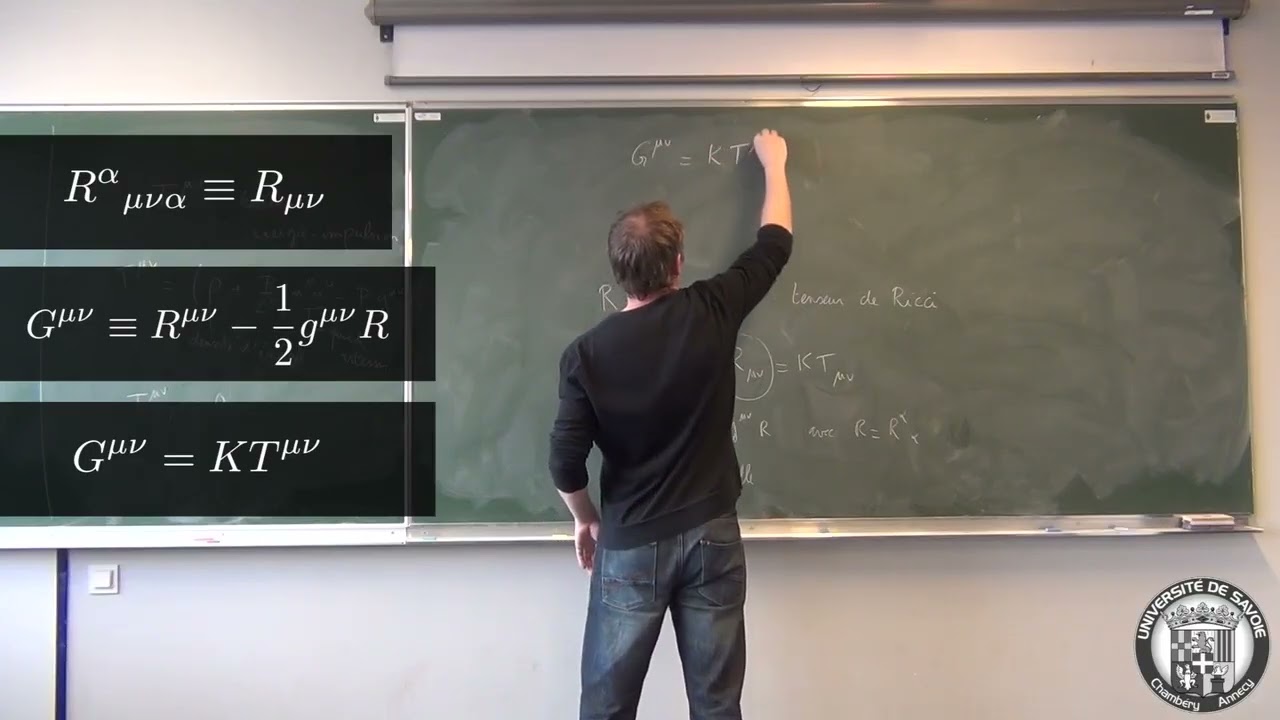
- Introduction: the goal is to derive Einstein's field equations, relating curvature to the content of spacetime.
- Recap of the role of curvature in geodesic motion and the need for a tensor equation.
- Newtonian limit: Poisson's equation for the gravitational potential motivates the form of the relativistic equation.
- Introduction of the energy-momentum tensor Tμν and its conservation law (divergence-free).
- Construction of the Ricci tensor Rμν by contracting the Riemann tensor.
- Problem: the divergence of Rμν is not zero, so Einstein constructs the Einstein tensor Gμν.
- The field equations: Gμν = κ Tμν, with κ determined later.
- Contraction of the Einstein tensor to obtain the scalar curvature R, and demonstration that in flat spacetime the trace of the metric is 4.
Contribution & Novelties
The lecture provides a clear pedagogical derivation of Einstein’s field equations, emphasizing the physical reasoning and the role of conservation laws. It bridges the gap between the geometric description of gravity and the energy-momentum content of spacetime.
Pour aller plus loin :
- General relativity - Wikipedia — Overview of the theory and its equations.
- Einstein field equations - Wikipedia — Detailed derivation and properties.
- Energy-momentum tensor - Wikipedia — Explanation of the source term in the field equations.
78 words
Radar Profile
The radar profile shows high scores in information quantity, quality, technical level, and reliability, indicating a well-balanced and rigorous lecture. The content is dense but clearly presented, suitable for an audience with a background in tensor calculus.