Histoire de la cosmologie 7 cours Richard Taillet
Keywords
Summary
194 words
Critical Evaluation
This lecture offers a valuable and engaging overview of the history of cosmology, focusing on the development of scientific knowledge from the 17th to the early 20th century. The professor, Richard Taillet, demonstrates a deep understanding of the subject and presents the material in an accessible yet rigorous manner. The content is well-structured, starting with a review of previous lectures and then branching into specific topics such as the discovery of Neptune and the state of physics around 1900.
One of the strengths of the lecture is its emphasis on the scientific method and the importance of critical thinking. For example, the professor takes time to debunk a common misquote attributed to Michelson, showing that the original quote was more nuanced and actually acknowledged the possibility of future discoveries. This illustrates the importance of context in interpreting historical statements and adds a layer of sophistication to the narrative.
The lecture also highlights the role of prediction in science, using the discovery of Neptune as a prime example. This serves as a powerful illustration of how theoretical physics can guide observational astronomy, a theme that will become even more prominent in the 20th century with Einstein’s theory of general relativity.
However, the lecture is not without its limitations. The informal style, with frequent digressions and asides, may be distracting for some viewers. The lack of visual aids, such as slides or diagrams, makes it difficult to follow the timeline and the relationships between different discoveries. Additionally, the lecture is primarily a narrative rather than a critical analysis of the historical sources, so it does not delve into the complexities of historical interpretation.
In terms of scientific rigor, the content is accurate and well-informed, but it is based on a single perspective and does not engage with alternative viewpoints or controversies in the history of science. The sources cited are not explicitly mentioned, but the lecture draws on well-known historical facts and figures.
Overall, this lecture provides a solid foundation for understanding the historical context of modern cosmology. It is informative and thought-provoking, but it would benefit from a more structured presentation and a more critical engagement with the historical record. The title accurately reflects the content, and the lecture successfully prepares students for the upcoming discussion of Einstein and Hubble.
379 words
Title / Content Match
The title accurately reflects the content: a lecture on the history of cosmology, part of a series, delivered by Richard Taillet.
Quality & Reliability
7/10
The video is a university-level lecture by a professor (Richard Taillet) on the history of cosmology, covering well-documented historical events and figures. The content is accurate and based on established historical knowledge, though it is a single perspective and not peer-reviewed. The lecturer demonstrates critical thinking, e.g., by debunking a common misquote of Michelson. The lack of visual aids and the informal style slightly reduce the overall reliability.
Key Moments
Markers derived by PSI from the transcript: the creator did not define chapters.
- Introduction and overview of the lecture's goals.
- Review of previous lectures: Galileo's observations, Newton's Principia, and the Laponian expedition.
- Discussion of the solar system discoveries: Saturn's rings, Uranus, Ceres, Neptune, and Pluto.
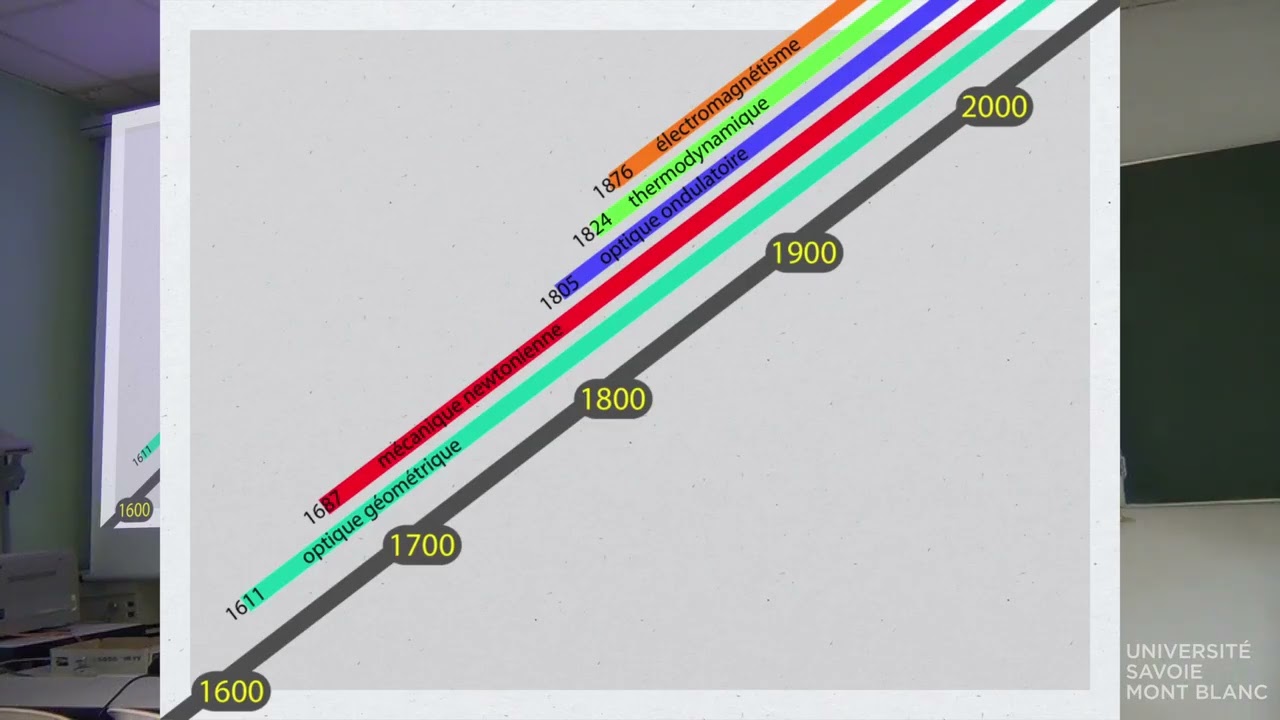
- Timeline of physical theories: optics, mechanics, thermodynamics, electromagnetism.
- The state of physics around 1900: Lord Kelvin's quote and the Michelson quote.
- Critical analysis of the Michelson quote, showing it is often taken out of context.
- Conclusion: the upcoming revolution with Einstein and Hubble.
Contribution & Novelties
This lecture provides a comprehensive historical narrative that connects key discoveries and theories, emphasizing the scientific method and the importance of context in interpreting historical statements. It offers a nuanced perspective on the state of physics at the turn of the 20th century, correcting common misconceptions.
Pour aller plus loin :
- History of cosmology — Provides a broader overview of the topic.
- Discovery of Neptune — Details the mathematical prediction and observation.
- Albert Einstein — Key figure in modern cosmology.
- Edwin Hubble — His observations led to the expanding universe theory.
91 words
Radar Profile
The radar profile shows a balanced lecture with high scores in information quantity and quality, moderate technical level, and good reliability. The lecture is informative and accurate but not highly technical, making it suitable for a general audience.