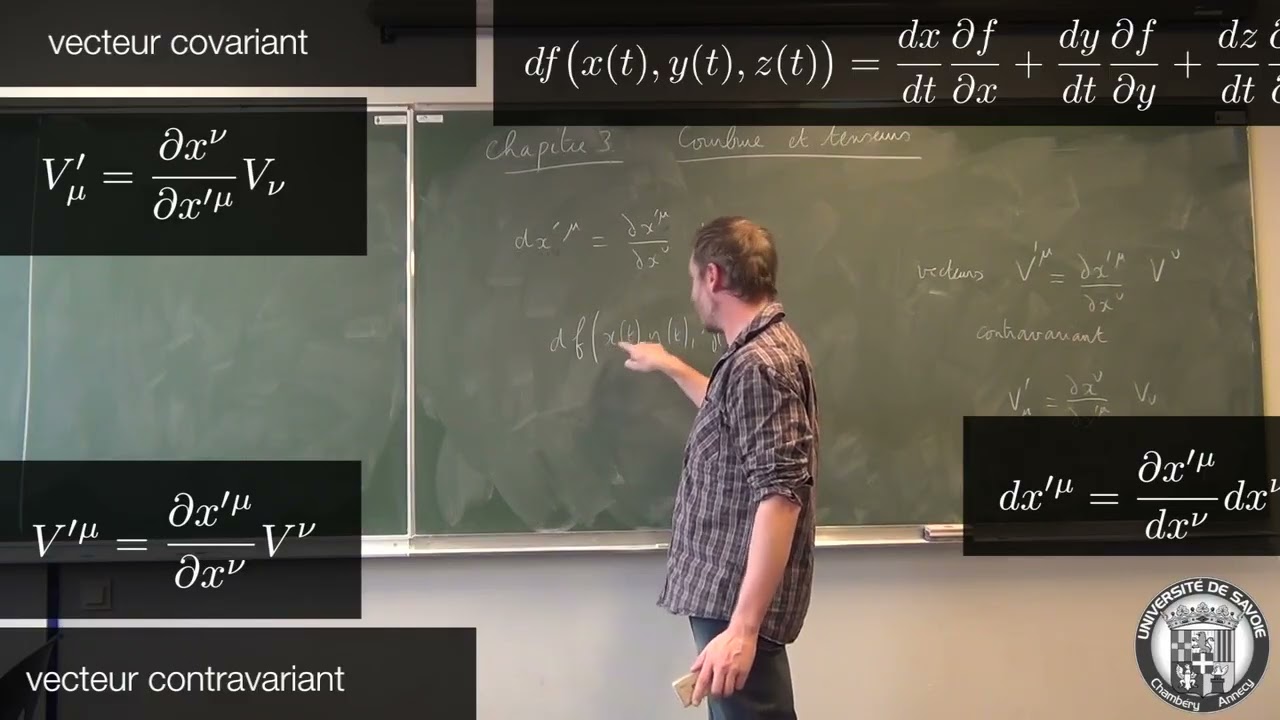
Relativité générale 7 cours Richard Taillet
Keywords
Summary
142 words
Critical Evaluation
The lecture provides a thorough and rigorous introduction to tensors, a fundamental concept in general relativity. The instructor, Richard Taillet, demonstrates a deep understanding of the subject and presents the material in a clear, step-by-step manner. The explanation of the difference between scalars, vectors, and tensors is particularly effective, using the transformation properties under coordinate changes as the defining characteristic. The distinction between contravariant and covariant vectors is well-illustrated with concrete examples, such as the displacement vector and the gradient, which helps to clarify a subtle but crucial point. The mathematical derivations are accurate and follow standard conventions in differential geometry. However, the lecture is somewhat abstract and may be challenging for viewers without a solid background in linear algebra and calculus. The lack of visual aids or diagrams might make it harder to follow the geometric interpretations. The video does not cite specific sources, but the content is consistent with established physics textbooks. Overall, the lecture is of high quality and serves as an excellent educational resource for those studying general relativity.
173 words
Title / Content Match
The title accurately reflects the content, which is the seventh lecture in a series on general relativity, focusing on tensors.
Quality & Reliability
8/10
The video is a lecture by Richard Taillet, a physicist, explaining tensors in the context of general relativity. The content is mathematically rigorous and pedagogically structured, with clear definitions and examples. The presentation is consistent with standard physics education, though it lacks citations to specific sources.
Key Moments
Markers derived by PSI from the transcript: the creator did not define chapters.
- Introduction: The instructor sets the goal to explain what a tensor is, referencing previous mentions.
- Discussion of the stress tensor as an example of a rank-2 tensor, represented by a matrix.
- Definition of a scalar: a quantity that remains invariant under coordinate transformations.
- Illustration of scalar transformation using temperature as an example, contrasting Cartesian and polar coordinates.
- Introduction to vectors: transformation rules are more complex due to change of basis vectors.
- Derivation of the transformation law for contravariant vectors, using the chain rule.
- Introduction of covariant vectors, with transformation law involving inverse derivatives.
- Example of a contravariant vector: the displacement vector, and its transformation properties.
- Example of a covariant vector: the gradient, and its transformation properties.
- Extension to higher-order tensors, emphasizing that tensors are defined by their transformation rules.
Contribution & Novelties
The lecture provides a clear and rigorous introduction to tensors, emphasizing their transformation properties, which is essential for understanding general relativity. It effectively distinguishes between scalars, vectors, and tensors, and between contravariant and covariant vectors, using concrete examples.
Pour aller plus loin :
- Tensor (Wikipedia) — Provides a comprehensive overview of tensors, including definitions and applications.
- Covariance and contravariance of vectors (Wikipedia) — Explains the distinction between contravariant and covariant vectors in detail.
- Introduction to Tensors (MIT OpenCourseWare) — A course on differential geometry that covers tensors in depth.
89 words
Radar Profile
The radar profile shows high scores across all dimensions, indicating a well-balanced and reliable educational content. The lecture is technically rigorous, provides substantial information, and is presented with clarity, making it a valuable resource for learners.