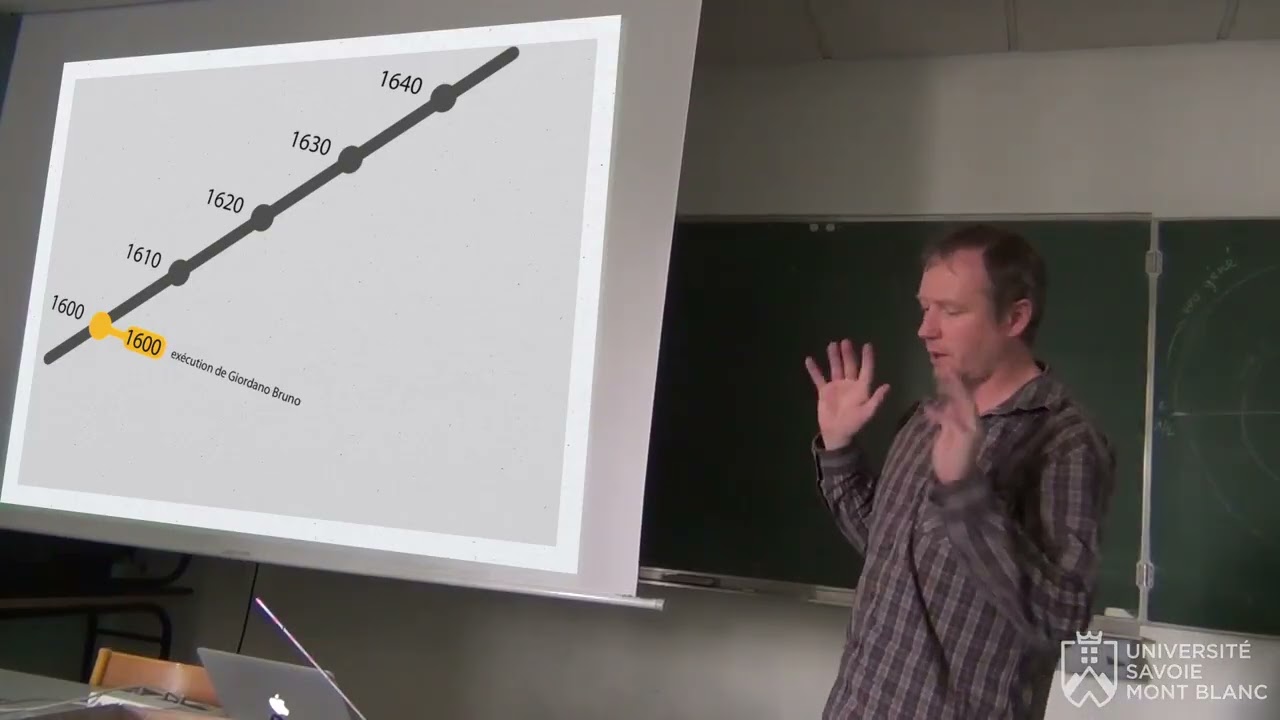
Histoire de la cosmologie 5 cours Richard Taillet
Keywords
Summary
173 words
Critical Evaluation
The lecture offers a comprehensive and engaging overview of a pivotal period in the history of cosmology. The speaker, presumably Richard Taillet, demonstrates deep knowledge of the subject, weaving together scientific developments, biographical details, and historical context. The discussion of astronomical tables (Alfonsine, Prutenic, Rudolphine) is particularly valuable, as it illustrates how theoretical models were translated into practical tools for prediction. The emphasis on the role of logarithms in Kepler’s calculations is a nice touch, showing the interplay between mathematics and astronomy. The treatment of the Inquisition and Giordano Bruno is nuanced, correctly noting that Bruno was executed for theological reasons, not heliocentrism, but acknowledging the chilling effect on Italian scientists. The lecture’s informal style, with asides and jokes, makes it accessible, but may detract from its scholarly tone. The lack of cited sources in the description is a limitation, though the content appears well-researched. The title accurately reflects the content, and the lecture provides a solid foundation for understanding the scientific revolution. Overall, it is a valuable resource for students and enthusiasts of the history of science.
178 words
Title / Content Match
The title accurately reflects the content: a lecture on the history of cosmology, part 5, by Richard Taillet.
Quality & Reliability
8/10
The lecture is given by a professor (Richard Taillet) and provides a detailed historical account of cosmology from 1600 to 1642, focusing on Galileo and Kepler. The content is well-structured, references historical documents and tables, and demonstrates scholarly rigor. However, it is a single lecture with no external sources cited in the description, and the presentation is informal.
Key Moments
Markers derived by PSI from the transcript: the creator did not define chapters.
- Recap of Ptolemaic, Copernican, and Keplerian models.
- Discussion of astronomical tables: Alfonsine, Prutenic, and Rudolphine.
- Introduction of the Roman Inquisition and Giordano Bruno's execution.
- Biographical overview of Galileo and Kepler.
- Galileo's telescopic observations and advocacy for heliocentrism.
- Conflict with the Church and trial.
- Kepler's Rudolphine tables and use of logarithms.
- Correspondence between Galileo and Kepler.
- Birth of Descartes and Newton, and calendar discrepancies.
Contribution & Novelties
This lecture provides a detailed historical narrative of cosmology from 1600 to 1642, focusing on Galileo and Kepler. It offers insights into the development of astronomical tables and the role of logarithms in Kepler’s calculations. The lecture also contextualizes the scientific developments within the religious and political climate of the time, including the Inquisition and the execution of Giordano Bruno.
Pour aller plus loin :
- Galileo Galilei — Overview of Galileo’s life and contributions.
- Johannes Kepler — Overview of Kepler’s laws and work.
- Rudolphine Tables — Details on Kepler’s astronomical tables.
- Giordano Bruno — Information on Bruno’s life and execution.
100 words
Radar Profile
The radar profile shows high scores in quantity and quality of information, reflecting the lecture's comprehensive coverage and scholarly depth. The technical level is moderate, suitable for a general audience, while reliability is high due to the expertise of the speaker.