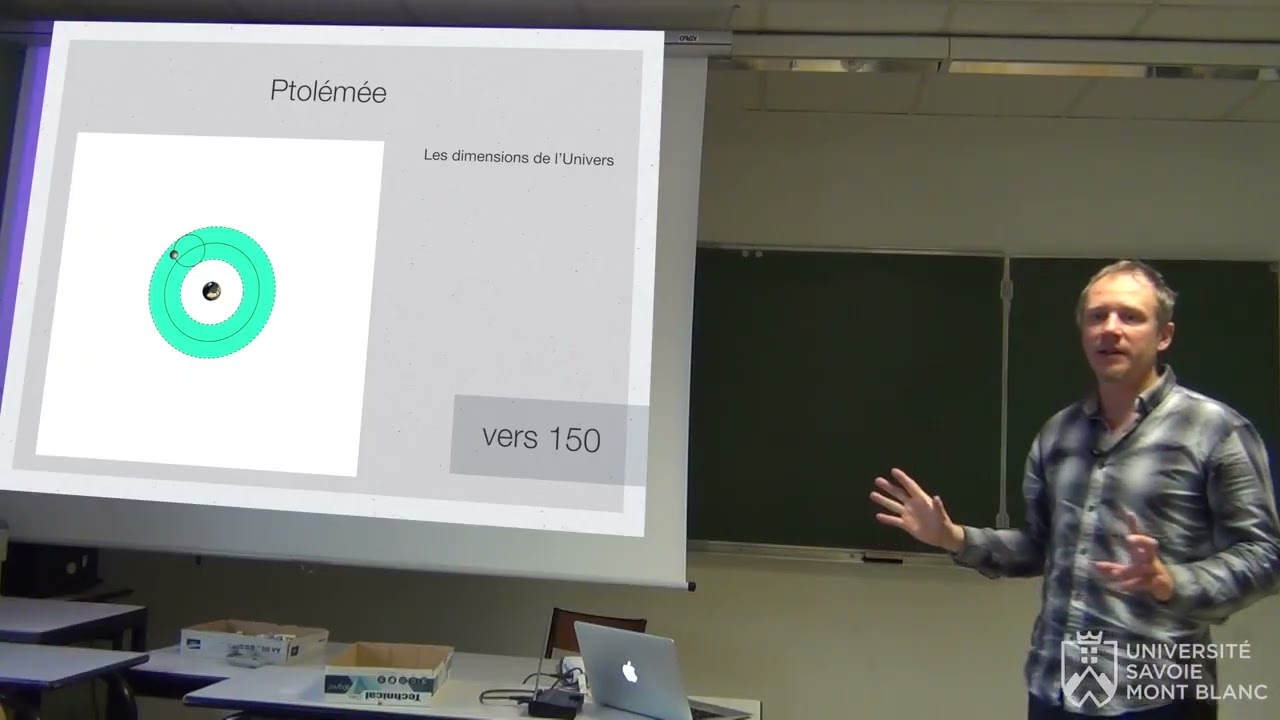
Histoire de la cosmologie 2 cours Richard Taillet
Keywords
Summary
136 words
Critical Evaluation
The video provides a solid introduction to the Ptolemaic model, explaining its key components and historical context. The speaker’s explanations are clear and accessible, using diagrams to illustrate the concepts. The content is scientifically accurate, based on well-established historical facts. However, the video lacks direct citations to primary sources, relying instead on secondary literature. The speaker mentions several books, but does not provide specific references or page numbers, which limits the ability to verify the information. The argumentation is logical and follows a historical narrative, but it could benefit from more critical analysis of the Ptolemaic model’s limitations and the motivations behind its acceptance. The video’s strength lies in its pedagogical approach, making complex astronomical concepts understandable. The adéquation between the title and content is good, as it accurately describes the focus on Ptolemy. Overall, this is a valuable educational resource for those interested in the history of science, though it could be enhanced by more rigorous sourcing.
158 words
Title / Content Match
The title accurately reflects the content, which is the second part of a course on the history of cosmology, focusing on Ptolemy.
Quality & Reliability
7/10
The video is a lecture-style presentation on the history of cosmology, focusing on Ptolemy's model. It is based on established historical facts and references several books, but lacks direct citations to primary sources. The speaker is a physics teacher, and the content is accurate but presented in a conversational manner.
Key Moments
Markers derived by PSI from the transcript: the creator did not define chapters.
- Introduction to Ptolemy and his synthesis of earlier Greek astronomy.
- Discussion of objections to Earth's motion, including the falling bodies argument.
- Explanation of Ptolemy's use of epicycles and eccentric deferents.
- Introduction of the equant point and its role in explaining planetary motion.
- Ptolemy's method for determining the sizes of planetary spheres by avoiding empty space.
- Overview of the Almagest and its historical transmission through Arabic and Hebrew translations.
- The role of Cardinal Bessarion and the Latin translation by Peurbach and Regiomontanus.
- Introduction to Copernicus and his early doubts about the Ptolemaic model.
Cited Sources
- The Copernican Revolution — Recommended by the speaker for clear explanations of epicycles and the Ptolemaic system.
- Copernicus and the Scientific Revolution — Recommended by the speaker for detailed information on Copernicus's life and work.
Concurring Sources
- Ptolemy's Almagest — Provides a comprehensive overview of the Almagest, consistent with the video's description.
- Equant — Explains the equant point, which the video discusses in detail.
Contribution & Novelties
The video provides a clear and accessible explanation of the Ptolemaic model, focusing on the equant point and the method for determining planetary distances. It also highlights the historical transmission of the Almagest, which is often overlooked.
Pour aller plus loin :
- Ptolemy’s Almagest — Overview of the Almagest and its significance.
- Equant — Explanation of the equant point in Ptolemaic astronomy.
- Epicycle — Detailed description of epicycles and their use in ancient astronomy.
74 words
Radar Profile
The radar profile shows a balanced performance across all dimensions, with slightly higher scores in information quantity and reliability, indicating a well-rounded educational video.