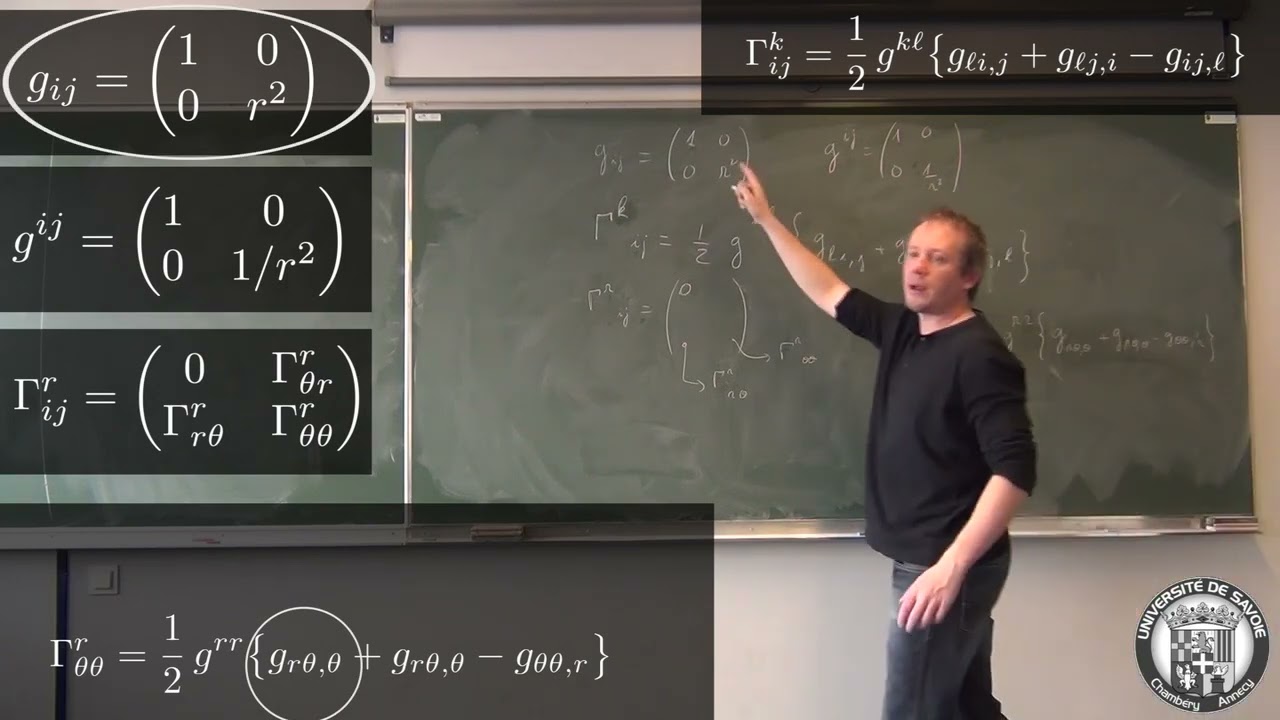
Relativité générale 9 cours Richard Taillet
Keywords
Summary
208 words
Critical Evaluation
The video provides a solid, step-by-step introduction to the computation of Christoffel symbols, a fundamental tool in general relativity. The lecturer’s approach is pedagogical, breaking down the calculations into manageable steps and explaining the reasoning behind each simplification. The content is mathematically correct, and the examples chosen (polar and spherical coordinates) effectively illustrate the difference between a flat space described in curvilinear coordinates and a genuinely curved space. However, the video has several limitations. First, it lacks any references to external sources, which is a significant drawback for a scientific tutorial. The viewer is not directed to textbooks or papers for further study. Second, the production quality is basic, with a blackboard-style presentation and occasional audio issues, which may detract from the learning experience. Third, the video is part of a series, and without the context of previous lectures, some viewers may find the notation and concepts challenging. The lecturer assumes familiarity with tensor notation and the metric tensor, which may not be suitable for absolute beginners. Despite these issues, the video is a valuable resource for students who want to see the detailed calculations behind the Christoffel symbols. The lecturer’s clear explanations and step-by-step approach make the material accessible, and the focus on a concrete example helps to demystify the abstract formalism. The video also correctly emphasizes the importance of the Riemann curvature tensor in determining intrinsic curvature, setting the stage for more advanced topics. Overall, the video is a useful tutorial for intermediate-level physics students, but it would benefit from additional context and references.
256 words
Title / Content Match
The title accurately describes the content: it is the ninth lecture in a series on general relativity, taught by Richard Taillet (though the channel is Anthony Bichler). The content matches the title.
Quality & Reliability
7/10
The video is a lecture-style tutorial on general relativity, specifically on calculating the metric tensor and Christoffel symbols. The content is mathematically rigorous and follows standard derivations. The instructor (likely Richard Taillet, though the channel is Anthony Bichler) demonstrates step-by-step calculations. However, the video lacks citations to external sources, and the production quality is basic (blackboard style). The mathematical steps are correct, but the presentation is somewhat informal and may lack depth for advanced learners.
Key Moments
Markers derived by PSI from the transcript: the creator did not define chapters.
- Introduction: review of metric tensor in different coordinate systems, polar and spherical coordinates.
- Explanation of the need to compute the Riemann curvature tensor to distinguish flat vs curved space.
- Definition of the Christoffel symbols and the plan to calculate them for the polar metric.
- Calculation of the inverse metric for polar coordinates.
- Step-by-step computation of the Christoffel symbols for the polar metric, showing most are zero.
- Detailed calculation of the non-zero Christoffel symbol for the polar metric.
- Beginning of the calculation for the spherical metric, setting up for the next lecture.
Contribution & Novelties
The video provides a clear, step-by-step derivation of the Christoffel symbols for a simple metric, which is a fundamental skill in general relativity. It emphasizes the importance of the Riemann curvature tensor in distinguishing flat from curved spaces, a concept that is often glossed over in introductory texts. The pedagogical approach of working through the calculations in detail is valuable for students.
Pour aller plus loin :
- Christoffel symbols - Wikipedia — A comprehensive reference on the definition and properties of Christoffel symbols.
- Riemann curvature tensor - Wikipedia — Detailed explanation of the curvature tensor and its role in general relativity.
- Introduction to Tensor Calculus for General Relativity — Lecture notes by Edmund Bertschinger at MIT, covering tensor calculus and its application to GR.
124 words
Radar Profile
The radar profile shows high scores in technical level and information quality, indicating a mathematically rigorous tutorial. The lower scores in information quantity and reliability reflect the lack of external references and the basic production quality.