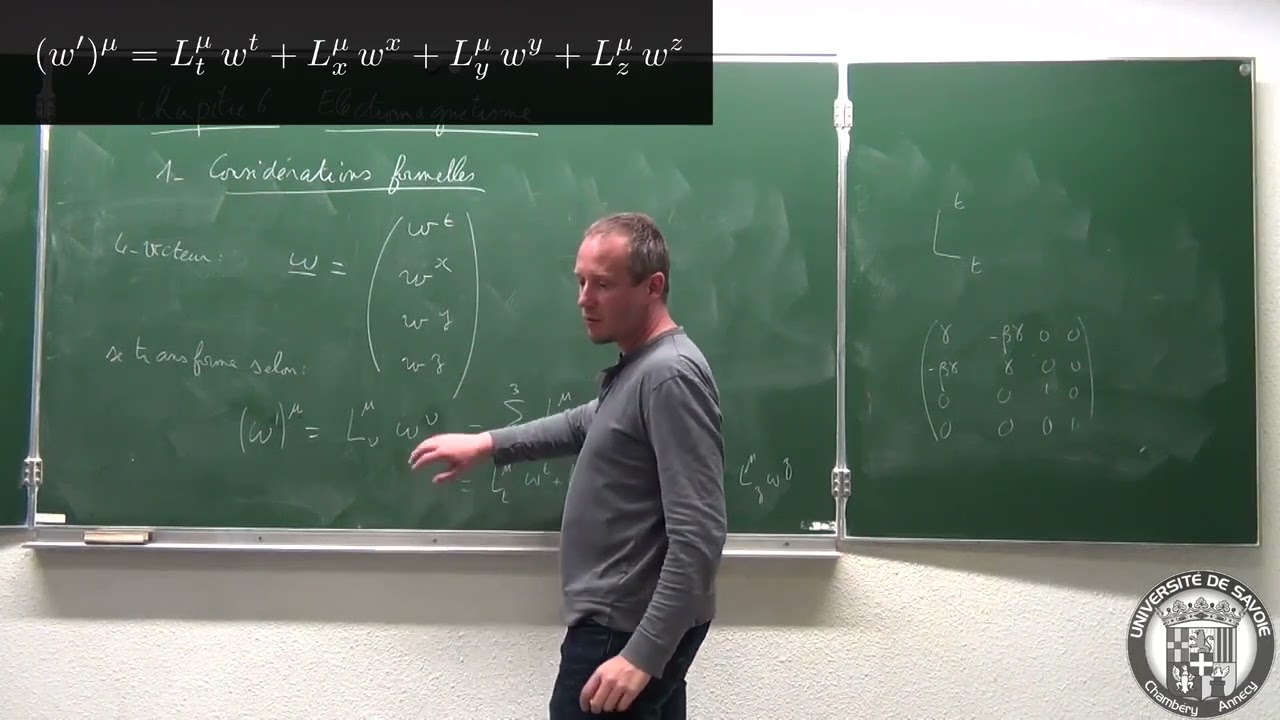
Relativité restreinte 10 cours Richard Taillet
Keywords
Summary
210 words
Critical Evaluation
The lecture provides a rigorous and insightful derivation of Maxwell’s equations from the principles of special relativity. The instructor’s approach is elegant, showing that the magnetic field is a relativistic consequence of the electric field and the principle of relativity. The use of four-vectors and the distinction between contravariant and covariant components is a standard and powerful technique in theoretical physics. The mathematical derivations are clear and well-paced, with the instructor explicitly addressing potential points of confusion. The lecture is based on the established work of Richard Taillet, a respected physicist, and the content aligns with standard textbook treatments of relativistic electrodynamics. However, the lecture does not cite specific sources or references, which limits its verifiability. The presentation is a tutorial, and while it is technically accurate, it assumes a high level of mathematical sophistication from the audience. The instructor’s teaching style is engaging, but the density of the material may be overwhelming for beginners. The title accurately reflects the content, and the lecture fulfills its promise of showing the power of the relativistic approach. Overall, this is a high-quality educational resource for advanced students, but it lacks external citations and may not be accessible to a general audience.
199 words
Title / Content Match
The title accurately reflects the content: a lecture on special relativity, part of a series, taught by Richard Taillet.
Quality & Reliability
7/10
The video is a lecture on special relativity and electromagnetism, presented by a physics instructor. The content is mathematically rigorous, deriving Maxwell's equations from the principle of relativity and the Lorentz force. The presentation is clear and structured, but it is a single lecture without peer review or external citations. The instructor references a course by Richard Taillet, but no specific sources are provided in the description.
Key Moments
Markers derived by PSI from the transcript: the creator did not define chapters.
- Introduction: The lecture will show that special relativity allows a powerful approach to electromagnetism using four-vectors.
- Review of four-vectors and their transformation under Lorentz transformations.
- Introduction of covariant four-vectors and their transformation with the inverse Lorentz transformation.
- Derivation of the Lorentz force law from the electrostatic force using four-vector formalism.
- Construction of the electromagnetic tensor and its transformation properties.
- Derivation of Maxwell's equations from the principle of relativity and Coulomb's law.
- Discussion of the unification of electric and magnetic fields in the relativistic framework.
- Summary and conclusion: the four-vector approach provides a complete and elegant formulation of electromagnetism.
Contribution & Novelties
The lecture provides a clear and systematic derivation of Maxwell’s equations from the principles of special relativity, emphasizing the power of the four-vector formalism. It shows that the magnetic field is a necessary consequence of the electric field and the principle of relativity, unifying the two phenomena. The presentation is pedagogical, with careful attention to the distinction between contravariant and covariant vectors, which is often a source of confusion. The lecture is based on the work of Richard Taillet, a well-known physicist, and aligns with standard treatments in textbooks.
Pour aller plus loin :
- Special relativity — Provides background on the theory and its postulates.
- Maxwell’s equations — The set of equations derived in the lecture.
- Four-vector — Mathematical object central to the lecture.
- Lorentz transformation — The transformation used to relate inertial frames.
134 words
Radar Profile
The radar profile shows high scores in quantity and quality of information, reflecting the dense and accurate content. The technical level is very high, indicating the advanced nature of the material. The reliability score is moderate, as the lecture lacks external citations but is based on established physics.