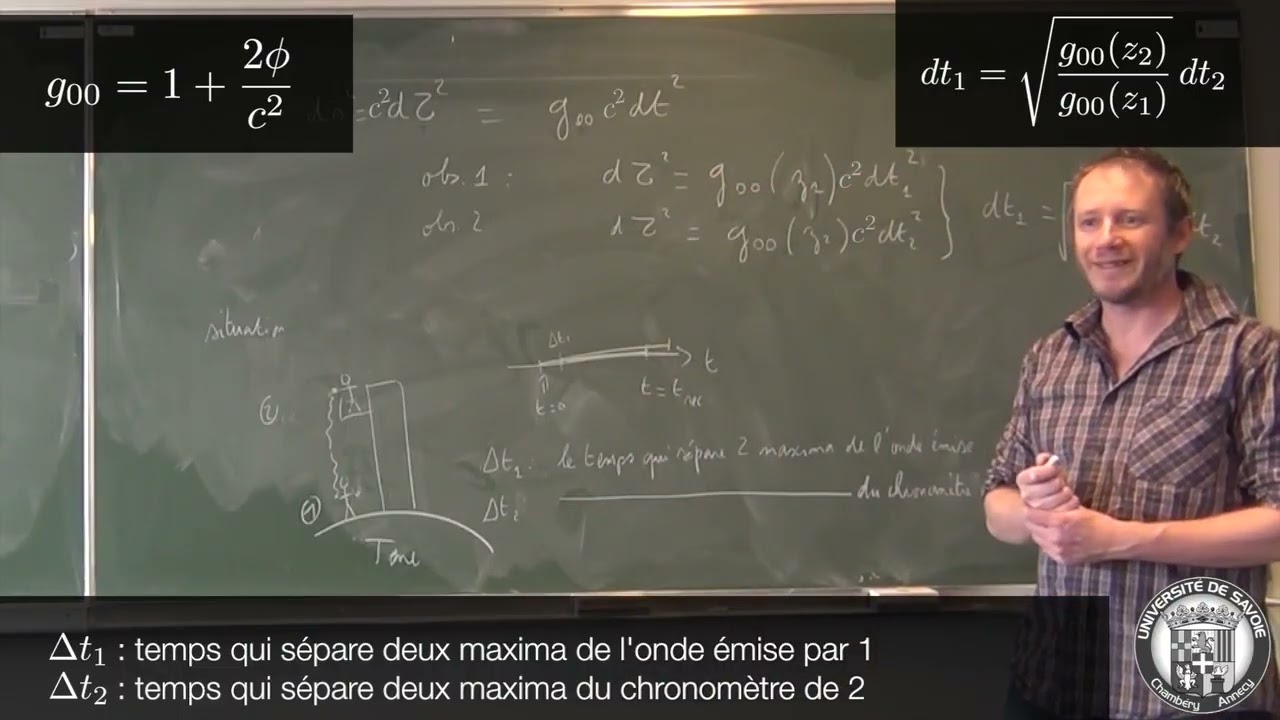
Relativité générale 5 cours Richard Taillet
Keywords
Summary
165 words
Critical Evaluation
The lecture provides a rigorous and clear derivation of the gravitational redshift, a key prediction of general relativity. The instructor builds the argument step by step, starting from the metric and proper time, and carefully explains the physical interpretation. The use of the equivalence principle to re-derive the result reinforces the conceptual foundation. The mathematical treatment is appropriate for an advanced undergraduate or graduate level, and the explanation is precise. However, the video lacks explicit references to sources or further reading, which would enhance its scholarly value. The mention of the Pound-Rebka experiment is brief and could be expanded with more details. The title accurately reflects the content, and the lecture is well-structured. Overall, the content is scientifically sound and pedagogically effective, though it may be challenging for beginners. The absence of visual aids or diagrams might make it harder to follow for some viewers, but the verbal explanations are thorough. The lecture does not address potential counterarguments or alternative interpretations, but this is not a significant weakness given its educational focus. The video is a valuable resource for students of general relativity.
183 words
Title / Content Match
The title accurately reflects the content: a lecture on general relativity, specifically the gravitational redshift.
Quality & Reliability
8/10
The video is a lecture by a physicist (Richard Taillet) explaining gravitational redshift with a clear derivation from the metric and equivalence principle. The reasoning is rigorous and mathematically sound, though it lacks explicit references to sources. The content is consistent with established physics.
Key Moments
Markers derived by PSI from the transcript: the creator did not define chapters.
- Introduction to the lecture and recap of the interval in special relativity.
- Definition of proper time and introduction of the metric for non-inertial frames.
- Setup of the thought experiment with two observers at different heights.
- Derivation of the relation between time intervals and the metric component g00.
- Conclusion that the higher observer measures a longer period, leading to a redshift.
- Quantitative expression for the redshift using weak-field approximation.
- Re-derivation using the equivalence principle with a freely falling elevator.
- Mention of the Pound-Rebka experiment as experimental evidence.
Contribution & Novelties
The lecture provides a clear and detailed derivation of the gravitational redshift, emphasizing the role of the metric and the equivalence principle. It offers a pedagogical approach that connects the mathematical formalism to physical intuition.
Pour aller plus loin :
- Gravitational redshift - Wikipedia — Overview and experimental confirmations.
- Equivalence principle - Wikipedia — Foundational concept used in the lecture.
- Pound–Rebka experiment - Wikipedia — Direct experimental verification of gravitational redshift.
71 words
Radar Profile
The radar profile shows high scores in quality of information, technical level, and reliability, with a slightly lower score in quantity of information due to the focused scope of the lecture. This indicates a dense, rigorous, and reliable educational content.