Relativité générale 14 cours Richard Taillet
Keywords
Summary
156 words
Critical Evaluation
The lecture provides a rigorous and detailed derivation of the geodesic equations in the Schwarzschild metric, which is essential for understanding the motion of particles and light in a gravitational field. The instructor, Richard Taillet, demonstrates a deep understanding of the subject and explains the mathematical steps clearly, making it suitable for advanced students or researchers. The content is scientifically accurate and aligns with standard textbooks on general relativity. However, the lecture is highly technical and assumes prior knowledge of tensor calculus and differential geometry, which may limit its accessibility to a broader audience. The lack of visual aids or diagrams might make it challenging for some learners to follow the spatial reasoning, but the verbal explanations are thorough. The title accurately reflects the content, and the lecture is well-structured, progressing from the general geodesic equation to specific applications. The main strength is the clarity of the derivations, which are often glossed over in other resources. The main weakness is the absence of concrete examples or numerical calculations, which could help illustrate the concepts. Overall, this is a high-quality lecture for those with a solid background in physics and mathematics.
190 words
Title / Content Match
The title accurately reflects the content: a lecture on general relativity, specifically the 14th session, taught by Richard Taillet (though the channel is Anthony Bichler).
Quality & Reliability
8/10
The lecture is based on standard general relativity formalism, with rigorous derivation of geodesic equations in Schwarzschild metric. The instructor demonstrates deep understanding and provides clear mathematical steps. No external sources are cited, but the content aligns with established physics.
Key Moments
Markers derived by PSI from the transcript: the creator did not define chapters.
- Introduction: The lecture will cover motion in Schwarzschild metric and tests of general relativity.
- Review of geodesic equation and affine parameter; discussion of massless particles.
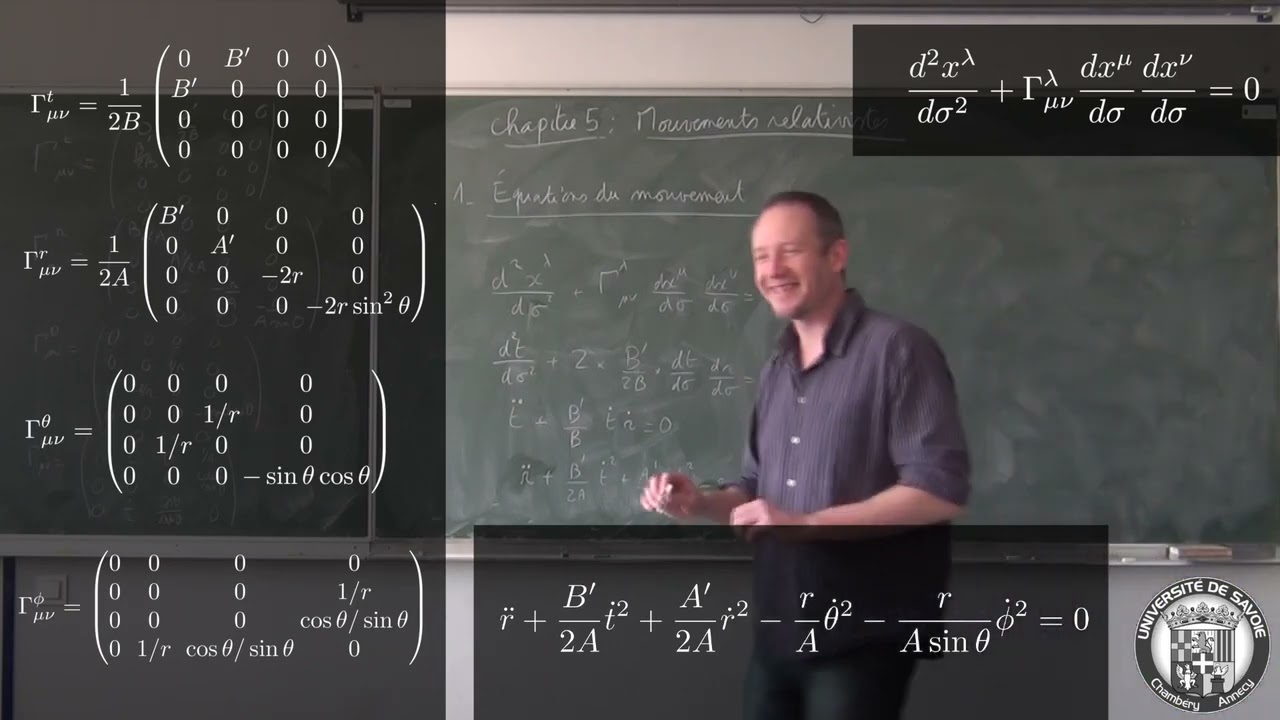
- Derivation of geodesic equations for t, r, θ, φ in Schwarzschild metric.
- Simplification using spherical symmetry; motion confined to a plane.
- Discussion of the affine parameter for photons and the null geodesic condition.
- Introduction to the classical tests: light deflection and time delay.
- Further elaboration on the equations and their physical interpretation.
- Preview of next session: black holes and extreme gravity.
Contribution & Novelties
The lecture provides a clear and detailed derivation of the geodesic equations in the Schwarzschild metric, which is a fundamental step in understanding the motion of particles and light in a gravitational field. It emphasizes the subtlety of using an affine parameter for massless particles, which is often overlooked. The lecture sets the stage for discussing classical tests of general relativity, such as the deflection of light and the Shapiro time delay.
Pour aller plus loin :
- Schwarzschild metric — Overview of the metric and its properties.
- Geodesics in general relativity — General concept of geodesics and affine parameters.
- Tests of general relativity — Summary of experimental verifications.
108 words
Radar Profile
The radar profile shows high scores in technical level and information quality, indicating a rigorous and detailed lecture. The quantity of information is also high, but the accessibility might be limited due to the advanced nature. Overall, the lecture is highly reliable and valuable for advanced learners.