Histoire de la cosmologie 6 cours Richard Taillet
Keywords
Summary
196 words
Critical Evaluation
The lecture provides a solid historical overview of a pivotal period in the development of cosmology. It effectively contextualizes the scientific revolution, emphasizing the shift from philosophical speculation to empirical, collaborative investigation. The discussion of the Cayenne expedition is particularly valuable, as it illustrates the practical motivations (navigation, longitude) and the scientific outcomes (measurement of solar parallax, discovery of gravity variation) that drove early modern astronomy. The speaker correctly identifies the significance of Richer’s pendulum observation and its role in supporting the notion of an oblate Earth, which was later confirmed by Newton’s theory. The comparison between Descartes and Newton is well-presented, highlighting Descartes’ mechanistic vortices and Newton’s universal gravitation, and how Newton’s approach, grounded in mathematics and empirical verification, ultimately prevailed. The lecture is scientifically accurate and well-structured, though it lacks explicit citations to primary sources, which would enhance its scholarly rigor. The speaker’s expertise is evident, and the content is accessible to an educated audience. The title accurately reflects the content, and the lecture fulfills its promise of exploring the history of cosmology during this transformative era. Overall, this is a high-quality educational resource that offers valuable insights into the history of science.
195 words
Title / Content Match
The title accurately reflects the content: a lecture on the history of cosmology, specifically the period from the mid-17th to early 18th century.
Quality & Reliability
8/10
The video is a lecture by a physics professor (Richard Taillet) on the history of cosmology, presenting well-established historical facts and scientific concepts. The content is accurate and based on scholarly knowledge, though it lacks explicit citations to primary sources.
Key Moments
Markers derived by PSI from the transcript: the creator did not define chapters.
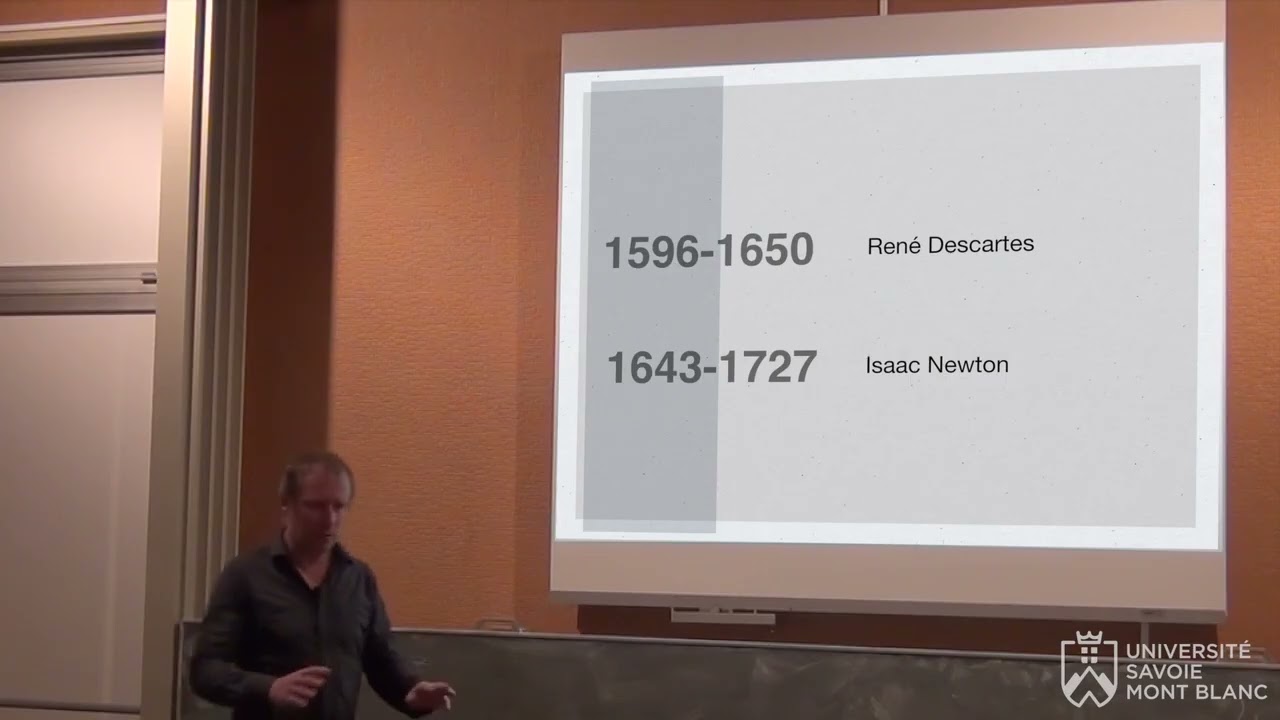
- Introduction: focus on the period from mid-17th to early 18th century, featuring Descartes and Newton.
- Discussion of the 1672 expedition to Cayenne: objectives include longitude determination, solar parallax, and pendulum experiments.
- Explanation of longitude problem and use of Jupiter's moons for timekeeping.
- Richer's observation: pendulum beats slower in Cayenne, indicating weaker gravity, leading to idea of oblate Earth.
- Mention of Royal Observatory Greenwich founded in 1675 for navigation and astronomy.
- Introduction of Descartes: his method and mechanistic philosophy, and his decision to avoid publishing Copernican ideas after Galileo's condemnation.
- Discussion of Descartes' vortices and his influence on later thinkers.
- Introduction of Newton: his laws of motion and universal gravitation, and his mathematical approach.
- Comparison of Descartes and Newton: Newton's synthesis and the triumph of his theory over Cartesian vortices.
- Conclusion: summary of the transformation of science during this period.
Cited Sources
- The Royal Observatory Greenwich — Recommended by the speaker for further reading on the history of the observatory and its role in navigation.
Concurring Sources
- The Scientific Revolution — General historical context supporting the period's transformation of science.
Contribution & Novelties
The lecture provides a clear narrative of the transition from Cartesian to Newtonian cosmology, emphasizing the role of empirical observations such as the Cayenne expedition. It connects practical needs (navigation) with theoretical advances (gravity, Earth’s shape).
Pour aller plus loin :
- Newton’s Principia — The foundational work of classical mechanics and gravitation.
- Jean Richer — The astronomer who led the Cayenne expedition and observed the pendulum anomaly.
- Oblate spheroid — The shape of the Earth as deduced from gravity variations.
80 words
Radar Profile
The radar profile shows high scores in information quantity, quality, and reliability, with a slightly lower technical level, indicating a well-balanced and accessible lecture suitable for a broad audience interested in the history of science.