Histoire des sciences 5
Keywords
Summary
157 words
Critical Evaluation
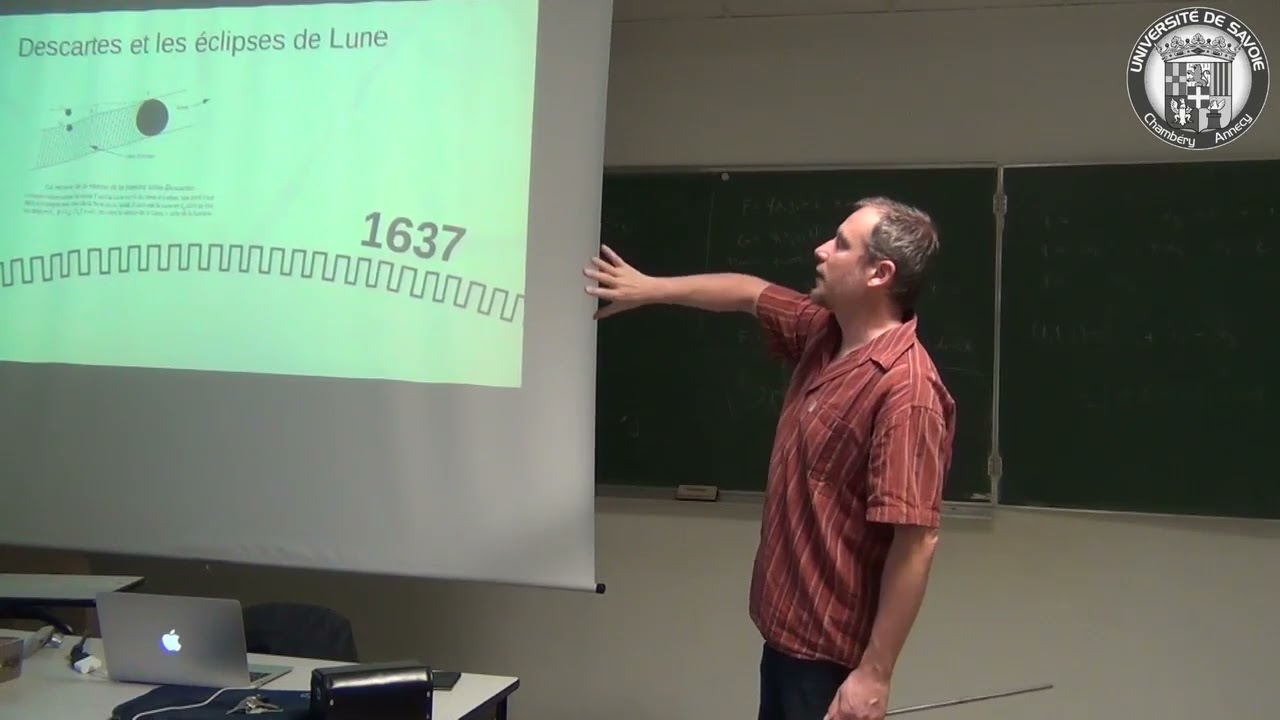
The video offers a valuable and accessible introduction to the historical development of the concept of the speed of light. Bichler’s presentation is well-structured, moving from Galileo’s experimental attempt to Descartes’ theoretical argument, and he effectively uses visual aids to explain the geometric reasoning behind Descartes’ eclipse argument. The content is scientifically accurate, correctly representing the historical figures’ methods and conclusions. However, the video lacks depth in discussing the broader scientific context, such as the contemporary understanding of light and the subsequent measurements by Rømer and others. The recommendation of Eisenstaedt’s book is helpful but not elaborated upon. The argumentation is sound, but the video could benefit from more critical analysis of the limitations of these early approaches. The sources cited are primarily historical texts, which are appropriate, but no modern references are provided to contextualize the historical narrative. The title is somewhat generic, but the content matches the expected theme. Overall, the video is a solid educational resource, though it could be enhanced with more detailed historical and scientific analysis.
171 words
Title / Content Match
The title is generic but appropriate, as the video is part of a series on the history of science, focusing on the speed of light.
Quality & Reliability
7/10
The video presents a historically accurate account of early attempts to measure the speed of light, citing primary sources (Galileo, Descartes) and a recommended book. The reasoning is sound and well-illustrated, though it lacks explicit references to modern sources or experimental details.
Key Moments
Markers derived by PSI from the transcript: the creator did not define chapters.
- Introduction to the topic of the speed of light and recommendation of the book 'Avant Einstein'.
- Discussion of Galileo's 1638 experiment with lanterns to measure the speed of light.
- Explanation of Galileo's conclusion that light is instantaneous due to the failure of the experiment.
- Introduction to Descartes' argument based on lunar eclipses.
- Detailed explanation of Descartes' reasoning and the apparent misalignment of Sun and Moon during eclipses.
- Descartes' numerical example and conclusion that light must be instantaneous.
- Summary and closing remarks.
Cited Sources
- Avant Einstein — Recommended book by Jean Eisenstaedt on the history of optics, particularly the speed of light.
- Discourse on the Two Chief World Systems — Galileo's work describing the lantern experiment.
Concurring Sources
- Galileo's experiment — Historical account of Galileo's attempt to measure the speed of light.
Contribution & Novelties
The video provides a clear and engaging historical account of early attempts to measure the speed of light, focusing on Galileo and Descartes. It effectively explains the reasoning behind their conclusions and the limitations of their methods. The use of diagrams and animations helps visualize the concepts.
Pour aller plus loin :
- Rømer’s determination of the speed of light — Relevant to the subsequent history of the speed of light.
- Speed of light — Provides a comprehensive overview of the topic.
- Jean Eisenstaedt — Background on the author of the recommended book.
92 words
Radar Profile
The radar profile shows a balanced distribution across the four dimensions, with slightly higher scores in quality and reliability, indicating a well-presented and accurate historical account, though with moderate technical depth.