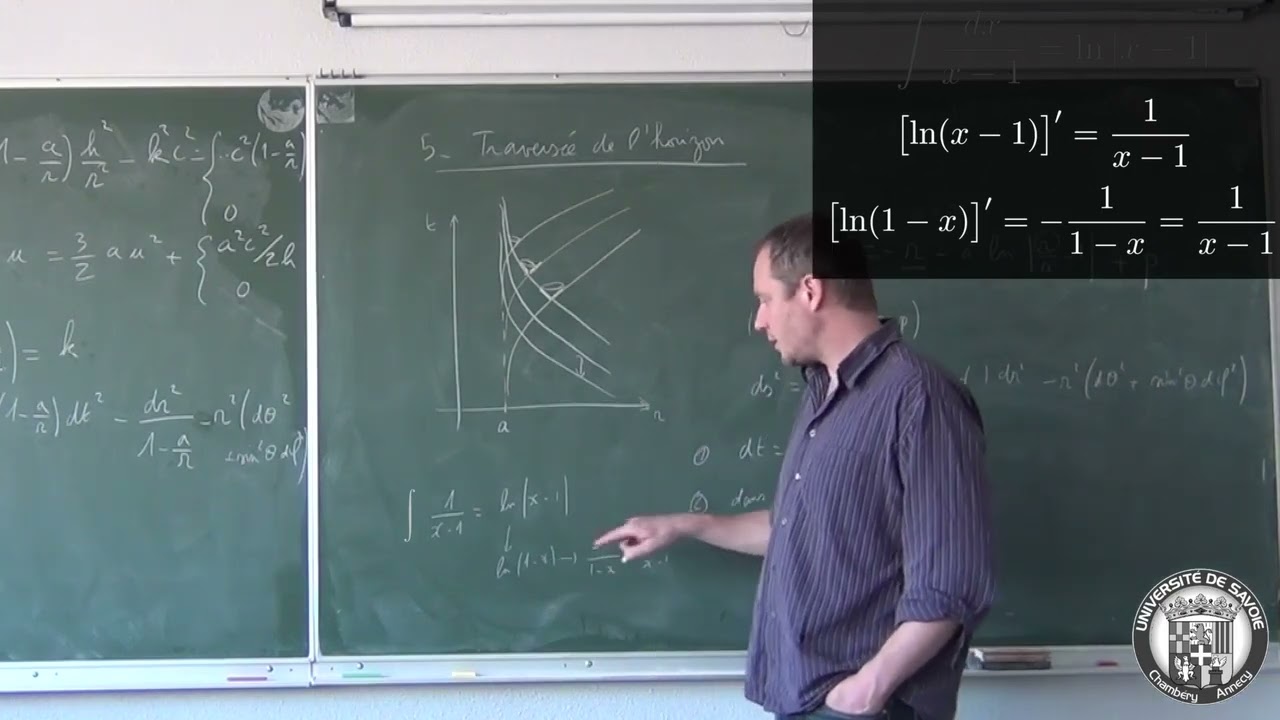
Relativité générale 19 cours Richard Taillet
Keywords
Summary
150 words
Critical Evaluation
The lecture provides a rigorous and detailed derivation of the Eddington-Finkelstein coordinates, a fundamental tool in general relativity for describing black holes. The instructor’s approach is methodical: he starts from the Schwarzschild metric, identifies the coordinate singularity at the horizon, and then introduces a new coordinate based on null geodesics. The mathematical steps are clearly explained, and he emphasizes the physical meaning of the coordinates, cautioning that they are not the same as proper time. The content is accurate and aligns with standard textbooks on general relativity. However, the lecture is technical and assumes prior knowledge of tensor calculus and the Schwarzschild solution. The instructor’s pace is steady, but the video is a raw recording without visual aids beyond the blackboard, which may limit accessibility. The sources are not explicitly cited, but the material is well-established. The title accurately reflects the content, and the lecture fulfills its educational purpose. Overall, this is a high-quality lecture for advanced students, though it may not be suitable for beginners.
166 words
Title / Content Match
The title accurately describes the content: a lecture on general relativity, specifically the 19th session, taught by Richard Taillet.
Quality & Reliability
7/10
The lecture is based on standard general relativity content, with a clear derivation of Eddington-Finkelstein coordinates. The instructor demonstrates the mathematical steps, but the video is a recording of a course, and the content is not peer-reviewed. The presentation is rigorous but relies on the instructor's expertise.
Key Moments
Markers derived by PSI from the transcript: the creator did not define chapters.
- Introduction and recap of light cones in Schwarzschild coordinates.
- Explanation of how light cones close near the horizon.
- Introduction of the new coordinate P and its relation to null geodesics.
- Derivation of the metric in the new coordinates, with simplification of terms.
- Analysis of radial light rays in the new coordinates, finding two solutions.
- Integration to find P as a function of R.
- Introduction of Eddington-Finkelstein coordinates by adding R to P.
- Discussion of the significance of the new coordinates and their physical interpretation.
Contribution & Novelties
This lecture provides a clear pedagogical derivation of the Eddington-Finkelstein coordinates, which are essential for understanding the causal structure of black holes. The instructor’s step-by-step approach helps students grasp the mathematical transformation and its physical implications.
Pour aller plus loin :
- Eddington–Finkelstein coordinates — Overview and definition.
- Schwarzschild metric — Background on the metric used.
- Black hole — General context on black holes.
63 words
Radar Profile
The radar profile shows high scores in quantity of information, technical level, and reliability, indicating a dense and rigorous lecture. The quality of information is also high, but the lack of visual aids and interactive elements may slightly reduce its accessibility.