Histoire des sciences 4
Keywords
Summary
173 words
Critical Evaluation
The video offers a thorough and engaging historical narrative, effectively combining primary source analysis with contextual explanation. The presenter demonstrates a strong command of the subject, weaving together the contributions of key figures such as Harriot, Snell, Descartes, and Rømer. The discussion of the law of refraction is particularly well-structured, clarifying the often-misunderstood priority dispute between Snell and Descartes. The presenter correctly notes that Descartes’ derivation was based on a mechanical analogy, which was later criticized, but he does not delve deeply into the scientific validity of Descartes’ argument. The section on the speed of light is similarly informative, tracing the progression from Galileo’s failed experiment to Rømer’s successful measurement using the eclipses of Jupiter’s moons. The presenter also touches on Bradley’s aberration of light, which provided further confirmation. However, the video lacks explicit citations or references to sources, which limits its utility for further research. The informal lecture style, with occasional asides and questions to the audience, may not appeal to all viewers, but it makes the content accessible. The title is somewhat generic, but it accurately reflects the content as part of a series. Overall, the video is a valuable resource for those interested in the history of physics, though it could benefit from more rigorous sourcing.
209 words
Title / Content Match
The title 'Histoire des sciences 4' is generic but accurately reflects the content as a continuation of a series on the history of science.
Quality & Reliability
7/10
The video provides a detailed historical account of the law of refraction and the speed of light, drawing on primary sources and historical context. The presenter demonstrates expertise in the history of science, though the lack of citations in the description and the informal presentation style limit the verifiability of some claims.
Key Moments
Markers derived by PSI from the transcript: the creator did not define chapters.
- Introduction to the lecture topics: law of refraction and speed of light.
- Discussion of Thomas Harriot and his secret discovery of the law of sines.
- Explanation of Snell's geometric formulation of the law of refraction.
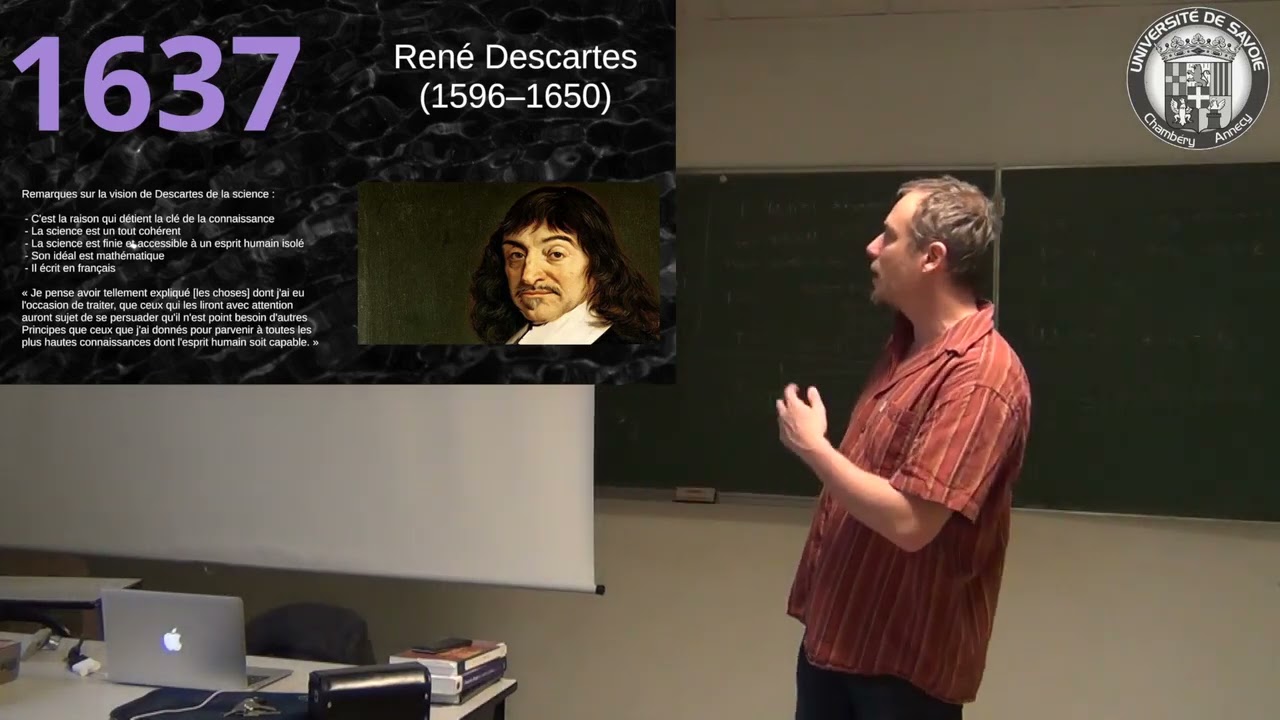
- Introduction to Descartes' approach to science and his derivation of the law.
- Reading of historical texts and discussion of Descartes' mechanical analogy.
- Transition to the speed of light topic.
- Galileo's attempt to measure the speed of light and its failure.
- Rømer's measurement using Jupiter's moons.
- Bradley's aberration of light and further confirmation.
- Discussion of the wave-particle debate and the role of Einstein's relativity.
Contribution & Novelties
The video provides a clear and accessible historical account of two fundamental topics in physics, emphasizing the process of scientific discovery and the importance of primary sources. It highlights the often-overlooked contributions of Thomas Harriot and the secretive nature of early scientific work.
Pour aller plus loin :
- Snell’s law — For a mathematical overview of the law of refraction.
- Ole Rømer — For more on the first measurement of the speed of light.
- Speed of light — For a comprehensive history and current understanding.
85 words
Radar Profile
The radar profile shows a balanced performance with high scores in information quantity and quality, moderate technical depth, and good overall reliability. The video excels in providing a rich historical narrative but could improve in technical rigor and source citation.