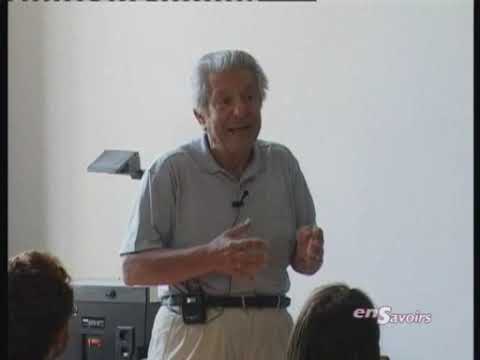
La physique au LHC la nouvelle frontière 1
Keywords
Summary
220 words
Critical Evaluation
The lecture provides a solid, accurate overview of particle physics as of 2009, suitable for a general audience with some scientific background. The speaker, a theoretical physicist, demonstrates deep knowledge and communicates complex ideas with clarity. The content is well-structured: it starts with fundamental concepts, progresses to the Standard Model, and concludes with the open questions that the LHC will address. The explanation of the four fundamental interactions and their mediators is particularly clear, using Yukawa’s potential as a historical anchor. The discussion of the three families of matter particles is accurate, and the speaker appropriately highlights the mystery of why there are three families. The lecture also correctly notes that quarks come in three colors, a quantum number with no relation to everyday color. The speaker is careful to distinguish between established facts and theoretical speculation, such as the existence of the graviton. The presentation is engaging, with occasional humor and personal anecdotes. However, the lecture lacks explicit citations to primary sources, which would enhance its scientific rigor. The speaker mentions the Particle Data Group but does not provide specific references. Additionally, the lecture is from 2009, so some details may be outdated, but the core physics remains relevant. The title accurately reflects the content, and the lecture fulfills its promise to provide an ‘état des lieux’ (state of the art). Overall, this is a high-quality educational resource that effectively conveys the excitement and challenges of particle physics at the LHC.
242 words
Title / Content Match
The title accurately reflects the content: a lecture on the physics expected at the LHC, starting with an overview of the current state of particle physics.
Quality & Reliability
8/10
The speaker is a theoretical physicist with a clear pedagogical approach. The content is accurate and up-to-date as of 2009, with appropriate caveats about the speculative nature of some topics. The presentation is well-structured and accessible, though it lacks explicit citations to primary sources.
Key Moments
Markers derived by PSI from the transcript: the creator did not define chapters.
- Introduction to the lecture series and overview of the program.
- Discussion on the definition of elementary particles and the Particle Data Group table.
- Explanation of the four fundamental interactions and their mediators.
- Yukawa's idea of force mediation and the evolution to gauge theories.
- Introduction to the Standard Model particle content: leptons and quarks.
- Explanation of the three families of matter particles and the mystery of their existence.
- Discussion on quark colors and the strong force.
- Preview of upcoming lectures on the LHC machine and detectors.
- Open questions in particle physics that the LHC will address.
Cited Sources
- Particle Data Group — Mentioned as the source of the table of elementary particles.
Concurring Sources
- CERN LHC page — Official CERN page about the LHC, confirming the machine's purpose and capabilities.
Contribution & Novelties
This lecture provides a clear and accessible introduction to the physics at the LHC, emphasizing the current understanding of particle physics and the open questions. It is particularly valuable for its pedagogical approach, explaining complex concepts like gauge theories and the three families of matter in an intuitive manner. The lecture also highlights the historical development of ideas, such as Yukawa’s potential, which helps contextualize modern theories.
Pour aller plus loin :
- Standard Model on Wikipedia — A comprehensive overview of the Standard Model of particle physics.
- Large Hadron Collider on Wikipedia — Detailed information about the LHC machine and its experiments.
- Particle Data Group — The authoritative source for particle physics data and the table of elementary particles.
119 words
Radar Profile
The radar profile shows high scores in quantity and quality of information, with a moderate technical level. This indicates a well-balanced lecture that is both informative and accessible, suitable for a general audience interested in particle physics.