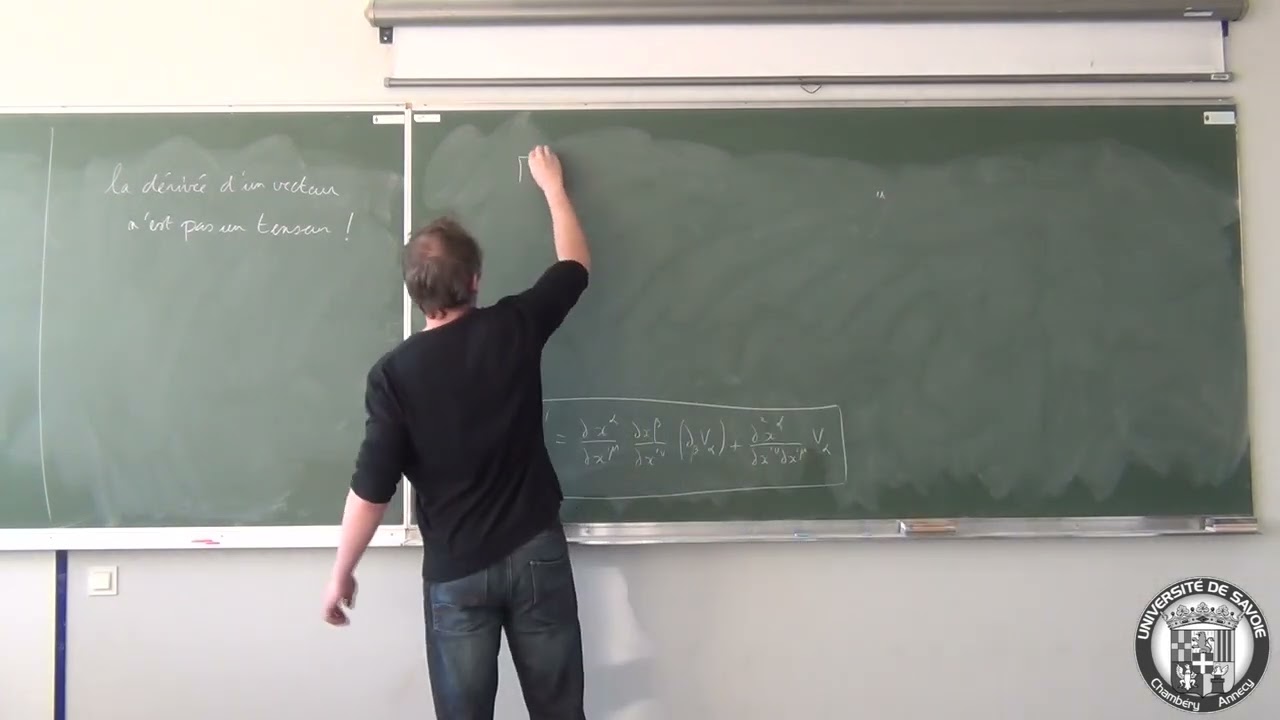
Relativité générale 8 cours Richard Taillet
Keywords
Summary
173 words
Critical Evaluation
The lecture provides a rigorous and clear exposition of the covariant derivative, a fundamental concept in general relativity. The instructor systematically derives the transformation properties of the partial derivative of a vector, showing why it fails to be a tensor, and then introduces the connection coefficients to construct a tensorial derivative. The argument is mathematically sound and follows standard treatments found in textbooks such as Wald’s ‘General Relativity’ or Carroll’s ‘Spacetime and Geometry’. The use of the equivalence principle to motivate the replacement of partial derivatives with covariant derivatives is pedagogically effective. However, the lecture is highly technical and may be challenging for viewers without a strong background in tensor calculus. The instructor does not provide references to external sources, but the content is consistent with established physics. The video is a single lecture, so it lacks the depth of a comprehensive course, but it covers the topic thoroughly. The presentation is clear, with step-by-step derivations, though the handwriting and notation could be improved for readability. Overall, the lecture is a valuable resource for students of general relativity, offering a solid foundation for understanding the covariant derivative and its role in formulating physical laws.
194 words
Title / Content Match
The title accurately reflects the content: it is the eighth lecture in a series on general relativity, taught by Richard Taillet.
Quality & Reliability
8/10
The video is a formal lecture on general relativity, based on the work of Richard Taillet. The content is mathematically rigorous and follows standard derivations. The instructor demonstrates a clear understanding of the subject. However, the video lacks citations to external sources, and the presentation is a single lecture without peer review. The mathematical derivations are correct and align with established physics.
Key Moments
Markers derived by PSI from the transcript: the creator did not define chapters.
- Introduction: review of tensors and motivation for covariant derivatives.
- Derivation showing that the partial derivative of a vector does not transform as a tensor.
- Introduction of the affine connection and its non-tensorial transformation.
- Combining partial derivative and connection to form the covariant derivative, which is a tensor.
- Definition of the covariant derivative and notation with semicolon.
- Discussion of the covariant derivative in inertial frames and its equivalence to partial derivatives.
- Application of the equivalence principle to replace partial derivatives with covariant derivatives in physical laws.
Concurring Sources
- Spacetime and Geometry: An Introduction to General Relativity — Standard textbook treatment of covariant derivatives in general relativity.
Contribution & Novelties
The lecture provides a clear and rigorous introduction to the covariant derivative, a key concept in general relativity. It explains why the partial derivative of a vector is not a tensor and how the covariant derivative remedies this by incorporating the connection. The presentation is didactic and builds on previous lectures on tensors.
Pour aller plus loin :
- Covariant derivative - Wikipedia — Provides a general overview and applications in differential geometry.
- Christoffel symbols - Wikipedia — Details the connection coefficients used in the covariant derivative.
- General relativity - Wikipedia — Contextualizes the covariant derivative within the broader theory.
99 words
Radar Profile
The radar profile shows high scores in technical level and information quality, indicating a mathematically rigorous and accurate presentation. The quantity of information is moderate, as the lecture focuses on a single concept. The overall reliability is high, consistent with the formal nature of the content.