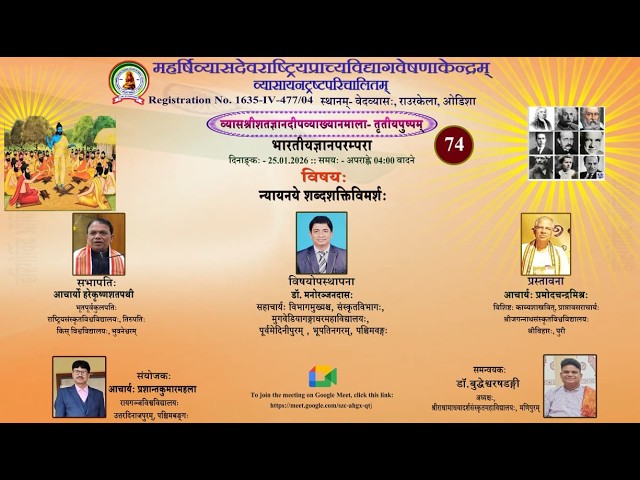
न्यायनये शब्दशक्तिविमर्शः lecture Delivered by Dr. Manoranjan Das, Mugberiya Gangadhar College.
Keywords
Summary
146 words
Critical Evaluation
Value of the Information & Strength of the Argument
The lecture provides a detailed and structured exposition of the Nyaya theory of verbal testimony, drawing on classical sources like the Tarka-sangraha and the Nyaya-sutras. The argumentation is logical and follows the traditional scholastic method, presenting definitions, classifications, and counterarguments. However, the value is limited to a descriptive account; there is no critical analysis or engagement with modern linguistic theories. The speaker’s reliance on traditional authorities without questioning their assumptions may reduce the scientific rigor.
Scientific Rigor, Source Quality, Title Accuracy
The lecture is based on classical Sanskrit texts, and the speaker references several works, including the Mahabhashya, Tarka-sangraha, and Nyaya-muktavali. The sources are appropriate for the topic, but they are not cited with specific editions or page numbers, making verification difficult. The title accurately reflects the content, and the lecture adheres to the traditional format of a scholarly discourse. No comments were provided, so public reception cannot be assessed.
159 words
Title / Content Match
The title accurately reflects the content, which is a lecture on the power of words in Nyaya philosophy.
Quality & Reliability
6/10
The lecture is a scholarly exposition of the Nyaya concept of verbal testimony (shabda pramana) and the power of words (shakti). It draws on classical Sanskrit sources and presents a coherent argument, but lacks critical engagement and empirical verification. The speaker is a professor of Sanskrit, indicating expertise, but the content is primarily exegetical and not subject to scientific scrutiny.
Key Moments
Markers derived by PSI from the transcript: the creator did not define chapters.
Cited Sources
- भारतीयज्ञानरम्परायां संस्कृतरूपकाणां योगदानम् — Related lecture in the series
- रतीयज्ञानपरम्परा— लक्ष्यम्, उद्देश्यम्... — Related lecture in the series
- शाक्ताद्वैतमतपरिचयः — Related lecture in the series
- वेदेषु विष्णुतत्त्वम् — Related lecture in the series
- मुद्रारक्षसे भारतीयज्ञानपरम्परा — Related lecture in the series
- शिवसंकल्पसूक्तस्य वैज्ञानिकता — Related lecture in the series
- रतीयज्ञानपरम्परायां चतुःषष्टिकलासु आलेख्यम् — Related lecture in the series
- श्रीराधातत्त्वविमर्शः — Related lecture in the series
Concurring Sources
- Nyaya Sutras — Foundational text of Nyaya philosophy.
Contribution & Novelties
The lecture offers a comprehensive overview of the Nyaya theory of verbal power, synthesizing classical sources and presenting a clear exposition. While it does not introduce new ideas, it serves as a valuable educational resource for students of Indian philosophy. The discussion of the three powers of words and the conditions for verbal understanding is particularly instructive.
Pour aller plus loin :
83 words
Radar Profile
The radar profile shows a balanced but moderate performance across all dimensions, with technical level slightly higher, indicating a lecture that is informative but not groundbreaking.