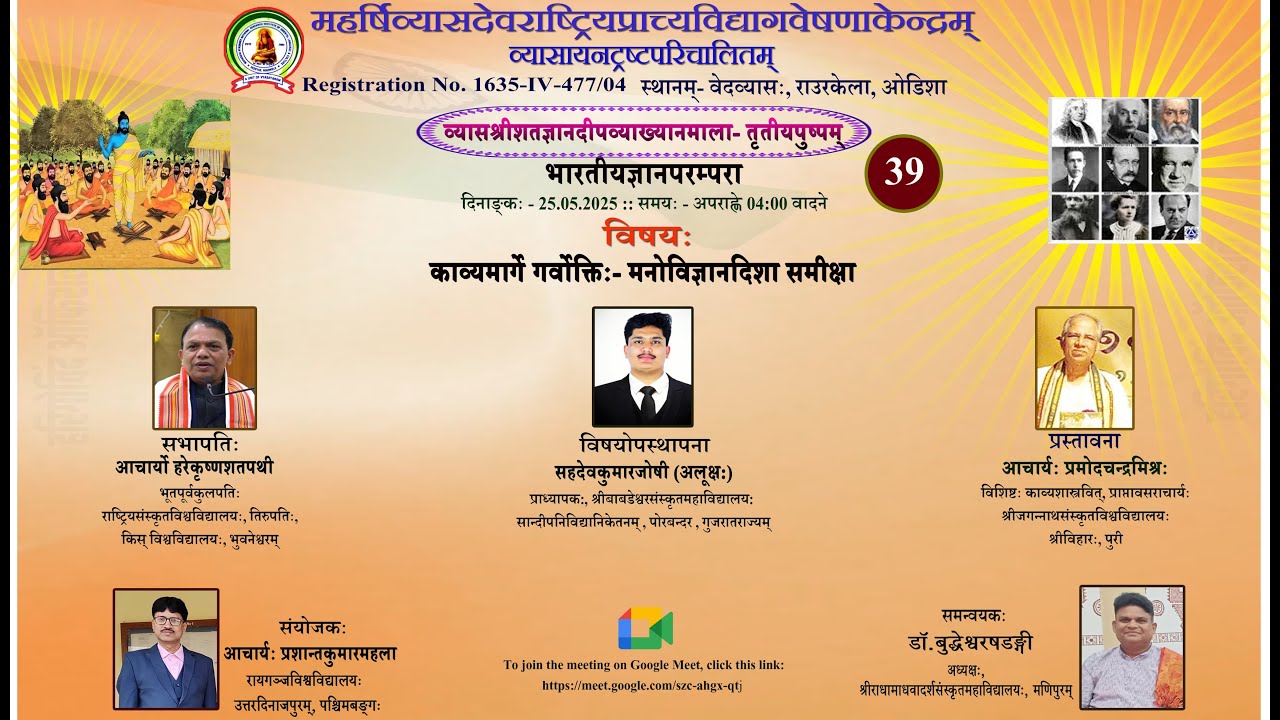
काव्यमार्गे गर्वोक्तिः-मनोविज्ञानदिशा समीक्षा
Keywords
Summary
166 words
Critical Evaluation
Value of the Information & Strength of the Argument
The lecture provides a traditional exposition of ‘garvokti’ in Sanskrit poetics, drawing on classical examples. The argumentation is based on the speaker’s expertise and traditional knowledge, but it lacks critical analysis or engagement with modern psychological theories. The value lies in the compilation of examples and the emphasis on the psychological aspect, which is a novel angle. However, the argumentation is not systematic and often relies on anecdotal references.
Scientific Rigor, Source Quality, Title Accuracy
The lecture demonstrates the speaker’s familiarity with Sanskrit literature, but it does not cite specific sources or provide verifiable references. The title accurately reflects the content. The description includes links to other lectures in the series, but these are not directly cited in the talk. The overall scientific rigor is moderate, as the content is more traditional than critical.
143 words
Title / Content Match
The title accurately reflects the content, which discusses the concept of 'garvokti' (proud speech) in Sanskrit poetry from a psychological perspective.
Quality & Reliability
6/10
The lecture is an expert discourse on Sanskrit poetics, but the transcription is incomplete and lacks citations. The speaker's authority is established, but the content is largely traditional and not critically evaluated.
Key Moments
Markers derived by PSI from the transcript: the creator did not define chapters.
- Opening invocations and welcome address
- Introduction to the topic and speaker
- Discussion on the concept of 'garvokti' in Sanskrit poetry
- Examples from Kalidasa and other poets
- Psychological perspective on poetic expression
- Discussion on the reader's response and aesthetic experience
- Further examples and analysis
- Q&A session and concluding remarks
Cited Sources
- Lecture on Agamashastra — Referenced in the description as part of the lecture series
- Lecture on Shabdabodha — Referenced in the description as part of the lecture series
- Lecture on Vishnu Tattva — Referenced in the description as part of the lecture series
- Lecture on Mudrarakshasa — Referenced in the description as part of the lecture series
- Lecture on Apratiratha Sukta — Referenced in the description as part of the lecture series
- Lecture on Purusha Sukta — Referenced in the description as part of the lecture series
- Lecture on Shiv Sankalpa Sukta — Referenced in the description as part of the lecture series
- Lecture on Chaturshashti Kala — Referenced in the description as part of the lecture series
- Lecture on Radha Tattva — Referenced in the description as part of the lecture series
Contribution & Novelties
The lecture offers a traditional perspective on ‘garvokti’ in Sanskrit poetry, highlighting its psychological dimensions. It compiles numerous examples from classical literature, which may be useful for students of Sanskrit aesthetics. However, the approach is not novel and lacks engagement with modern psychological theories.
Pour aller plus loin :
- Rasa theory — Foundational concept in Indian aesthetics.
- Dhvani theory — Related to suggestion in poetry.
- Abhinavagupta — Key philosopher of aesthetics.
71 words
Radar Profile
The radar profile shows moderate scores across all dimensions, indicating a balanced but not exceptional lecture. The highest score is in 'quantite_information' and 'fiabilite_globale', reflecting the speaker's expertise, while 'niveau_technique' is lower due to the lack of technical depth.