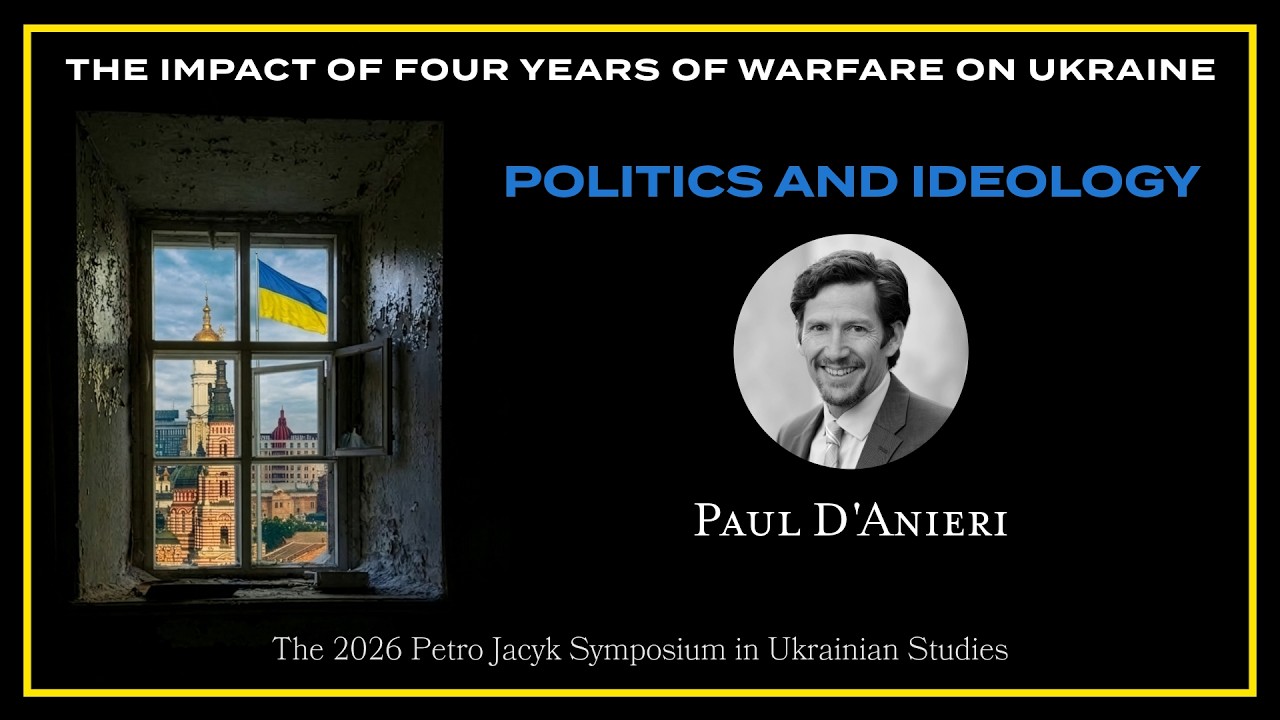
Paul D'Anieri — Politics and Ideology
Keywords
Summary
130 words
Critical Evaluation
Value of the Information & Strength of the Argument
The presentation offers valuable insights into the evolving political dynamics in Ukraine during wartime. D’Anieri’s argumentation is well-structured, drawing on his expertise and observable trends. He effectively highlights the paradox of Putin’s war creating a stronger Ukrainian state and identity. His analysis of the submerged politics, the potential for a diaspora vote, and the shifting cleavages is thought-provoking. While he acknowledges uncertainty, his reasoning is grounded in political science concepts and empirical observations, making the argumentation solid.
86 words
Title / Content Match
The title accurately reflects the content, which focuses on political and ideological changes in Ukraine during the war.
Quality & Reliability
8/10
The presentation is based on the author's expertise as a political scientist specializing in Ukraine-Russia relations. It offers a nuanced analysis of political dynamics, drawing on observable trends and public opinion data. While it includes speculative elements about the future, these are clearly framed as questions rather than definitive predictions. The discussant's remarks and the academic setting add credibility.
Key Moments
Markers derived by PSI from the transcript: the creator did not define chapters.
- Opening remarks by Terry Martin and Andrea Graziosi
- Andrea Graziosi introduces the symposium and the impact of war on Ukraine
- Paul D'Anieri begins his presentation on politics and ideology
- Discussion of elections and the suspension of democratic processes
- Analysis of the collapse of pro-Russian sentiment and regional cleavages
- Exploration of new political cleavages and the role of ideology
- Discussion of decentralization and local government capacity
- Consideration of corruption and its impact on post-war reconstruction
- Economic challenges and opportunities for post-war Ukraine
Cited Sources
- Charles Tilly, 'War Making and State Making as Organized Crime' — Referenced as a theoretical framework for understanding state formation through war.
- IMF (International Monetary Fund) — Mentioned as an external actor influencing anti-corruption efforts in Ukraine.
- NABU (National Anti-Corruption Bureau of Ukraine) — Referenced in the context of anti-corruption reforms and external pressure.
- SAPO (Specialized Anti-Corruption Prosecutor's Office) — Mentioned alongside NABU in the discussion of anti-corruption institutions.
Concurring Sources
- Public opinion polls on Ukrainian attitudes towards territorial concessions — D'Anieri references polling data showing a gradual increase in support for concessions, which aligns with his observations.
Contribution & Novelties
This presentation provides a timely and expert analysis of the political transformations in Ukraine during the war. It offers a nuanced perspective on the suspension of elections, the consolidation of executive power, and the potential for new political cleavages. The discussion of the diaspora vote and the impact of migration on the electorate is particularly novel. The emphasis on decentralization and local government capacity as a lasting change adds to the understanding of Ukraine’s political evolution.
Pour aller plus loin :
- Charles Tilly - War Making and State Making as Organized Crime — Foundational text on the relationship between war and state formation.
- Ukraine’s Decentralization Reform — Overview of the decentralization process that began in 2014.
- NABU (National Anti-Corruption Bureau of Ukraine) — Information on Ukraine’s key anti-corruption body.
129 words
Radar Profile
The radar profile shows high scores in information quantity, quality, and reliability, with a slightly lower score in technical level, reflecting the accessible yet expert nature of the presentation. The overall balance indicates a well-rounded and credible analysis.
💬 No comments were provided for analysis.