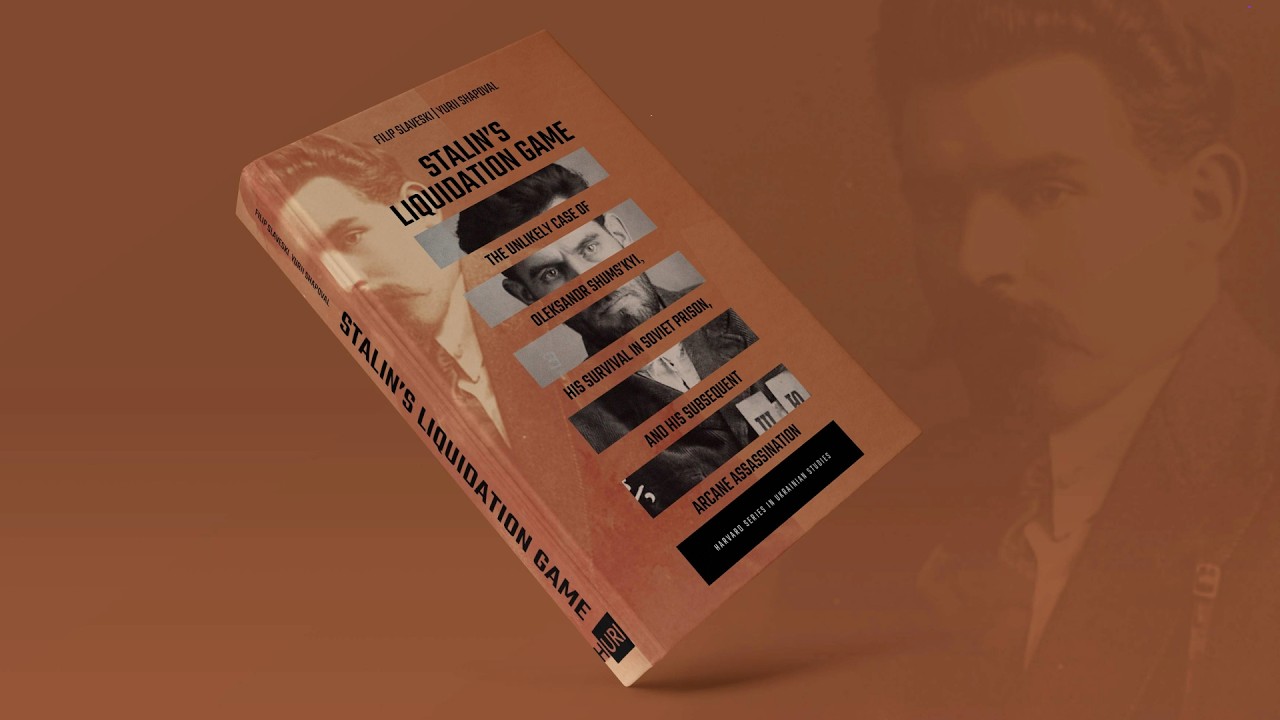
Stalin's Liquidation Game
Keywords
Summary
145 words
Critical Evaluation
Value of the Information & Strength of the Argument
The talk provides valuable insights into Soviet repression mechanisms, using Shums’kyi’s case as a lens to understand broader patterns. Slaveski argues that Shums’kyi’s refusal to confess and his survival challenge conventional narratives about the Terror. The argumentation is solid, grounded in archival evidence and historical analysis. The connection to contemporary Ukraine adds relevance, though some may find the parallels somewhat speculative. The discussion with Michelle Viise enriches the analysis, offering perspectives on the state’s need for confession and the role of sincerity.
Scientific Rigor, Source Quality, Title Accuracy
The talk is based on a scholarly book, and Slaveski references specific archival documents, such as NKVD correspondence, which adds credibility. The sources are not explicitly cited in the talk, but the book itself is a reliable academic publication. The title accurately reflects the content, focusing on the ’liquidation game’ of Stalin’s regime. The talk maintains a high level of historical rigor, though it is a book talk rather than a formal academic lecture. No comments are provided, so no analysis of public reception is possible.
183 words
Title / Content Match
The title accurately reflects the content, focusing on Stalin's repressive policies and the specific case of Oleksandr Shums'kyi, framed as a 'liquidation game'.
Quality & Reliability
8/10
The talk is based on a scholarly book by historians Filip Slaveski and Yurii Shapoval, drawing on archival documents from the NKVD and other sources. The authors are established academics, and the discussion is moderated by a Harvard editor. The content is well-researched and presented with scholarly rigor, though it is a book talk rather than a peer-reviewed presentation.
Key Moments
Markers derived by PSI from the transcript: the creator did not define chapters.
- Introduction by Oleh Kotsyuba, setting the context of Stalin's repressions and introducing Shums'kyi.
- Slaveski reads Shums'kyi's suicide letter to Stalin, highlighting his protest against Russification.
- Discussion of Shums'kyi's role in Ukrainization and his opposition to Malorossiya.
- Slaveski explains the NKVD's stalling of Shums'kyi's case and the significance of archival documents.
- Comparison of Soviet interrogation practices with contemporary Russian occupation tactics in Ukraine.
- Michelle Viise comments on the uniqueness of Shums'kyi's case and the state's need for confession.
- Discussion of Shums'kyi's sincerity and his belief in the Soviet project.
- Slaveski responds to Viise, discussing the broader implications for understanding Soviet repression.
Cited Sources
- Event Page: Stalin's Liquidation Game Book Talk — Official event page for the book talk, providing details about the book and authors.
Concurring Sources
- Remaking Ukraine after World War II: The Clash of Local and Central Soviet Power — Previous work by Filip Slaveski, providing background on Soviet policies in Ukraine.
Contribution & Novelties
The talk offers a fresh perspective on Soviet repression by focusing on a unique case of resistance and survival. It brings to light previously unpublished archival documents, providing new insights into the mechanics of the NKVD and the Terror. The connection between historical patterns and contemporary Russian aggression is a novel contribution to public discourse.
Pour aller plus loin :
- Oleksandr Shumskyi — Overview of Shumskyi’s life and political career.
- Great Purge — Context on Stalin’s mass repression campaign.
- Ukrainization — Policy of promoting Ukrainian language and culture in the Soviet Union.
92 words
Radar Profile
The radar profile shows high scores in information quality and reliability, reflecting the scholarly nature of the talk. The technical level is moderate, accessible to a general audience. The overall balance indicates a well-researched and credible presentation.