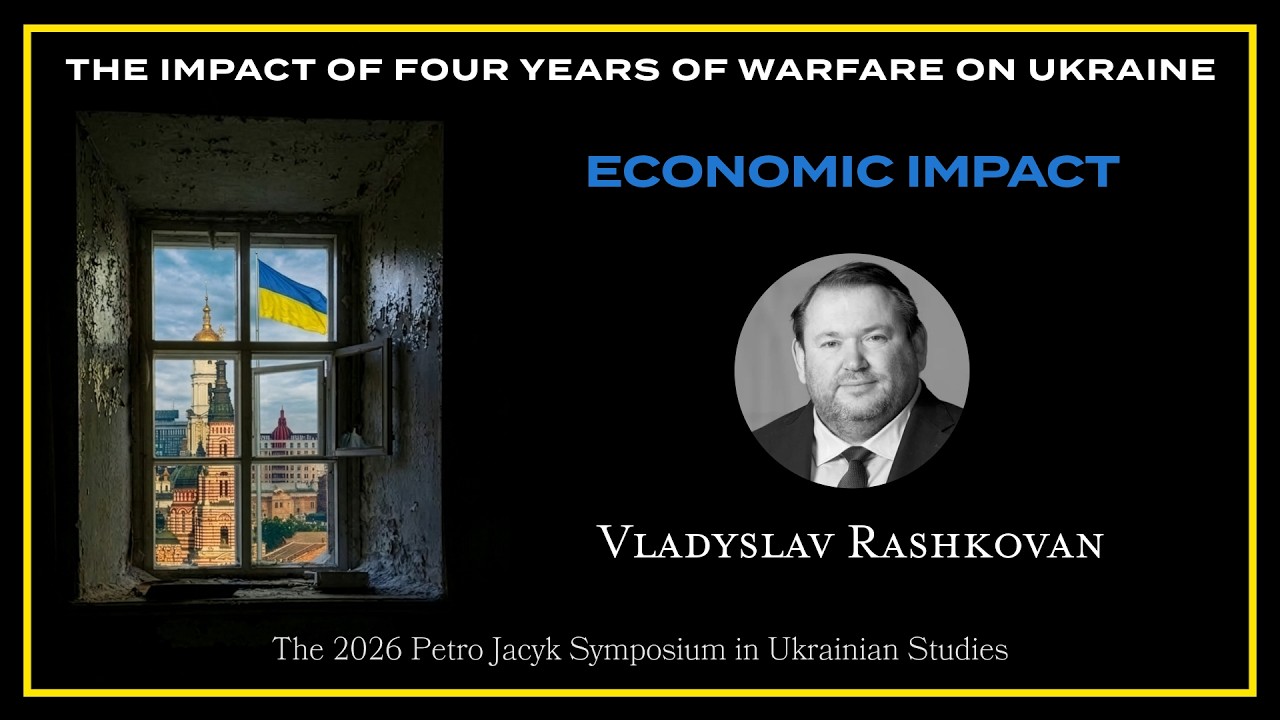
Vladyslav Rashkovan — Economic Impact
Keywords
Summary
166 words
Critical Evaluation
Value of the Information & Strength of the Argument
The presentation offers valuable insights from an insider perspective, combining macro-level data with practical observations. Rashkovan’s argumentation is solid, supported by specific figures and references to official reports. He effectively demonstrates the multidimensional nature of the war’s economic impact, from direct damages to structural shifts in the economy. The discussion of the banking sector’s resilience and the challenges of labor shortage adds depth. However, some points could benefit from more detailed explanation, and the presentation is somewhat dense, potentially overwhelming for a non-specialist audience.
Scientific Rigor, Source Quality, Title Accuracy
The presentation demonstrates strong scientific rigor, relying on data from reputable sources such as the World Bank, IMF, and Ministry of Finance. Rashkovan references specific reports and provides concrete numbers, enhancing credibility. The title accurately reflects the content, which is focused on economic impact. The discussant’s questions and the speaker’s responses add to the depth, though the format limits the depth of analysis. Overall, the sources are appropriate and well-integrated.
169 words
Title / Content Match
The title accurately reflects the content, which focuses on the economic impact of the war on Ukraine.
Quality & Reliability
8/10
Presentation by a senior IMF economist with direct involvement in Ukraine's macroeconomic policy, drawing on official data from the World Bank, IMF, and Ministry of Finance. The analysis is data-driven and balanced, though it reflects the author's institutional perspective.
Key Moments
Markers derived by PSI from the transcript: the creator did not define chapters.
- Introduction by Mark Kramer and start of presentation
- Overview of war damages: displacement, poverty, and $195 billion in direct infrastructure damage
- Analysis of GDP decline and comparison with 2014 war
- Impact on industries: metallurgy, defense sector, and grain exports
- Trade deficit, energy imports, and labor shortage as key obstacles
- Banking sector resilience, inflation management, and international aid figures
- Concluding remarks on reconstruction and future scenarios
Cited Sources
- World Bank Rapid Damage Assessment (5th edition) — Cited for direct damage figures of $195 billion
- IMF program documents — Referenced for financial support and program details
- Ministry of Finance of Ukraine — Cited for international aid figures of $174 billion
- OECD report on reconstruction architecture — Mentioned in the context of reconstruction planning
Concurring Sources
- World Bank Rapid Damage Assessment — Provides official damage figures consistent with the presentation
- IMF Article IV Consultation reports — Support the analysis of macroeconomic trends and policies
Dissenting Sources
- Alternative estimates of war damage — Some independent analyses may estimate higher or lower damage figures, but the presentation relies on official data.
Contribution & Novelties
This presentation provides a unique insider perspective on Ukraine’s wartime economy, combining macro-level data with practical insights from an IMF economist. It highlights the structural shifts in the economy, such as the rise of the defense sector and the challenges of labor shortage, which are often overlooked. The discussion of the banking sector’s resilience and the role of international aid adds depth. The presentation also touches on reconstruction planning, emphasizing the need for institutional frameworks.
Pour aller plus loin :
- World Bank Ukraine Overview — Provides context on Ukraine’s economic situation and World Bank support.
- IMF Ukraine Country Page — Details on IMF programs and financial assistance to Ukraine.
- OECD Ukraine Reconstruction — Reports and analysis on reconstruction efforts.
119 words
Radar Profile
The radar profile shows high scores in information quantity, quality, and reliability, with a slightly lower technical level, reflecting the presentation's accessibility. The overall balance indicates a well-rounded, data-rich analysis suitable for an informed audience.