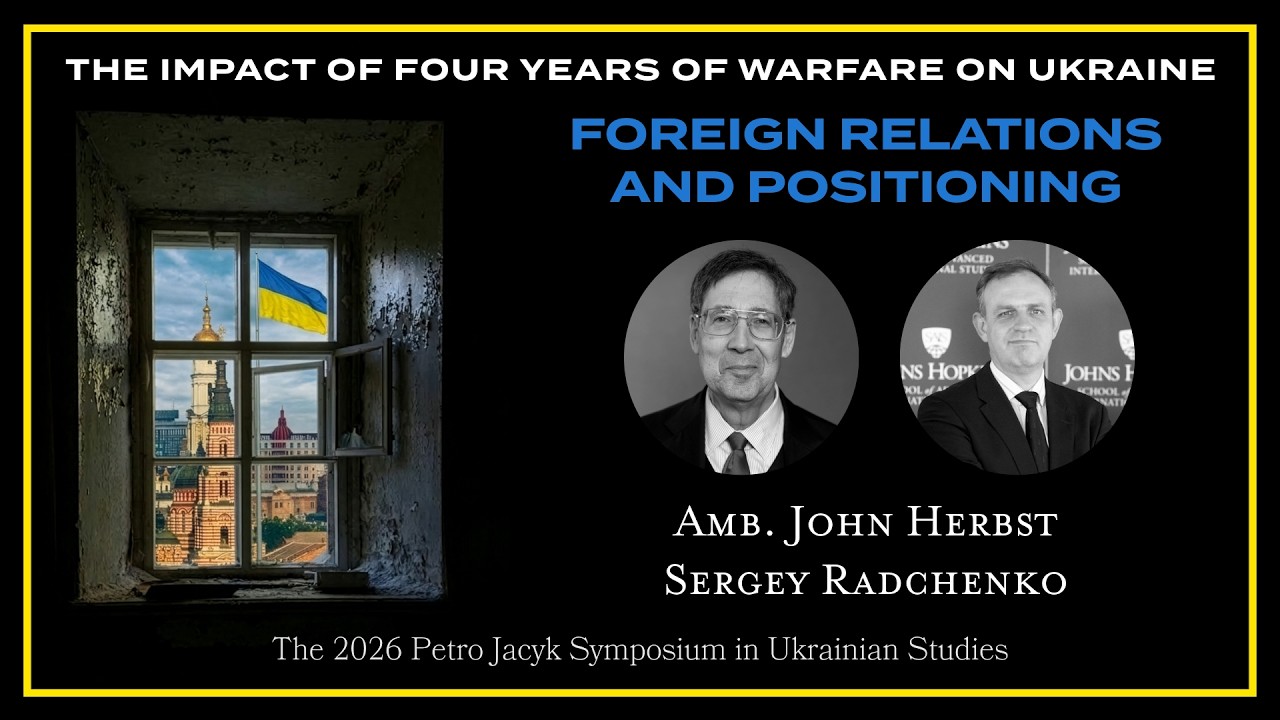
Ambassador John Herbst and Sergey Radchenko — Foreign Relations and Positioning
Keywords
Summary
167 words
Critical Evaluation
Value of the Information & Strength of the Argument
The value of the information is high due to the speakers’ expertise and insider perspectives. Ambassador Herbst provides a nuanced assessment of US policy and Zelensky’s diplomatic tactics, offering a unique insider view. Professor Radchenko provides a structured scenario analysis, grounding his arguments in historical context. The argumentation is solid, with clear reasoning and evidence from recent events, though some claims are speculative. The discussion is well-reasoned and balanced, acknowledging uncertainties.
Scientific Rigor, Source Quality, Title Accuracy
The scientific rigor is moderate. The speakers rely on their professional experience and knowledge, but do not cite specific sources or data. The quality of sources is high given their credentials, but the lack of verifiable references limits the ability to fact-check. The title accurately reflects the content, and the discussion is well-structured and relevant.
141 words
Title / Content Match
The title accurately reflects the content: a panel discussion on Ukraine's foreign relations and positioning, featuring Ambassador Herbst and Professor Radchenko.
Quality & Reliability
7/10
The speakers are highly credentialed experts (former ambassador, academic historian) providing informed analysis. However, the content is largely opinion and interpretation, with limited verifiable data or citations. The discussion is forward-looking and speculative, reducing its factual reliability.
Key Moments
Markers derived by PSI from the transcript: the creator did not define chapters.
- Introduction and biographies of Ambassador Herbst and Professor Radchenko.
- Ambassador Herbst begins his presentation on Ukraine's foreign policy.
- Herbst discusses US-Ukraine relations under Biden and Trump.
- Herbst analyzes Zelensky's diplomatic strategy and recent 'swagger'.
- Herbst concludes with remarks on Israel's impact on Ukraine.
- Professor Radchenko begins his presentation on three scenarios.
- Radchenko discusses the stalemate scenario and ceasefire possibilities.
- Moderator comments and questions, discussion on security guarantees.
Cited Sources
- Atlantic Council's Eurasia Center — Ambassador Herbst is the Senior Director of the Atlantic Council's Eurasia Center.
- Johns Hopkins University — Professor Radchenko is a professor at Johns Hopkins University.
- Harvard Ukrainian Research Institute — The symposium is organized by HURI.
Concurring Sources
- Atlantic Council — Herbst's institutional affiliation, providing credibility to his analysis.
- Johns Hopkins University — Radchenko's academic affiliation, supporting his expertise.
Contribution & Novelties
The video provides a unique expert perspective on Ukraine’s foreign policy challenges and opportunities, offering a nuanced analysis of US and European roles. It contributes to the discourse by presenting three distinct scenarios for the war’s outcome and their implications for Ukraine’s international positioning.
Pour aller plus loin :
- Ukraine–NATO relations — Overview of Ukraine’s relationship with NATO.
- Minsk agreements — Background on previous ceasefire attempts.
- European Union–Ukraine Association Agreement — Context for Ukraine’s EU integration.
76 words
Radar Profile
The radar profile shows high scores in information quantity, quality, and technical level, reflecting the expert analysis. The reliability score is slightly lower due to the speculative nature of the discussion, but overall the profile is well-balanced.