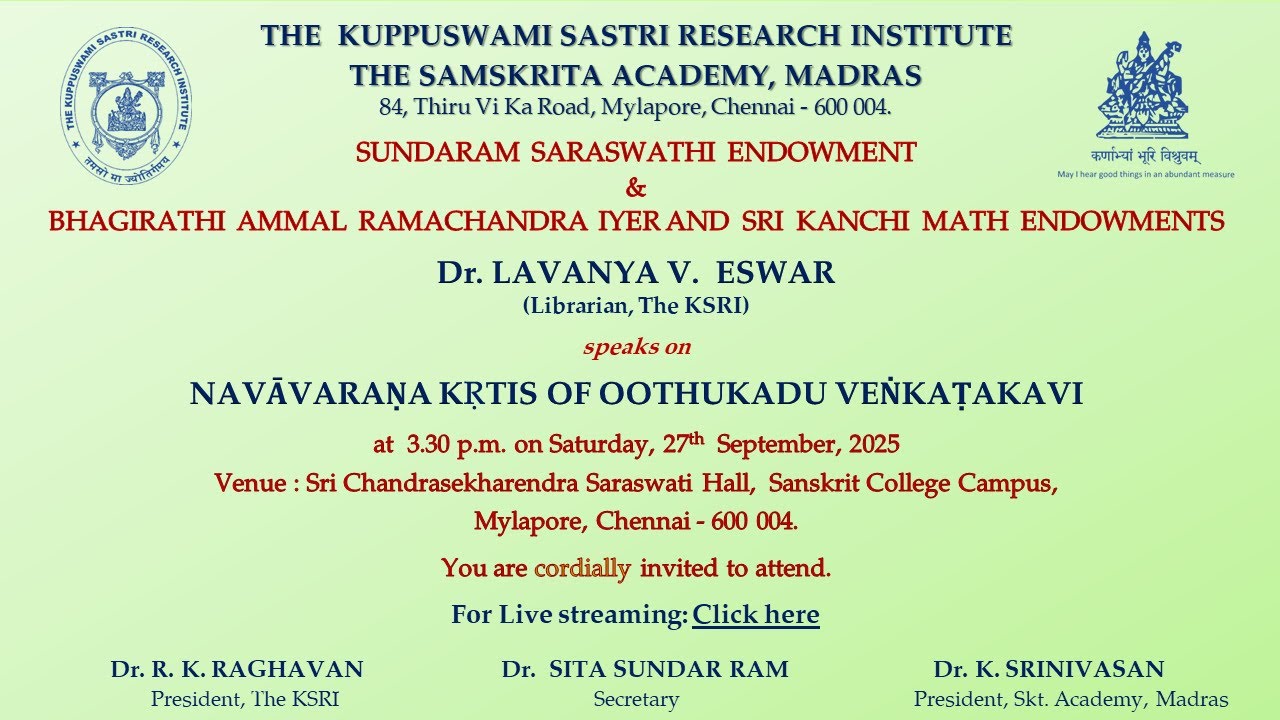
NAVĀVARAṆA KṚTIS OF OOTHUKADU VEṄKAṬAKAVI
Keywords
Summary
178 words
Critical Evaluation
Value of the Information & Strength of the Argument
The lecture provides valuable insights into the Navāvaraṇa Kṛtis, offering both musical and philosophical analysis. Dr. Eswar demonstrates a deep understanding of the Śrī Vidyā tradition and its connection to the compositions. She supports her arguments with references to classical texts such as the Lalitopākhyāna, Taittirīya Upaniṣad, and Lalitā Sahasranāma, as well as the Mūka Pañcaśatī. The musical demonstrations enhance the presentation, allowing the audience to appreciate the rāgas and tālas discussed. The argumentation is coherent and well-structured, though it relies primarily on traditional knowledge and the speaker’s expertise rather than formal academic citations.
Scientific Rigor, Source Quality, Title Accuracy
The lecture is scientifically rigorous in its exposition of the compositions’ structure and symbolism. The speaker cites traditional sources and demonstrates scholarly knowledge. However, the presentation is not accompanied by formal citations or a bibliography, and the transcription contains some inaccuracies. The title accurately reflects the content, and the lecture is well-organized. The audience comments are positive, praising the program and the speaker’s presentation.
173 words
Title / Content Match
The title accurately reflects the content, which focuses on the Navāvaraṇa Kṛtis of Oothukadu Veṅkaṭakavi.
Quality & Reliability
8/10
The lecture is delivered by a scholar with a PhD in Sanskrit, and it is hosted by a reputable research institute. The content is well-structured, with references to classical texts and musical analysis. However, the lecture is primarily an oral presentation without formal citations or peer-reviewed sources, and the transcription contains some errors.
Key Moments
Markers derived by PSI from the transcript: the creator did not define chapters.
- Introduction to the endowment and the speaker
- Overview of Oothukadu Venkata Kavi and his works
- Introduction to the Navavarana Kritis and Sri Chakra
- Comparison with Muka Panchasati
- Musical demonstration of the first avarana kriti
- Analysis of ragas and talas used
- Detailed discussion of the sixth avarana kriti in Hindolam
- Explanation of the eighth avarana kriti and its gati bhedam
- Conclusion and summary of the spiritual significance
Cited Sources
- Mūka Pañcaśatī — Referenced as a key text for comparison with the Navavarana Kritis.
- Lalitopākhyāna — Mentioned as a source for themes in the Navavarana Kritis.
- Taittirīya Upaniṣad — Cited as a source for philosophical concepts.
- Lalitā Sahasranāma — Referenced for its descriptions of the Goddess.
Concurring Sources
- Mūka Pañcaśatī — The lecture draws parallels between the Navavarana Kritis and this text, which is a central devotional work on Goddess Kamakshi.
Contribution & Novelties
The lecture provides a detailed and accessible analysis of the Navāvaraṇa Kṛtis, highlighting their esoteric structure and musical sophistication. It offers a comparative perspective with the Mūka Pañcaśatī, enriching the understanding of both works. The speaker’s musical demonstrations bring the compositions to life, making the lecture valuable for both scholars and enthusiasts.
Pour aller plus loin :
- Śrī Vidyā — Overview of the Śrī Vidyā tradition.
- Śrī Cakra — Explanation of the mystical diagram.
- Carnatic music — Background on the musical tradition.
82 words
Radar Profile
The radar profile shows high scores in information quantity, quality, and reliability, with a slightly lower score in technical level, indicating a lecture that is rich in content and well-supported, but may require some background knowledge to fully appreciate the technical aspects.
💬 Sur les 3 commentaires analysés, les auditeurs expriment une appréciation positive, qualifiant le programme de 'très beau' et 'bon', et remercient la conférencière.