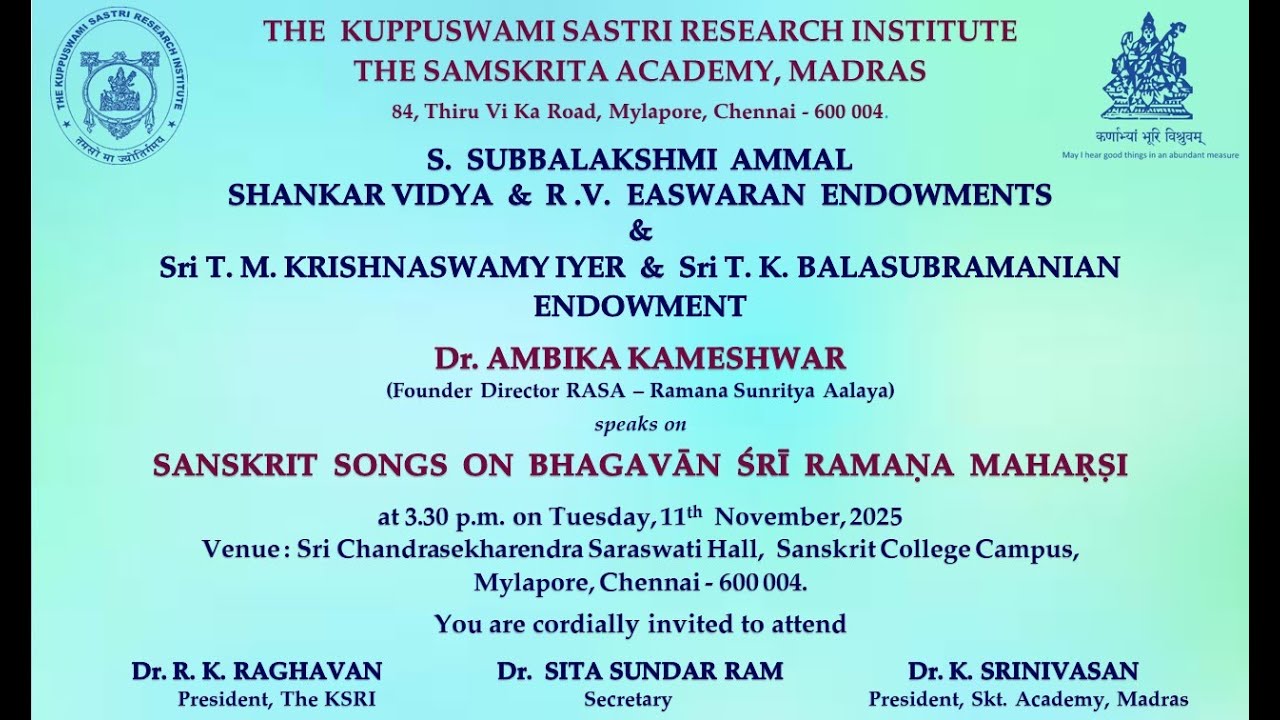
SANSKRIT SONGS ON BHAGAVĀN ŚRĪ RAMAŅA MAHARŞI
Keywords
Summary
147 words
Critical Evaluation
Value of the Information & Strength of the Argument
The lecture provides valuable insights into the devotional literature of Ramana Maharshi, showcasing the richness of Sanskrit compositions. The speaker’s argumentation is based on personal experience and deep familiarity with the texts, making it authentic and heartfelt. However, the presentation lacks critical analysis and relies heavily on anecdotal evidence, which may not appeal to a purely academic audience.
Scientific Rigor, Source Quality, Title Accuracy
The lecture demonstrates a high level of scholarly familiarity with the subject, but it does not cite external sources or provide references. The title accurately describes the content, and the speaker’s expertise is evident. The lack of formal citations and the devotional tone may reduce its scientific rigor, but it remains a valuable cultural and spiritual presentation.
130 words
Title / Content Match
The title accurately reflects the content, which is a lecture on Sanskrit songs dedicated to Ramana Maharshi.
Quality & Reliability
7/10
The lecture is based on the speaker's deep personal knowledge and experience with Sanskrit compositions on Ramana Maharshi, referencing specific works and authors. However, no external sources are cited, and the content is primarily devotional and anecdotal, limiting its scientific rigor.
Key Moments
Markers derived by PSI from the transcript: the creator did not define chapters.
- Introduction and welcome by the host.
- Dr. Ambika Kameshwar begins her lecture, expressing gratitude.
- Discussion on the dhyana sloka by Vishwanatha Swami.
- Introduction to Kavyakantha Ganapati Muni and his compositions.
- Singing and explanation of a composition on Ramana as Subramanya.
- Discussion on the biography of Ramana in a composition by Muni.
- Explanation of the qualities of a jnani as described in Ramana Gita.
- Story of Jagadishwara Shastri and his cancer cure.
- Singing of the Prapatti Ashtakam.
- Discussion on the composition by Lakshmana Sharma with the mantra letters.
- Singing of the Ramana Suprabhatam and conclusion.
Cited Sources
- Ramana Ashtottaram — A dhyana sloka composed by Vishwanatha Swami, recited at the beginning.
- Ramana Pancharatnam — A composition by Kavyakantha Ganapati Muni, sung and explained.
- Ramana Gita — Referenced for descriptions of a jnani's qualities.
- Tattvabodhini — A commentary on Upadesa Saram by Jagadishwara Shastri, mentioned.
- Prapatti Ashtakam — A composition by Jagadishwara Shastri, sung.
- Mahayoga — A book by Lakshmana Sharma, mentioned.
Concurring Sources
- Ramana Maharshi — General reference for the life and teachings of Ramana Maharshi.
- Ganapati Muni — Reference for the poet and his relationship with Ramana.
Contribution & Novelties
The lecture offers a unique perspective on the devotional Sanskrit literature dedicated to Ramana Maharshi, combining scholarly knowledge with personal devotion. It highlights lesser-known compositions and their spiritual significance, providing a valuable resource for students of Indian philosophy and music.
Pour aller plus loin :
- Ramana Maharshi — Overview of his life and teachings.
- Ganapati Muni — Information on the poet and disciple of Ramana.
- Upadesa Saram — Text by Ramana Maharshi, commented upon by Jagadishwara Shastri.
77 words
Radar Profile
The radar profile shows high scores in information quantity and quality, reflecting the speaker's expertise and the richness of the content. The technical level is moderate, as the lecture is accessible to a general audience. The reliability is good but not perfect due to the lack of formal citations.