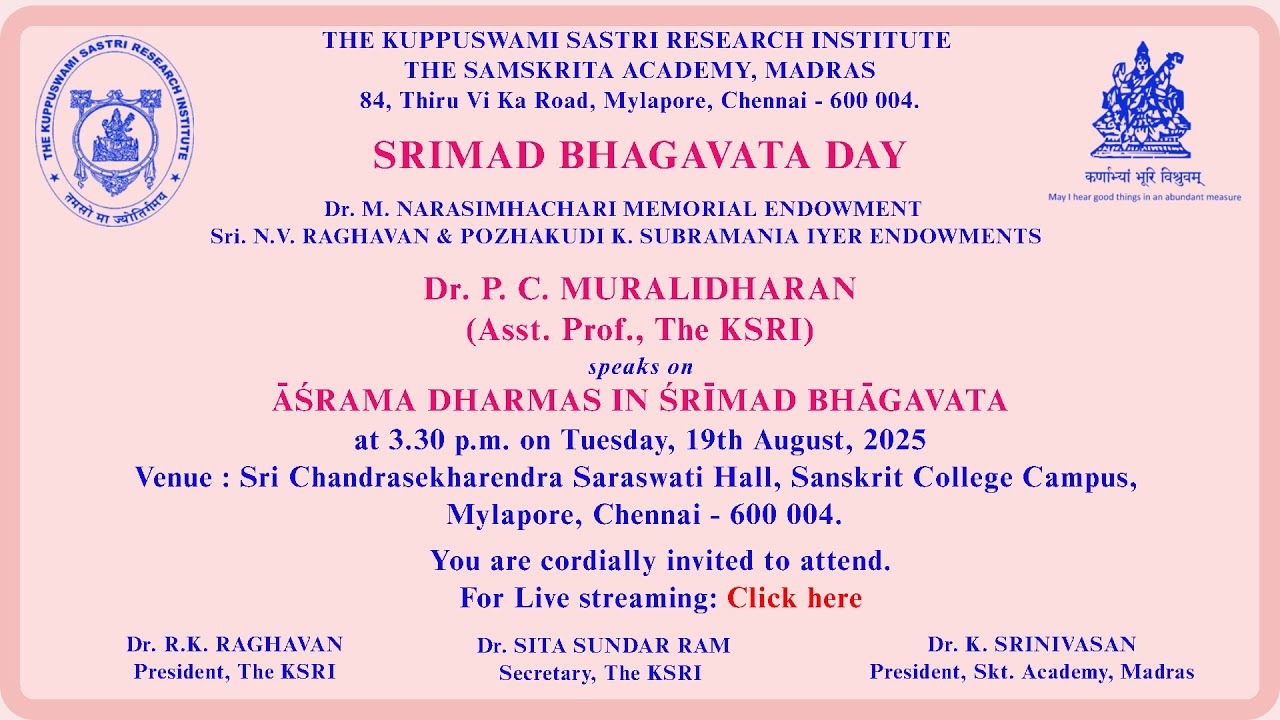
ĀŚRAMA DHARMAS IN ŚRĪMAD BHĀGAVATA by Dr. P.C. Muralidharan (Asst. Prof., The KSRI)
Keywords
Summary
165 words
Critical Evaluation
Value of the Information & Strength of the Argument
The lecture provides a detailed and structured exposition of the ashrama dharmas as found in the Bhagavata Purana, drawing on classical commentaries such as those by Sridhara Swami and Viracara. The speaker demonstrates a deep familiarity with the text and its interpretive traditions, offering specific references to chapters and verses. The argumentation is coherent, moving from the general concept of dharma to the specific duties of each ashrama, and it is supported by citations from the Bhagavata and other Vedic sources. However, the lecture is primarily descriptive rather than analytical, and it does not engage critically with the material or address potential contradictions or historical context. The value lies in its comprehensive overview and the speaker’s expertise, but it may be less valuable for those seeking a critical or comparative perspective.
Scientific Rigor, Source Quality, Title Accuracy
The lecture is grounded in the Bhagavata Purana and its traditional commentaries, which are authoritative within the tradition. However, the speaker does not provide specific citations or references that can be independently verified, and the transcription contains numerous errors that may affect accuracy. The title accurately reflects the content, and the lecture is well-structured. The sources are not explicitly listed, but the reliance on classical texts is evident. The adequacy between title and content is high, as the lecture directly addresses the topic. The scientific rigor is moderate, as it is a traditional exposition rather than a critical study, and the lack of verifiable references limits its scholarly value.
255 words
Title / Content Match
The title accurately reflects the content, which focuses on the four ashramas as described in the Bhagavata Purana.
Quality & Reliability
7/10
The lecture is delivered by a Sanskrit scholar and draws on classical texts and commentaries, but lacks direct citations and verifiable references, and the transcription contains errors.
Key Moments
Markers derived by PSI from the transcript: the creator did not define chapters.
Cited Sources
- Srimad Bhagavatam — Primary text discussed throughout the lecture
- Commentaries by Sridhara Swami, Viracara, and others — Referenced for interpretations of the Bhagavata
Concurring Sources
- Bhagavata Purana — Primary source for the lecture
Contribution & Novelties
The lecture offers a systematic overview of the ashrama dharmas as presented in the Bhagavata Purana, drawing on traditional commentaries. It highlights the unique definition of dharma in terms of bhakti and provides detailed descriptions of duties for each stage. The original contribution lies in the synthesis of these teachings from a traditional perspective, though it does not introduce new research or critical analysis.
Pour aller plus loin :
- Ashrama (stage of life) — Overview of the four ashramas in Hinduism.
- Bhagavata Purana — Background on the text and its significance.
- Vedanta — Philosophical schools referenced in the lecture.
99 words
Radar Profile
The radar profile shows high scores in quantity and quality of information, with moderate technical level and reliability. This indicates a lecture that is informative and well-structured but may lack critical depth and verifiable sources.
💬 No comments were provided for analysis.