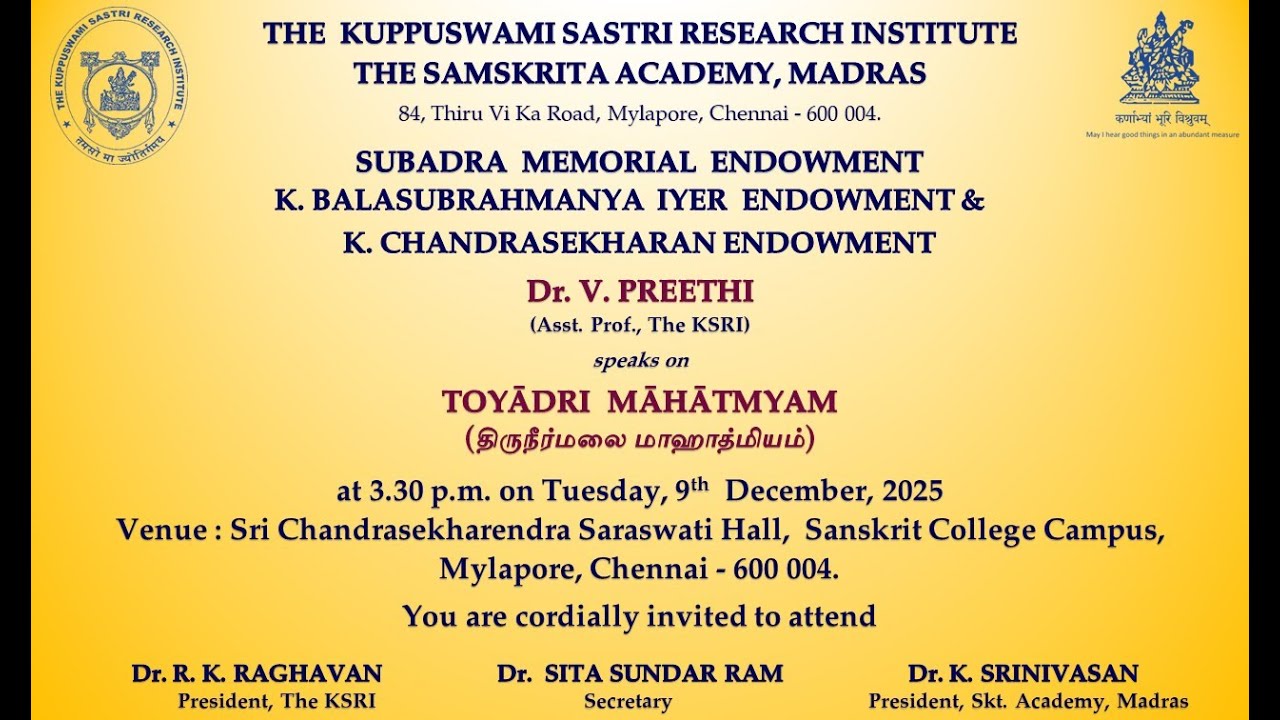
Dr. V. PREETHI (Asst. Prof., The KSRI) speaks on TOYADRI MAHATMYAM (திருநீர்மலை மாஹாத்மியம்)
Keywords
Summary
191 words
Critical Evaluation
Value of the Information & Strength of the Argument
The lecture provides valuable insights into a relatively obscure Sanskrit text, the Toyadri Mahatmyam, and situates it within the broader context of Vaishnavite tradition and epigraphical records. The speaker’s argumentation is structured and evidence-based, drawing on literary sources, inscriptions, and the manuscript itself. She effectively demonstrates the historical and religious significance of Thiruneermalai, showing how the text complements and enriches our understanding of the site. The presentation of the manuscript’s content, including its unique stotras and detailed descriptions, adds original value to the field. However, the argumentation is somewhat descriptive rather than analytical, and the speaker does not critically engage with the text’s authorship or historical context beyond noting its colophon attribution. The reliance on secondary sources like the Annual Reports of Indian Epigraphy, without direct access to the inscriptions, slightly weakens the evidential base.
Scientific Rigor, Source Quality, Title Accuracy
The lecture demonstrates a good level of scientific rigor, with the speaker citing specific sources such as the Divya Prabandham, inscriptions from various dynasties, and the Toyadri Mahatmyam manuscript. She acknowledges limitations, such as damaged inscriptions and the manuscript being under proofreading. The sources are appropriate for the topic, though the lack of direct citation of the manuscript’s verses (beyond a few examples) and the reliance on secondary reports for some inscriptions could be improved. The title accurately reflects the content, and the lecture stays focused on the Toyadri Mahatmyam and its context. No public comments were provided for analysis.
250 words
Title / Content Match
The title accurately reflects the content, which is a lecture on the Toyadri Mahatmyam by Dr. V. Preethi.
Quality & Reliability
7/10
The lecture is based on scholarly research, including epigraphical evidence and a critical edition of a Sanskrit text. However, the speaker notes that the manuscript is still under proofreading and some inscriptions are damaged or unreadable, limiting full verification.
Key Moments
Markers derived by PSI from the transcript: the creator did not define chapters.
- Introduction and endowment details
- Introduction to Thiruneermalai and its significance
- Early Tamil sources: Bhuthathalvar and Thirumangai Alvar
- Epigraphical evidence from Chola and Vijayanagara periods
- Temple architecture and inscriptions
- Introduction to the Toyadri Mahatmyam manuscript
- Content of the Mahatmya: Krishna-Arjuna dialogue and sacred geography
- Description of the Khandava forest and its flora
- Episodes of Markandeya, Bhrigu, and Narasimha
- Vamana and Bali episode, Shiva's stotra, and Valmiki's vision
Cited Sources
- Annual Reports of Indian Epigraphy 1912 and 1913 — Mentioned as sources for inscriptions at Thiruneermalai
- Tamil Nadu Inscriptions, Part 9 — Cited for inscriptions related to donations
- Kanchipuram Inscriptions, Volume 5 — Cited for inscriptions related to donations
- Divya Prabandham — Mentioned as the collection of Alvar hymns
- Toyadri Mahatmyam manuscript — The central text being discussed, from Government Oriental Manuscript Library
Concurring Sources
- Thiruneermalai Temple - Wikipedia — Provides general information about the temple and its history, consistent with the lecture.
Contribution & Novelties
The lecture provides a detailed introduction to the Toyadri Mahatmyam, a relatively unknown Sanskrit text, and its connection to the sacred site of Thiruneermalai. It highlights the text’s unique features, such as the rare stotra by Shiva and the extensive botanical descriptions, which are not found in other Puranas. The speaker’s work on editing and publishing the manuscript with Central Sanskrit University funding is a significant contribution to Sanskrit scholarship. The lecture also synthesizes epigraphical and literary evidence to trace the historical development of the temple, offering a comprehensive view of its religious and cultural significance.
Pour aller plus loin :
- Divya Desam — Overview of the 108 sacred Vishnu temples.
- Alvars — Information on the Tamil poet-saints.
- Thiruneermalai — Details about the temple and its history.
- Vaikhanasa — A school of Vaishnavism mentioned in the text.
- Brahmanda Purana — The Purana to which the text is attributed.
148 words
Radar Profile
The radar profile shows high scores in quantity of information and fiability, reflecting the lecture's rich content and scholarly grounding. The moderate scores in quality and technical level indicate that while the information is valuable, the presentation is more descriptive than analytical, and the technical depth is accessible to a general audience.