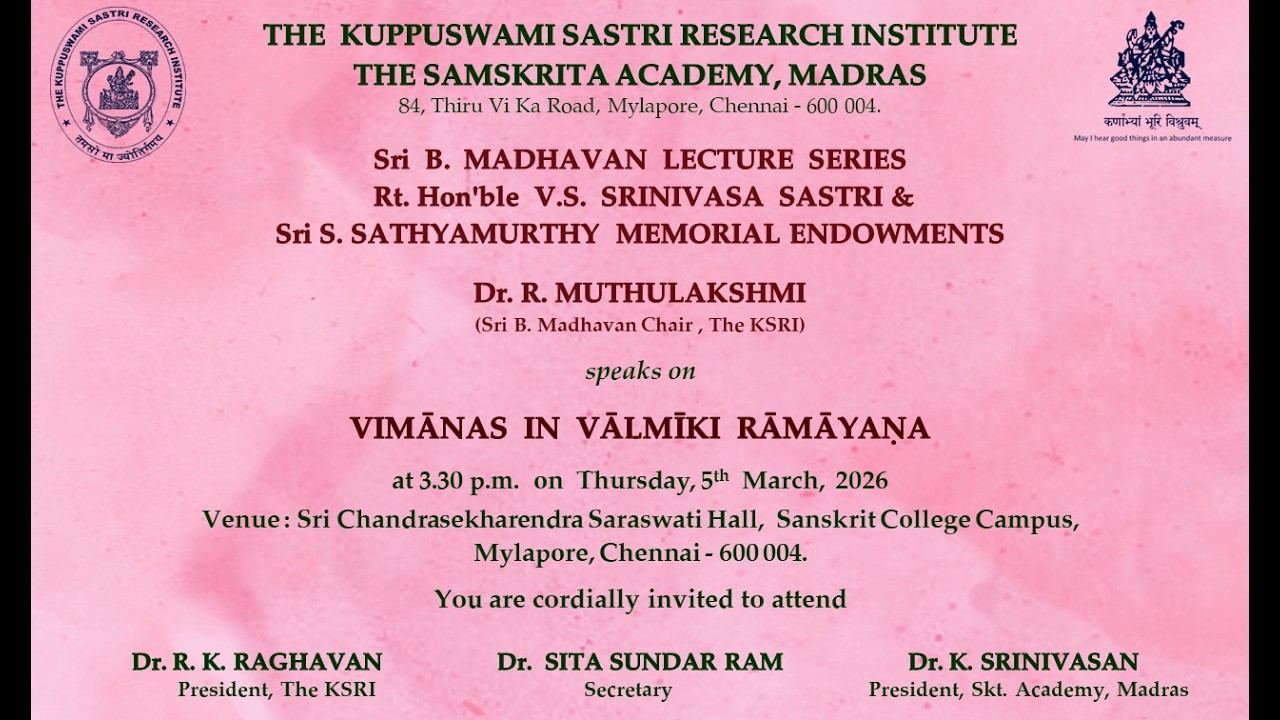
Dr. R. MUTHULAKSHMI (Sri B. Madhavan Chair, The KSRI) speaks on VIMĀNAS IN VĀLMĪKI RĀMĀYAŅA
Keywords
Summary
146 words
Critical Evaluation
Value of the Information & Strength of the Argument
The lecture provides a detailed and structured analysis of vimanas in the Ramayana, offering a systematic breakdown of Hanuman’s flight. The argumentation is based on textual evidence from the epic, but it often makes speculative connections to modern technology without sufficient scientific backing. The speaker does not critically evaluate the sources or consider alternative interpretations, which weakens the overall argument.
Scientific Rigor, Source Quality, Title Accuracy
The lecture relies primarily on the Valmiki Ramayana and a few secondary sources, such as articles by K. Gopalakrishnan. The sources are not always clearly cited, and the speaker does not engage with scholarly debates on the historicity of vimanas. The title accurately reflects the content, but the lecture could benefit from a more critical approach to the sources.
134 words
Title / Content Match
The title accurately reflects the content, which focuses on vimanas as described in the Valmiki Ramayana.
Quality & Reliability
6/10
The lecture is based on a scholarly analysis of the Valmiki Ramayana, drawing on Sanskrit texts and modern scientific parallels. However, it lacks rigorous peer-reviewed sources and makes speculative connections without strong evidence.
Key Moments
Markers derived by PSI from the transcript: the creator did not define chapters.
- Introduction to the lecture and the topic of vimanas.
- Discussion on the origin and definition of the term 'vimana'.
- Description of various vimanas mentioned in the Ramayana.
- Analysis of Hanuman's flight and its eight stages.
- Comparison of ancient vimanas with modern aerospace technology.
- Discussion on brain-computer interfaces and quantum consciousness.
- Conclusion and final remarks on the significance of vimanas.
Cited Sources
- Valmiki Ramayana — Primary source for the descriptions of vimanas.
- Articles by K. Gopalakrishnan — Referenced for scientific and geographical truths in the Ramayana.
Concurring Sources
- Valmiki Ramayana — Primary source for the descriptions of vimanas.
Dissenting Sources
- Modern aerospace engineering studies — The lecture draws parallels between ancient texts and modern technology, but these are speculative and not supported by direct evidence.
Contribution & Novelties
The lecture offers a structured analysis of Hanuman’s flight, breaking it into eight stages and suggesting a possible space flight interpretation. It also draws parallels between ancient descriptions and modern technologies, such as brain-computer interfaces and modular spacecraft design.
Pour aller plus loin :
- Vimana (Wikipedia) — Overview of vimanas in ancient Indian literature.
- Pushpaka Vimana (Wikipedia) — Specific information on the Pushpaka vimana.
- Ancient Indian Aviation Technology (ResearchGate) — Academic discussions on ancient Indian aviation.
76 words
Radar Profile
The radar profile shows moderate scores across all dimensions, with a relatively higher score in quantity of information but lower in technical depth and reliability, indicating a lecture that is informative but not deeply technical or rigorously sourced.