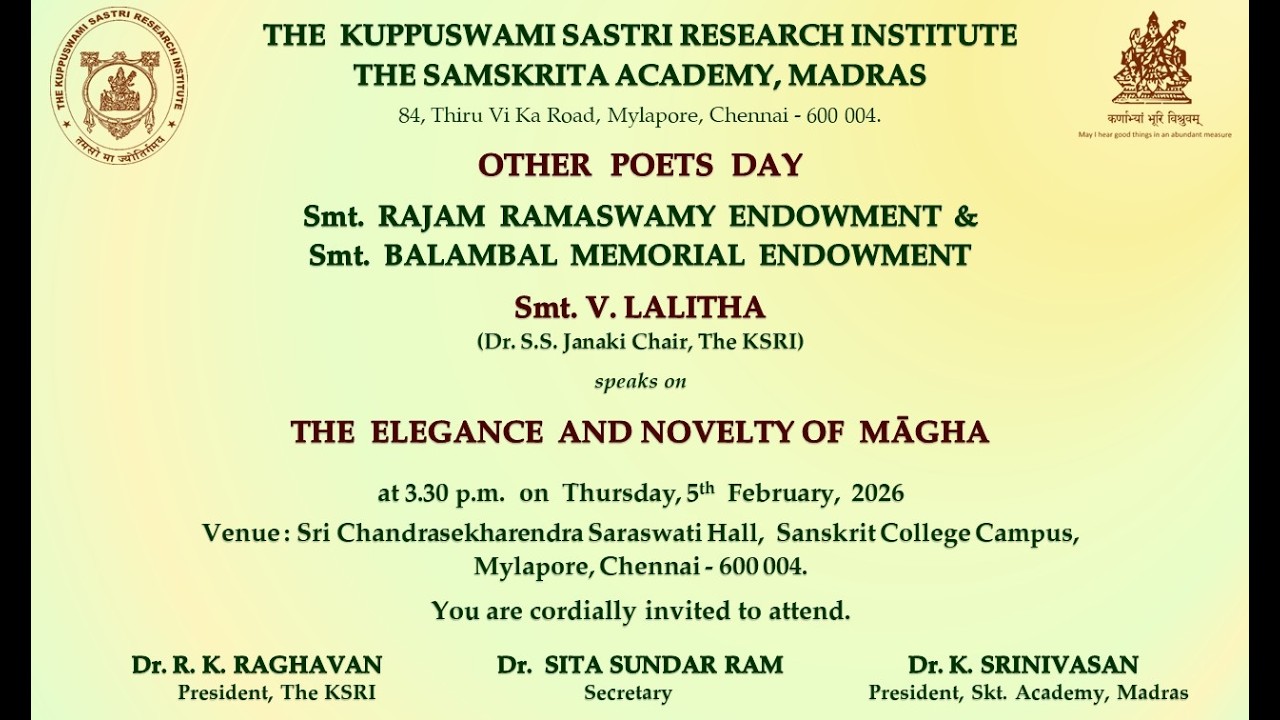
Smt. V. LALITHA (Dr. S.S. Janaki Chair, The KSRI) speaks on THE ELEGANCE AND NOVELTY OF MAGHA
Keywords
Summary
181 words
Critical Evaluation
Value of the Information & Strength of the Argument
The lecture provides valuable insights into Magha’s poetic techniques, supported by specific examples from the text. Lalitha’s argumentation is coherent, systematically moving from biographical details to stylistic analysis, and she effectively demonstrates Magha’s novelty through comparisons with other poets. The discussion of the philosophical underpinnings, such as the unity of nirguna and saguna Brahman, adds depth. However, the argumentation is primarily descriptive and appreciative rather than critical, and it relies on traditional interpretations without engaging with modern scholarly debates.
Scientific Rigor, Source Quality, Title Accuracy
The lecture demonstrates scholarly rigor through its reliance on traditional commentaries, particularly Mallinatha’s, and its close reading of the text. However, no external sources are cited, and the lecture is based on the speaker’s expertise and traditional knowledge. The title accurately reflects the content, focusing on the elegance and novelty of Magha’s work. The lecture does not present original research but rather a synthesis of existing knowledge, which is appropriate for an endowed lecture.
168 words
Title / Content Match
The title accurately reflects the content, focusing on the elegance and novelty of Magha's poetry as presented in the lecture.
Quality & Reliability
8/10
The lecture is delivered by a scholar with deep expertise in Sanskrit literature, as evidenced by her academic background and the detailed analysis of Magha's work. The content is well-structured, drawing on traditional commentaries and textual examples. However, the lecture is based on personal interpretation and traditional scholarship rather than peer-reviewed research, and no external sources are cited.
Key Moments
Markers derived by PSI from the transcript: the creator did not define chapters.
- Introduction of the speaker and her background.
- Overview of Magha's life and the uniqueness of his autobiographical references.
- Analysis of the opening verse and the philosophical implications of Krishna's vision of Narada.
- Discussion of Magha's similes, including the comparison of Balarama's anger to stars in a crimson sky.
- Examination of Magha's use of yamakas and rare vocabulary.
- Explanation of Magha's triple excellence and his innovative approach to beauty.
- Examples of Magha's wordplay and his command of language.
- Discussion of Magha's philosophical depth and his portrayal of Krishna as a sthita-prajna.
- Concluding remarks on the enduring appeal of Magha's poetry.
Contribution & Novelties
The lecture offers a comprehensive appreciation of Magha’s poetic genius, highlighting his novelty in terms of language, imagery, and philosophical depth. It provides a detailed analysis of specific verses, showcasing Magha’s mastery of alankaras and his ability to convey complex ideas through beautiful imagery. The lecture also emphasizes Magha’s unique approach to beauty as ever-new, which is a refreshing perspective.
Pour aller plus loin :
- Shishupala Vadha - Wikipedia — Overview of the epic and its significance.
- Magha (poet) - Wikipedia — Biographical details and literary context.
- Sanskrit literature - Wikipedia — Broader context of Sanskrit literary traditions.
- Alankara - Wikipedia — Explanation of figures of speech in Sanskrit poetics.
- Rasa (aesthetics) - Wikipedia — Concept of aesthetic experience in Indian art.
122 words
Radar Profile
The radar profile shows high scores in quantity and quality of information, indicating a content-rich lecture. The technical level is also high, reflecting the specialized nature of the topic. The overall reliability is good, though it could be enhanced by citing external sources. The lecture is well-balanced, with strengths in content and delivery.
💬 No comments were provided for analysis.