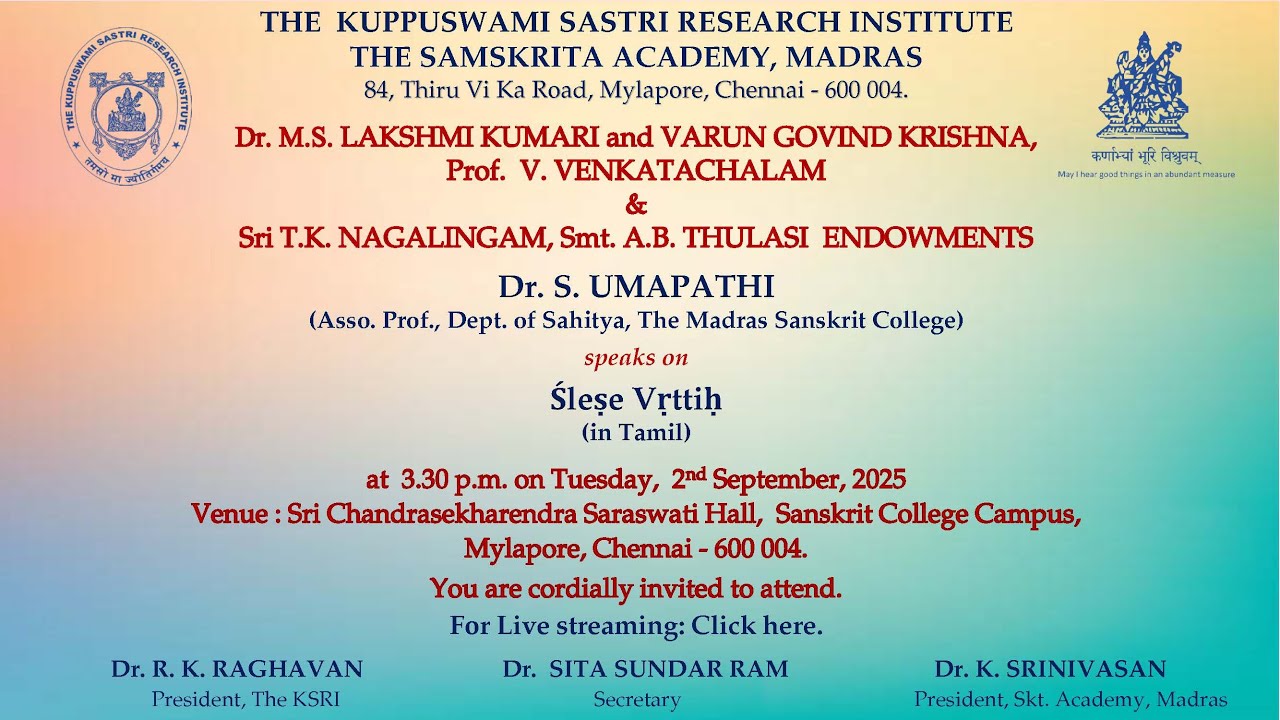
ŚLEṢE VR̥TTIḤ
Keywords
Summary
163 words
Critical Evaluation
Value of the Information & Strength of the Argument
The lecture provides valuable insights into the concept of śleṣa, drawing on classical Sanskrit sources and illustrating its relevance to contemporary issues like AI. The argumentation is structured logically, tracing the historical development of the concept and its applications. However, the incomplete transcription and the speaker’s rapid delivery in some parts limit the clarity of the argument. The use of examples, such as the ‘growing cabbages’ sentence, helps to illustrate the concept, but the discussion could have been more detailed.
Scientific Rigor, Source Quality, Title Accuracy
The lecture is grounded in traditional Sanskrit scholarship, referencing key texts and authors. The speaker’s expertise is evident, and the content aligns with the title. However, the lack of explicit citations in the transcription and the incomplete nature of the recording reduce the ability to verify all claims. The title accurately reflects the content, and the lecture maintains a high level of scholarly rigor.
159 words
Title / Content Match
The title accurately reflects the content, which focuses on the concept of śleṣa (double meaning) in Sanskrit poetics.
Quality & Reliability
7/10
The lecture is delivered by a subject expert (Associate Professor of Sahitya) and is based on traditional Sanskrit poetics, but the transcription is incomplete and contains many inaudible parts, limiting the ability to fully assess the content.
Key Moments
Markers derived by PSI from the transcript: the creator did not define chapters.
- Introduction and welcome by the host, mentioning the endowments and the speaker's background.
- Speaker begins his lecture on śleṣa, defining it as a figure of speech with multiple meanings.
- Discussion on the relevance of śleṣa in modern contexts, including AI and natural language processing.
- Examples of śleṣa in Sanskrit literature, including the comparison of mṛdaṅga and kala.
- Analysis of the views of Jagannātha and Appayya Dīkṣita on śleṣa.
- Discussion on the role of context (prakaraṇa) in resolving ambiguity.
- Conclusion and thanks to the audience and sponsors.
Cited Sources
- Kāvyādarśa of Daṇḍin — Referenced as a classical work on poetics that discusses śleṣa.
- Kāvyālaṅkāra of Bhāmaha — Mentioned as another foundational text on alaṅkāra.
- Works of Jagannātha — Cited for his analysis of śleṣa.
- Works of Appayya Dīkṣita — Cited for his views on śleṣa.
Concurring Sources
- Kāvyādarśa of Daṇḍin — Supports the traditional definition of śleṣa.
- Kāvyālaṅkāra of Bhāmaha — Provides early classification of alaṅkāras including śleṣa.
Contribution & Novelties
The lecture offers a comprehensive overview of śleṣa in Sanskrit poetics, connecting it to modern linguistic and AI challenges. It emphasizes the importance of context in meaning resolution, which is a key issue in natural language processing. The speaker’s expertise provides a traditional perspective that is often missing in contemporary discussions.
Pour aller plus loin :
- Śleṣa (Wikipedia) — Overview of the concept in Sanskrit literature.
- Alaṅkāra (Wikipedia) — General introduction to figures of speech in Sanskrit.
- Natural Language Processing (Wikipedia) — Relevance of ambiguity resolution in AI.
88 words
Radar Profile
The radar profile shows high scores in technical level and quality of information, reflecting the scholarly nature of the lecture. The quantity of information is moderate due to the incomplete transcription, and the overall reliability is solid but not perfect.
💬 No comments were provided for analysis.