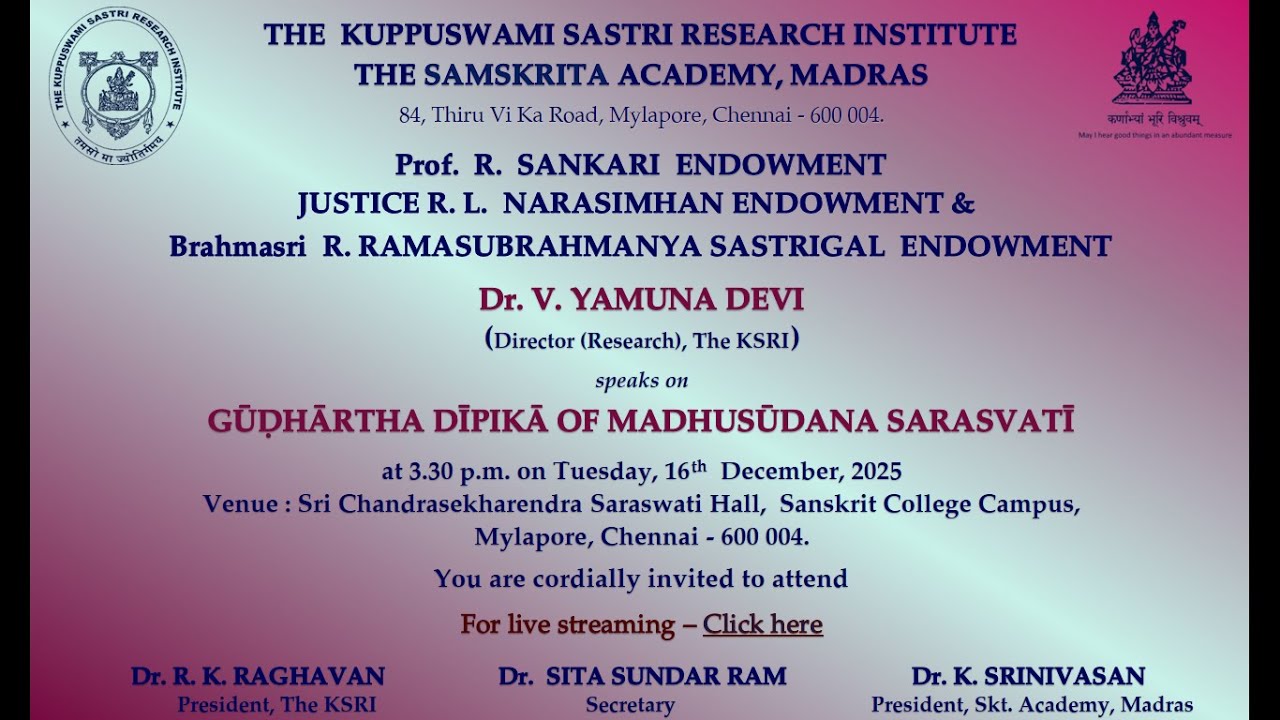
Dr. V. YAMUNA DEVI (Director (Research), KSRI) speaks on GŪḌHĀRTHA DĪPIKĀ OF MADHUSŪDANA SARASVATĪ
Keywords
Summary
198 words
Critical Evaluation
Value of the Information & Strength of the Argument
The lecture offers valuable insights into the Gūḍhārtha Dīpikā, presenting a detailed analysis of its structure, philosophical content, and unique features. The argumentation is solid, grounded in the speaker’s deep knowledge of Sanskrit and Advaita Vedanta. She effectively demonstrates how Madhusūdana integrates Bhakti into Advaita, providing specific examples and textual references. The historical context of the author and the philosophical debates of the time enrich the presentation, making a compelling case for the commentary’s importance.
Scientific Rigor, Source Quality, Title Accuracy
The lecture demonstrates scholarly rigor, with the speaker drawing on her expertise and traditional sources. While no external citations are provided, the content aligns with established academic understanding of Madhusūdana Sarasvatī and his works. The title accurately reflects the content, and the lecture is well-structured. The speaker’s authority and the coherence of the presentation contribute to its reliability.
148 words
Title / Content Match
The title accurately reflects the content: a scholarly lecture on the Gūḍhārtha Dīpikā by Madhusūdana Sarasvatī, delivered by Dr. V. Yamuna Devi.
Quality & Reliability
8/10
The lecture is delivered by a recognized scholar in Sanskrit and Advaita Vedanta, with a structured presentation of the historical context, the author's biography, and the commentary's content. The information is consistent with established academic knowledge, though it relies on traditional sources and the speaker's expertise rather than providing verifiable citations.
Key Moments
Markers derived by PSI from the transcript: the creator did not define chapters.
- Introduction and welcome by the host, outlining the endowment lectures and introducing Dr. Yamuna Devi.
- Biography of Madhusudana Saraswati: his early life, initial intention to refute Advaita, and conversion.
- Discussion of Madhusudana's role in establishing the Naga sect and his interaction with Akbar.
- Overview of Madhusudana's works, emphasizing the Advaita Siddhi and the Gūḍhārtha Dīpikā.
- Explanation of the Gūḍhārtha Dīpikā's structure: division of the Gita into Karma, Bhakti, and Jnana sections.
- Unique naming of chapters by Madhusudana and his summaries of chapters and verses.
- Examples of philosophical integration: Sankhya and Yoga in the commentary, and the synthesis of Jnana and Bhakti.
Contribution & Novelties
The lecture provides a scholarly introduction to the Gūḍhārtha Dīpikā, highlighting its unique features such as the division of the Gita into three sections, the special naming of chapters, and the integration of Bhakti into Advaita. It offers insights into Madhusūdana’s philosophical synthesis and his approach to other schools like Sankhya and Yoga.
Pour aller plus loin :
- Advaita Vedanta — Overview of the non-dualistic school.
- Bhagavad Gita — The text commented upon.
- Madhusudana Saraswati — Biography and works of the author.
82 words
Radar Profile
The radar profile shows high scores in quantity and quality of information, with a strong technical level, indicating a dense and reliable lecture. The overall reliability is high, reflecting the speaker's expertise.