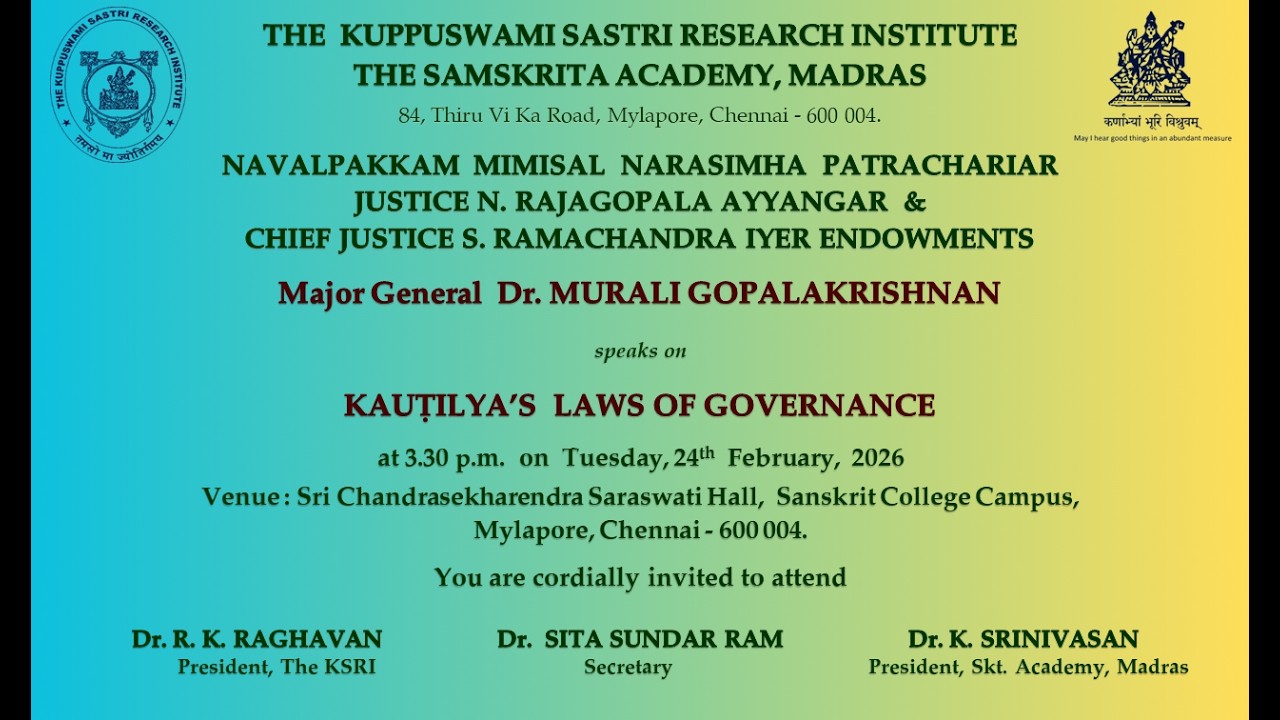
Major General Dr. MURALI GOPALAKRISHNAN speaks on KAUȚILYA'S LAWS OF GOVERNANCE
Keywords
Summary
153 words
Critical Evaluation
Value of the Information & Strength of the Argument
The lecture provides valuable insights into Kautilya’s Arthashastra, offering a nuanced interpretation that goes beyond common misconceptions. The speaker’s military background and academic research lend credibility to his analysis. He effectively argues for the contemporary relevance of Kautilya’s ideas, drawing parallels with modern political science and international relations. The argumentation is logical and well-structured, though some points could benefit from more detailed evidence. The speaker’s expertise is evident, but the lack of formal citations and the conversational style may reduce the perceived rigor for academic audiences.
Scientific Rigor, Source Quality, Title Accuracy
The speaker demonstrates a strong command of the subject, referencing classical texts and modern theories. However, he does not provide formal citations or a bibliography, relying instead on his expertise. The title accurately reflects the content, which focuses on Kautilya’s laws of governance. The lecture is well-organized, but the lack of verifiable sources limits its scientific rigor. The speaker’s authority as a PhD holder and military expert adds credibility, but the absence of peer-reviewed references is a notable weakness.
180 words
Title / Content Match
The title accurately reflects the content, which focuses on Kautilya's principles of governance and their relevance to modern statecraft.
Quality & Reliability
7/10
The speaker is a retired Major General with a PhD on Kautilya's Arthashastra, providing expert opinion grounded in academic research. The lecture is well-structured, referencing classical texts and modern theories, but lacks formal citations and peer review.
Key Moments
Markers derived by PSI from the transcript: the creator did not define chapters.
- Introduction and welcome by the host, outlining the speaker's credentials and the lecture's context.
- Speaker begins his talk, paying homage to Shukra and Brihaspati, and explaining the four sciences in Arthashastra.
- Discussion on the Saptanga theory of state elements and their interdependence.
- Explanation of the Shadguna foreign policy and its correlation with modern international relations.
- Kautilya's concept of national power and the importance of economic strength.
- Discussion on the welfare state and the king's duties towards the people.
- Kautilya's vision of empire and the logic behind territorial expansion.
- Application of Kautilya's principles to modern national security strategy.
- Conclusion: the enduring relevance of Kautilya's laws of governance.
Cited Sources
- Arthashastra (original text) — The primary source discussed throughout the lecture.
- Manusmriti — Referenced as a classical text on law and governance.
- Weber's theory of democracy — Mentioned as a modern political theory contrasting with Kautilya's approach.
Concurring Sources
- Arthashastra - Wikipedia — Provides background on the text and its contents, consistent with the lecture's claims.
- Kautilya - Internet Encyclopedia of Philosophy — Offers scholarly analysis of Kautilya's ideas, supporting the lecture's interpretations.
Dissenting Sources
- None — No discordant sources were identified in the lecture.
Contribution & Novelties
The lecture offers a unique perspective by bridging ancient Indian political thought with modern national security strategy, drawing on the speaker’s military and academic expertise. It highlights the practical relevance of Kautilya’s ideas for contemporary governance and security challenges.
Pour aller plus loin :
- Arthashastra - Wikipedia — Provides an overview of the text and its historical context.
- Kautilya - Internet Encyclopedia of Philosophy — A scholarly article on Kautilya’s philosophy and contributions.
- National Security Strategy - Wikipedia — Explains the concept and its application in modern states.
88 words
Radar Profile
The radar profile shows high scores in information quantity and quality, reflecting the speaker's expertise and the depth of content. The technical level is moderate, making it accessible to a general audience while still offering depth. Overall, the lecture is reliable and informative, with a strong foundation in classical texts and modern theory.
💬 No comments were provided for analysis.