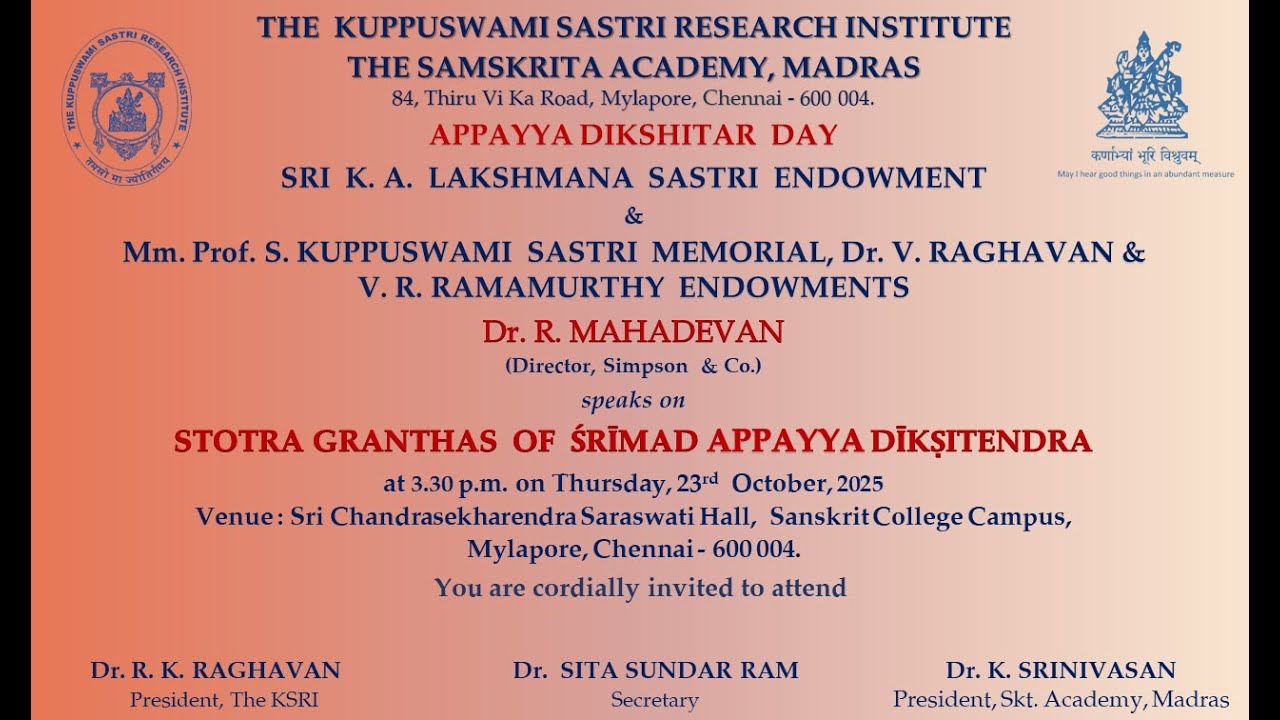
STOTRA GRANTHAS OF ŚRĪMAD APPAYYA DİKŞITENDRA
Keywords
Summary
185 words
Critical Evaluation
Value of the Information & Strength of the Argument
The lecture provides valuable insights into the stotra literature of Appayya Dikshita, offering detailed explanations of verses and their puranic backgrounds. Mahadevan’s argumentation is solid, grounded in the texts themselves and traditional commentaries. He effectively demonstrates Appayya’s unique approach of self-commentary and his use of obscure puranic episodes, enhancing the listener’s appreciation. The speaker’s expertise is evident, and he supports his points with specific examples, making the content both informative and persuasive.
Scientific Rigor, Source Quality, Title Accuracy
The lecture demonstrates high scholarly rigor, with references to primary texts such as the Devi Mahatmya, Shiva Purana, and Harivamsa, as well as Appayya’s own commentaries. Mahadevan cites specific verses and explains their sources, showing careful research. The title accurately reflects the content, which is a focused overview of Appayya’s stotra works. No external sources are cited beyond the texts mentioned, but the speaker’s authority and the detailed textual analysis lend credibility. The lecture is well-structured and maintains a high standard of academic discourse.
171 words
Title / Content Match
The title accurately reflects the content, which focuses on the stotra literature of Appayya Dikshita.
Quality & Reliability
7/10
The lecture is delivered by an expert in Sanskrit literature and philosophy, with detailed references to primary texts and commentaries. However, it is a single oral presentation without formal peer review, and some claims rely on traditional anecdotes.
Key Moments
Markers derived by PSI from the transcript: the creator did not define chapters.
- Introduction by the host, highlighting Dr. Mahadevan's background and the endowment.
- Dr. Mahadevan begins his lecture, introducing Appayya Dikshita's life and works.
- Discussion on the unique feature of Appayya's self-commentaries, citing his introduction to Shivarkamanidipika.
- Analysis of the Marabandhu Stotra, explaining verses and puranic references.
- Explanation of the Devi Chandrakala Stotra, including the legend of its composition and its 16 verses.
- Detailed study of the Varadaraja Stava, highlighting its structure and poetic devices.
- Discussion on other stotras and Appayya's practical phalas in prayers.
- Conclusion summarizing Appayya's contributions and the importance of his stotra literature.
Cited Sources
- Marabandhu Stotra — Discussed in detail, with verses and puranic references.
- Devi Chandrakala Stotra — Analyzed, including its legend and structure.
- Varadaraja Stava — Examined, with emphasis on its poetic and philosophical content.
- Shivarkamanidipika — Mentioned as an example of Appayya's Vedantic works.
- Devi Mahatmya — Referenced for the stories of Madhu-Kaitabha, Mahishasura, and Shumbha-Nishumbha.
- Shiva Purana — Cited as source for the origin of Kaushiki.
- Harivamsa — Mentioned for the episode of Banasura and Aniruddha.
Concurring Sources
- Appayya Dikshita - Wikipedia — Provides biographical and bibliographic information consistent with the lecture.
Contribution & Novelties
The lecture offers a comprehensive overview of Appayya Dikshita’s stotra literature, highlighting his unique practice of self-commentary and his integration of puranic narratives. It provides fresh perspectives on the practical phalas in his prayers, distinguishing him from other poets. The speaker’s expertise brings depth to the analysis, making it a valuable resource for scholars and enthusiasts.
Pour aller plus loin :
- Appayya Dikshita - Wikipedia — Overview of his life and works.
- Devi Mahatmya - Wikipedia — Source for the Devi stories referenced.
- Shiva Purana - Wikipedia — Puranic source for the Kaushiki legend.
94 words
Radar Profile
The radar profile shows high scores in information quantity, quality, and technical level, with a slightly lower but still strong reliability score. This indicates a well-researched and informative lecture, though the reliance on traditional narratives and lack of external verification slightly reduces the reliability.