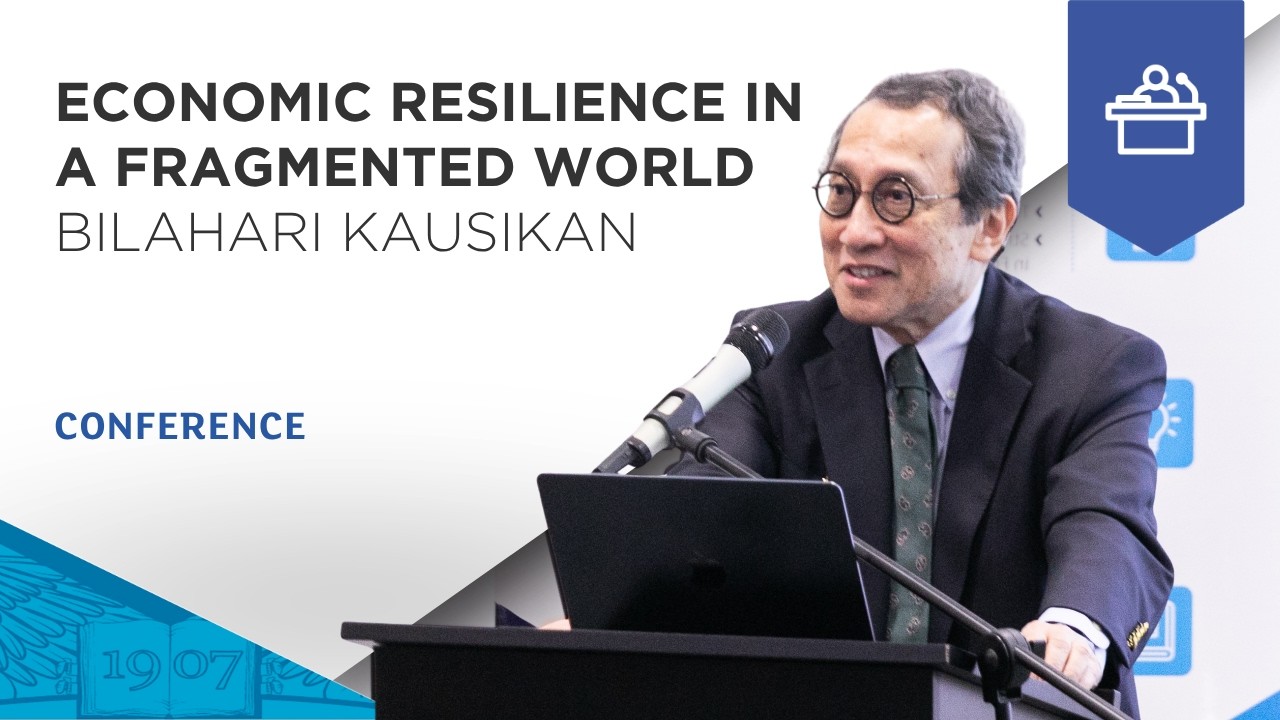
Global Economic Resilience - Bilahari KAUSIKAN at the Tricontinental Dialogue | ESSEC Conference
Keywords
Summary
182 words
Critical Evaluation
Value of the Information & Strength of the Argument
The talk provides valuable insights from a seasoned diplomat, offering a non-Western perspective on global shifts. The argumentation is coherent and well-supported with concrete examples, such as the CPTPP, RCEP, and defense cooperation agreements. Kausikan effectively challenges Western assumptions about the liberal international order and highlights the importance of hard power and balance of power. However, the argument is primarily opinion-based and lacks empirical data or citations. Some claims, such as the characterization of European gestures as ‘ridicule’, are subjective and may be contested. Overall, the value lies in its pragmatic, realpolitik perspective that is often underrepresented in Western discourse.
Scientific Rigor, Source Quality, Title Accuracy
The speaker is a highly credible authority on the subject, given his extensive diplomatic career. However, the talk does not cite specific sources or data, relying instead on personal experience and historical examples. The title accurately reflects the content, focusing on economic resilience in a fragmented world. The description provides context about the ESSEC Institute for Geopolitics & Business, but no additional sources are cited. The talk is an opinion piece rather than a research presentation, so the lack of citations is expected but limits its scientific rigor. The title is appropriate and does not overpromise.
211 words
Title / Content Match
The title accurately reflects the content, focusing on economic resilience in a fragmented world from a geopolitical perspective.
Quality & Reliability
8/10
The speaker is a highly experienced former diplomat with deep expertise in international relations. The talk is well-structured, draws on historical and contemporary examples, and offers a coherent, pragmatic perspective. However, it is an opinion piece without formal citations or empirical data, and some claims are contestable.
Key Moments
Markers derived by PSI from the transcript: the creator did not define chapters.
- Introduction and framing of economic resilience in a fragmenting world.
- Critique of John Kerry's 2014 statement on Crimea.
- Critique of Mark Carney's Davos speech and the contradiction in his argument.
- Discussion of the liberal international order as a historical artifact.
- Asia's pragmatic approach to the US and examples of regional cooperation.
- The US redefining its engagement and Asia's understanding of this.
- The role of hard power and balance in maintaining stability.
- The need to discard exceptional period habits and confront reality.
- Conclusion: message of hope and resilience.
Cited Sources
- ESSEC Knowledge — Official research and insights platform of ESSEC Business School.
- ESSEC Business School — Official website of the institution hosting the conference.
- ESSEC LinkedIn — Professional network page of ESSEC.
- ESSEC YouTube Channel — Channel where the video is published.
Concurring Sources
- The Liberal International Order and Its Discontents — Article discussing the challenges to the liberal international order.
- Singapore's Foreign Policy: A Pragmatic Approach — Official site of Singapore's Ministry of Foreign Affairs, reflecting its pragmatic foreign policy.
Dissenting Sources
- The End of the Liberal International Order? A European Perspective — European think tank perspective that may differ on the viability of the liberal order.
Contribution & Novelties
The talk offers a distinctive Singaporean perspective on global economic resilience, challenging Western-centric narratives. It provides a clear-eyed analysis of the post-Cold War exceptionalism and its impact on contemporary decision-making. The emphasis on the need to discard outdated habits of mind is a valuable contribution to the discourse on resilience.
Pour aller plus loin :
- Liberal international order — Overview of the concept and its critiques.
- Balance of power (international relations) — Theoretical foundation for stability.
- Comprehensive and Progressive Agreement for Trans-Pacific Partnership (CPTPP) — Example of Asian cooperation mentioned.
- Regional Comprehensive Economic Partnership (RCEP) — Another example of Asian economic integration.
102 words
Radar Profile
The radar profile shows high scores in quantity and quality of information, reflecting the speaker's expertise and the depth of analysis. The technical level is moderate, as the talk is accessible but assumes some familiarity with geopolitics. The overall reliability is high due to the speaker's credibility, though the lack of citations slightly lowers it.
💬 Sur les 0 commentaires analysés, aucune tendance n'est disponible.